Bucks That Never Shed Velvet, Antlers

Hunters are a lot like the white-tailed deer that they hunt, with each one being different from the rest of the herd. Some hunters like bucks with big, wide spreads while others want long tine lengths or bucks with mega-mass. Fortunately, not all bucks are cut from the same template. Late summer is the time of the year when whitetail bucks begin shedding antler velvet. While this is true for most bucks, what about the very small percentage of bucks that do not shed their velvet? How can this happen?

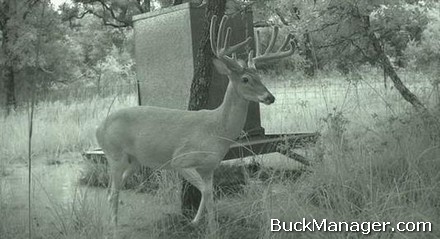
Hunter’s Story: “I heard from my taxidermist about the largest 6 point whitetail buck he had ever seen. Apparently, he was an 8 year old deer, harvested in December while still in full velvet, and the deer had been castrated, most likely by jumping a fence. The explanation goes something like this: The deer was likely injured/castrated in the summer of his 3rd or 4th year. Because the velvet dies off in the fall due to increased testosterone levels, and this bucks levels obviously did not increase, his velvet lived and the antlers continued to grow. Continue reading “Bucks That Never Shed Velvet, Antlers”

Whitetail Deer with Canine Teeth

Most hunters know that a successful white-tailed deer management program is a multifaceted endeavor. For noticeable changes to be observed in a deer population, the age, genetics and nutrition of the herd must be managed at some level. Because age is an important parameter within a deer population, aging deer on the hoof and then re-evaluating that assessment after “ground checking” based on the deer’s tooth wear is a common practice on many ranches.

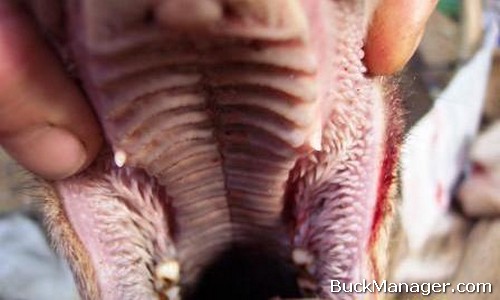
After cutting a deer’s check, most hunters expect to see teeth with six teeth per side, with some amount of wear, but most never expect to see a deer with fangs in its upper mouth.

Whitetail Deer with Canine Teeth - Deer with Fangs

Canine Teeth are Rare

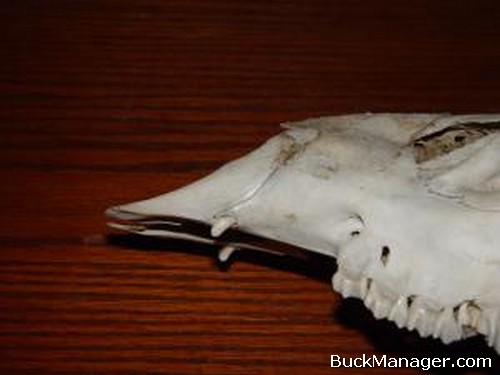
These “fangs” are actually canine teeth. All whitetail have lower canines, but few deer have upper canines. The harvested deer that do have them often go undetected because hunters focus on the teeth located in the bottom jaw when aging, not those positioned on top.

The upper canine teeth that are seen are usually discovered by taxidermist preparing buck deer for European (skull) mounts, not by curious hunters probing around inside an animals mouth. Common sense would make one believe that most ungulates such as white-tailed deer do not have canine teeth, but a small number of deer actually do.
Whitetail Deer with Canine Teeth

A History of Cervids with Canines

Although most whitetail do not have fangs, there are some ungulates that posses the more appropriately termed canine teeth. But why do these teeth occur at all in deer? Genetics. We have to go back many, many years to understand the relationship between the whitetail and its prehistoric ancestors.

Research suggests that the white-tailed deer evolved from deer that originated in Asia tens of millions of years ago. Several of the deer found on that continent back then had canine teeth. Some, like the Chinese Water Deer and Muntjac (oldest known deer), still do.

Adult Muntjac males have tiny antlers, but have well-pronounced canine teeth that can grow up to three inches in length. In the same manner that whitetail bucks use their antlers to intimidate and fight other bucks during the rut, the canine teeth of Asian deer have similar functions in buck competition during the breeding season. While the whitetail deer’s genetic link to its Asian ancestors has weakened over time, the gene for these vestigial canine teeth still remains.
Whitetail Deer with Fangs

Bucks with Canine Teeth?

Like the Asian deer mentioned above, only whitetail bucks typically possess these small, upper canine deer “fangs.” It’s been reported that whitetail does never grow canines, but there have in fact been documented cases of does having upper canines.

But even when these specialized teeth are not present, deer can pass on the canine gene to their offspring. By the way, whitetail deer are not the only North American cervide with canine teeth. Elk, both male and female, possess canine teeth. In fact, you can age this species based on canine tooth wear.


Antler Restrictions, Concerns Continue in Texas

The white-tailed deer hunting seasons are just months away, which means hunters will begin making their final preparations for the fall. With summer heading into the home-stretch, hunters remaining tasks include the addition of new spin-feeders, the replacement of old stands with new ones, the clearing of shooting lanes, conducting deer surveys and a review of the whitetail hunting regulations for their area. In Texas, one of the most discussed deer hunting regulations continues to be the antler restriction regulations that are in place for bucks in many counties.

Regulations. It’s a safe bet that most hunters are not old enough to remember a time when there were no deer hunting regulations, before there were seasons and limits for specifically for whitetail. One can only imagine the outrage of hunters, commercial ones included, when some well-meaning game biologist came along and suggested that the harvest of wild animals be managed through regulations. I bet a good number of hunters wanted to tan his hide along with the other skins salted down around back. Fast forward to modern times and it’s easy to see (and hear) that some things never change.

Texas Whitetail Hunting: Deer Management through Antler Restrictions

In Texas counties with antler restriction regulations, only two legal bucks exists: those with at least one unbranched antler and those with an inside spread of 13 inches or greater. Antler restrictions get talked about quite often because, well, it can be darn difficult to estimate the inside antler spread of a buck in the field. This is the toughest part of the regulation; the antler spread of many bucks will be close to 13 inches, but no hunter wants to come up short when a warden puts a tape to it. Many hunters have suggested using regulations based on points, such as three or four antler points per side, but this does not work. For those wondering why, take a look at the response from Texas Parks and Wildlife Department after a regular reader of this site recommended a point-based antler regulation:

“I appreciate your comments. One thing this is unique about the Texas antler restriction regulation is that it is designed to eliminate the risk of high-grading bucks. Point restrictions certainly could result in high grading. For example, a rule allowing only bucks with 4 points on a side to be killed is allowing for the harvest of the best yearlings and protection of the poorest-quality yearlings. The reason for this is that there is no correlation between age and number of points.

However, there is a very strong correlation between age and inside spread. That’s one reason why we went with the spread restriction. Another unique aspect of the Texas model is the “slot limit” (i.e., it allows for the harvest of deer with at least one unbranched antler) — further reducing the risk of high grading. Nonetheless, this regulation does indeed protect some mature bucks with narrow spreads, which is an unintended consequence.

But the good news is that only 4 percent of all mature bucks in these Resource Management Units (RMUs) have an inside spread less than 13″ wide (based on data from thousands of harvested bucks). And long-term research has shown us that the bucks with at least one unbranched antler are more likely to be those narrow-racked bucks at maturity. So it would behoove hunters to take advantage of that second buck tag (for spikes and 3-pointers).”

I dislike being managed and regulated as much as the next guy, but most of the regulations in my life seem to be working out okay. They are not overly intrusive. I don’t like it that I can not legally drive my truck as fast as I would like, but I do appreciate the fact that neither can the other idiots on the road. Safety first. I also like the fact that the Food and Drug Administration (FDA) is keeping the foods I eat safe for the most part. That’s good for the family. I guess deer hunting regulations, possibly even antler restrictions, are something that will always be a part our lives.

If all these regulations ensure that we will be around with some number of deer to chase, then so be it. Regulated hunting through limits and seasons are a component of any state’s deer management program.  I have, without a doubt, observed larger and older free-ranging bucks in areas after antler restriction regulations were implemented. Additionally, most of testimonials I have received on the subject of the antler restriction regulations in Texas have been positive, but there will always be  unhappy campers with any regulation, hunting or otherwise. Of course, I suspect that if all deer regulations were removed and white-tailed deer had no bag limit and no closed season, a small percentage of hunters would actually be happy, but the majority would not. What do you think?

Suburban and Melanistic Whitetail Deer

The white-tailed deer population has been on quite a ride over the past century. Historical reports indicate that whitetail populations were nearly extirpated within the United States by the early 1900’s. Fast forward a hundred years, add in regulated hunting, deer management efforts and the fact that only about 8 percent of the people in the U.S. hunt, and it is not uncommon to surf the web, pick up a newspaper or drive down the road to see another instance of deer overpopulation in both rural and suburban areas.

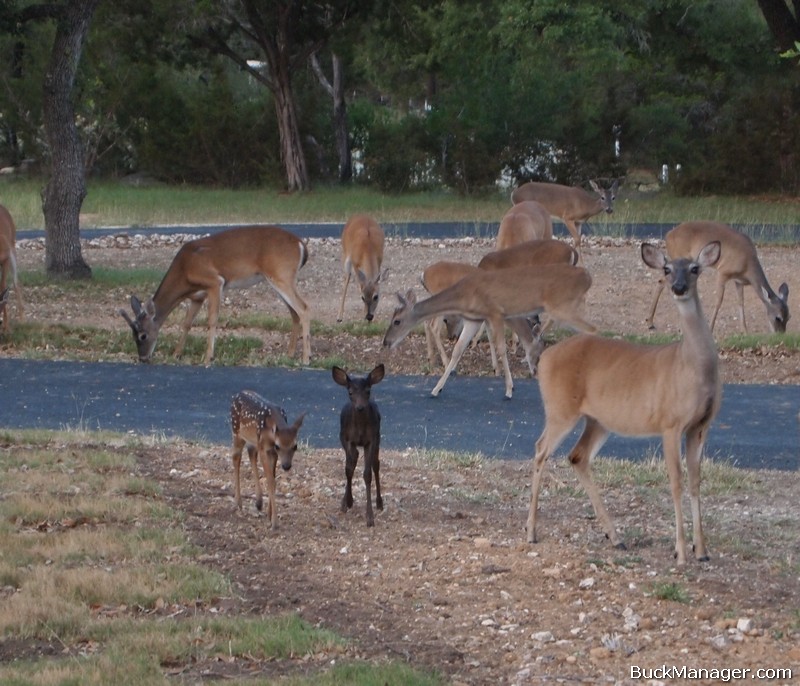
As the number of suburban areas have increased in Texas—and elsewhere—the whitetail populations found within them have grown proportionally, sometimes exponentially. Suburban deer overpopulation is literally a growing problem, but listen closely to any debate related to controlling a suburban whitetail population and you will soon find that for every person that wants to control deer through shooting, trapping, etc., there are others that want to protect them. Continue reading “Suburban and Melanistic Whitetail Deer”

Supplemental Feeding of Deer: Protein Pellets

It’s summer time in Texas and hot, dry weather is wreaking havoc on white-tailed deer habitat. That means deer will be hitting supplemental feed sources where they are available harder than ever. In fact, I’ve already heard from numerous hunters and landowners that whitetail are really hammering protein feeders, and this is on properties that provide relatively good deer habitat. Unfortunately, it looks like things are going to get worse before they get better. That has got everyone, deer included, feeling a little uneasy.

It’s the antler growing season for bucks right now, so that means game cameras have already been deployed. Reports indicate that the majority of bucks have anywhere from 3-10 inches of antler growth and that there are still a good number of does that have yet to domino (give birth). Guys in the pastures as well as camera photos are also seeing a good number of fawns already on the ground. Everyone is aware that natural foods are low, but deer are needing a lot of high quality nutrition right now.

Whitetail Deer Management: Supplemental Feeding of Deer Protein Pellets

If ever there was a time to supplement deer with free-choice protein pellets, that time would be now. Not only will deer manager after deer manager tell you first-hand what the addition of protein pellets has done for whitetail deer found on their properties, but respectable research from many different camps has found that protein pellets (16+%)  really do make a difference for white-tailed deer in a number of ways.

There are many reasons to feed protein pellets, with the most cited one being increased antler growth for bucks. Other positives of this form of supplemental feeding include improved body condition in all deer, which translates into more milk production for lactating does and better muscle and skeletal growth for fawns later into the summer. Deer, both bucks and does, that get a good start the first year of their life will be superior animals down the road.

With natural foods on hold (at best) and deer nutritional requirements on the rise, feeding protein to deer seems like the thing to do right now, but there can also be some issues that arise that come along with the management practice. The first one that comes to mind is, well, cost. Let’s face it, the price tag of the feed alone can get expensive, but then there are also transport and labor costs.

With a white-tailed deer density that is appropriate for the habitat, a general rule of thumb is to estimate average consumption at about 3/4 pound of feed per day per deer day over the course of a year (even though the majority of properties do not provide pellets during October, November, and December). This number varies depending on the rainfall each year and the amount of natural forage deer eat, but averages out to about 275 pounds of protein pellets for each deer on an annual basis. That’s about $55 in feed. How many deer are found on your property?

Another issue that arises with the supplemental feeding of protein pellets to whitetail deer is increased reproduction, as in higher fawn survival. Now, this many not sound like much of a negative, but it really can be depending on the deer management objectives of a landowner or hunter. This phenomenon is something many well-intending managers do not realize until several years into their management program. I will focus more on this topic in the near future, but until then let’s keep an eye out for those whitetail fawns, bucks in velvet and maybe even a rain cloud?