Justin Hurst Wildlife Management Area – Info

The Texas Parks and Wildlife Department wildlife management area formerly known as Peach Point Wildlife Management Area (WMA) will be formally rededicated this Friday, Oct. 12 as “Justin Hurst WMA” in recognition of the former game warden and wildlife biologist who was killed in the line of duty earlier this year. As a department biologist in the Wildlife Division, Hurst devoted six years to the 15,612-acre WMA known for its lush wetlands and coastal plains.

As Peach Point’s area manager he was instrumental in the development of many waterfowl conservation projects on the site, including mottled duck research. Hurst switched careers and became a game warden in 2002, and while at the training academy, he shared his knowledge about waterfowl with fellow game warden cadets and taught duck identification.

On March 17, Hurst’s 34th birthday, he was killed while attempting to apprehend a suspected poacher. Employees are invited to attend the rededication, which begins with self guided tours of the WMA from 8 a.m. to 1:30 p.m. Ceremonies begin at 2 p.m. and conclude around 4 p.m. Speakers will include Mike Berger, Col. Peter Flores, Todd Merendino, David Lobpries, Jesse Oetgen, John Thorne, Andrew Sansom, Amanda Hurst and Robert L. Cook.

Get more information by calling Texas Parks & Wildlife’s Bay City office at (979) 244-7697.

Parrie Haynes Ranch – Celebration of History

The Friends of Parrie Haynes Ranch has arranged to have more than 200 young people attend an event on Saturday, October 13, 2007 to mark the 50th anniversary of the passing of Parrie Haynes, who donated the property near Killeen that eventually became a Texas Parks and Wildlife Department outreach facility.

Parrie and Allen Haynes were married in 1895 and started working as tenant farmers. Through hard work and determination, and by saving and living a frugal life, they eventually built a modest cattle empire. After Mr. Haynes died in 1953, Parrie took over the ranch. The Haynes were very fond of children, but were childless. So, upon her death in 1957, Mrs. Haynes bequeathed $100,000 to the Killeen School district for scholarships, and donated about 4,500 acres of her beloved ranch to the Texas Youth Commission to serve “the orphans of Texas.”

In 1993, the Stae of Texas, specifically Texas Parks and Wildlife Department, in partnership with the Texas Game Warden Association, leased Parrie Haynes Ranch to establish camps for children. In 2003, the Camp Coca Cola Foundation (now the C-5 Foundation) generously added new facilities at the ranch which are used for their summer residential camping program. Today, the Communications Division manages the ranch as a youth activity, conference, and equestrian facility open to groups on an advance-reservation basis. This Saturday from 10 a.m.- 4 p.m. youth will fish, nature walk, ride ponies and enjoy other activities at the 50th anniversary celebration. At 2 p.m., the friends group will unveil a new stone pedestal and marble plaque dedicated to Parrie Haynes’ legacy.

Scoring Deer on the Hoof – TrophyScore Product Review

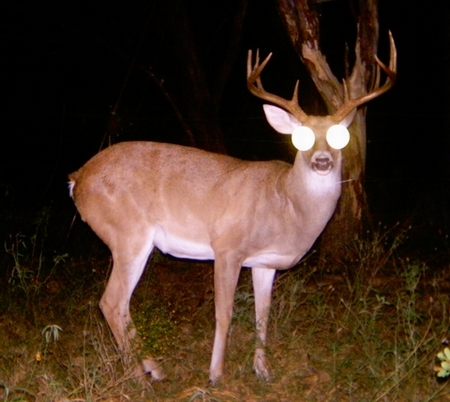
TrophyScore is a great new software program that allows digital game camera users to download their whitetail photos and then, using TrophyScore, measure the animal to give the user a reliable estimate on its trophy score. This program will allow hunters to rough score their deer before they shoot. We’ve posted the TrophyScore Review here.

My CamTrakker game camera came with the software for the TrophyScore program. After we recovered Roy’s 10-point buck I installed the software onto my computer and I scored the buck with TrophyScore. This was a perfect opportunity to use the program and see how accurate it was.

Here is How it Works

When you open the program you select a picture of the buck you want to score from your digital images.

After the picture is loaded your first step is to give the program a reference to base all the measurements on. You have the choice of measuring the buck’s eye or its nose. To do this you use our mouse and click on the edges of the eye or nose. The instructions display as you move through the program and are available to guide you along the way. The instructions state that to measure the eye you mark the edges of the eye, without getting into the skin.

You can Zoom In and Out on any feature and I found it was easier to get an accurate measurement of the eye by zooming in on an eye to measure it. I clicked on each edge of the eye and a line filled in between the two points. Then the program asked me if I had measured the eye or the nose and I of course selected eye.

You only measure one, either the eye or the nose. If your picture has a front view you can see all the nose and get a good measurement. But from the front, the eye is at an angle so your measurement won’t be as accurate as a profile shot. On a side view you can not see all the nose but you can see all the eye.

Onward, here is how to measure the nose. At this point the screen shows you how to make the measurement and you click on the sides of the nose, from inside nostril edge to inside nostril edge.

Next, it’s time to measure each antler beginning with the right antler. First you click along the right main beam. When it is marked you click Next. You then measure the length of each tine, one at a time beginning with the brow tine. When you’re done with the right antler you do the left. Then you measure the width of the antler at the base and between the points. Lastly, you measure the spread of the antlers and click Next. The program tells you it is ready for Completion and when you click Next you receive a print out of the rough Boone & Crockett score, including both gross and net scores.

How Easy Was It To Do This

My first time through I didn’t know what to expect. I didn’t zoom in on my nose measurement and didn’t get it right and the buck scored over 160. But on my second time around I knew what was going on and took advantage of the zoom feature — then the program nailed the score. TrophyScore actually adjusts to the angle of the deer in your photo by the relationship of the eye or nose measurements to the antler measurements.

So was it easy? Yep. Accurate? That too!

Roy’s measurements with the tape were half an inch more. The TrophyScore grossed the buck at 131.2″ and the it taped 131.7. That’s incredibly close. The TrophyScore web site has full information on the program and you can download it from the site.

Will it work on live deer? Yep, that is what it was created for!

This article was adapted from www.Bowhunting.net Check out the rest of this story here.

Wildlife Management Area Named After Justin Hurst

Justin Hurst and young hunter

The 12,000-acre Peach Point Wildlife Management Area located west of Freeport will soon be known to hunters and other waterfowl enthusiasts as the Justin Hurst Wildlife Management Area. The Texas Legislature passed May 29, and Gov. Rick Perry signed June 2, House Bill 12, Section 53 of which makes the name change official.

Soon after Texas Game Warden Justin Hurst of El Campo was killed March 17 in a shoot-out near Lissie with a suspected poacher (which involved another game warden, Texas DPS and Wharton County Sheriff’s Department officers), word got out that the Texas Wildlife Commission would be asked to consider renaming Peach Point for Hurst since he had worked there as a wildlife biologist from 1995 through 2001.

Texas Parks & Wildlife Department officials said shortly after Hurst’s funeral March 21 that the renaming was all but a done deal. The late game warden’s wife, Amanda, said she thinks the renaming ceremony and dedication will be held in October, which is exactly when large numbers of Hurst’s beloved migrating waterfowl are arriving on the Texas coast. “Justin would think we are making way too big a deal out of this, but I think it’s awesome,” Mrs. Hurst said.

“I think it’s very much a fitting memory for him, and I think it’s good for the biologists that he worked with. It’s been their baby, and was something they wanted to do in remembrance of Justin.” Peach Point wasn’t just special to Hurst as a TPWD biologist, but to his wife as well. It was where her future husband took her on their first date on March 14, 1998.

They had met at a Wildlife Society meeting in Beaumont in 1997, and were married April 7, 2002. Both earned degrees in wildlife ecology from Texas A&M. They also hunted and fished together.

“We went down there and drove around. He showed me the different impoundments.It was spring, so we probably looked at a few teal and some mottled ducks, shore birds and stuff like that. He showed me the bunkhouse, the barn, the tractor and the airboat. I know it’s pretty exciting,” she said, laughing.

Mrs. Hurst said her husband’s duties as biologist were wide in scope. “He did everything from cutting grass around the bunkhouse to burning, shredding … he maintained the habitat there.” Justin also worked with waterfowl banding programs, youth hunts and regular hunts on the weekends.

Peach Point provided public hunting opportunities for more than 2,000 hunters this past season. Hurst was instrumental in helping to develop those public hunting opportunities. Hurst left the TPWD Wildlife Division at Peach Point in the fall of 2001 to join the Law Enforcement Division. He entered the TPWD Game Warden Academy in March 2002.

About Peach Point WMA

Peach Point WMA near Jones Creek has 10,311 acres which were purchased using waterfowl stamp funds from 1985 to 1987. In 1988, an additional 1,627 acres were acquired as mitigation from the Brazos River Harbor District. Peach Point WMA is a part of the Central Coast Wetlands Ecosystem Project (CCWEP). The CCWEP’s mission is to provide for sound biological conservation of all wildlife resources within the central coast of Texas for the public’s common benefit.

Peach Point WMA is located within a league of land deeded to Stephen F. Austin by the Mexican government in 1830. The tract was known as Peach Point Plantation. The plantation was established in 1832 by James F. Perry and his wife, Emily Austin Perry, Stephen F. Austin’s sister, who bought the property from Austin for $300. The land was operated as a slave plantation until 1863 with cotton and sugar cane the primary crops.

Perry died in 1853, after which Emily Perry gave William Joel Bryan (her son by previous marriage) 200 acres of the original plantation. Bryan and his wife, Lavinia Perry, made their home there and developed a thriving cotton and cattle business known as the Durazno Plantation. A portion of Durazno Plantation is contained within the present boundaries of Peach Point WMA.

The portion of Peach Point Plantation that contained Peach Point WMA was donated to Austin College by Lucy Harvey. The property was later sold to a consortium of six major petro-chemical corporations. Development plans included construction of an offshore pumping station for oil tankers. However, plans were canceled due to the decline in the oil-based economy. The Nature Conservancy eventually acquired the 8,580 acre tract, and it was from them that TPWD purchased the area using waterfowl stamp funds.

Goals of Peach Point WMA

In prioritized order, the Central Coast Wetlands Ecosystem Project’s goals are:
n To develop and manage habitats for indigenous and migratory wildlife species with a special emphasis on waterfowl.

To formulate research and management activities on WMAs and private lands and disseminate research results and management information to scientists, land managers, resource agencies, and other interested groups and individuals.

To expand and improve WMA facilities to accommodate intensive research and management activities that will allow complete understanding of coastal ecosystems.

To provide optimal public outreach and recreational opportunity on state-owned lands compatible with the resource.

The wildlife management area where Justin Hurst worked as a wildlife biologist prior to becoming a game warden will be renamed as the Justin Hurst Wildlife Management Area and dedicated in October 2007.

The Control of Suburban Deer

Controlling Whitetail Populations

White-tailed deer populations in metropolitan areas of Texas are increasing significantly. The same thing is happening across the US. Deer populations have been increasing due to both conservation efforts and deer herd and habitat management, but in many areas a low mortality rates is the number one reason for rising population. To compound the issue,the human population of most cities in the United States is also rising.

In order to make room for the expanding human population, deer habitat is being destroyed as development of residential areas is increased. Each year these residential areas grow, spreading farther out into rural areas. Simply go for a drive in the “country” or rural, low-human population areas, on the edge of any metropolitan-urban setting and you will discover that the “country” getting further and further away!

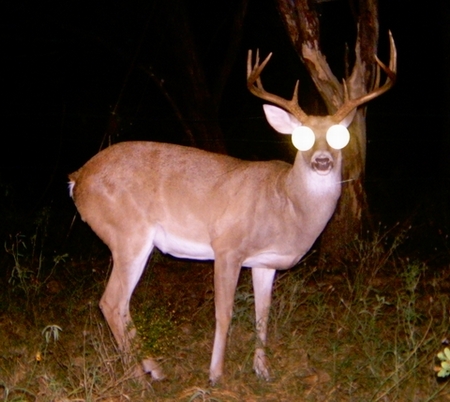
Urban Deer Management: Whitetail Buck in Bulverde, Texas

The Adaptable Whitetail

The good news is that deer, especially whitetail, have a strong survival instinct as well as the ability to adapt to their changing environment. When their previously-forest or farmland habitat is cleared out and developed, they are pushed out temporarily. After homes are built-out and neighborhoods are completed, white-tailed deer will often return to live on the edges of these areas, in whatever suitable habitat they can find. Their previous food sources are replaced with new ones. Deer are also regularly fed by well-meaning humans.

Prior to the development of their habitat, deer would feed in the woods and fields and develop diets based on the natural foods found in their environment. After the development is complete, the whitetail will use new food sources including gardens, trees and other plants which have been planted in the new residential areas. Often, these deer stay out of sight, sleeping, eating and breeding until their population overtakes the “carrying capacity” of their new, reduced habitat.

Carrying Capacity in Suburban Areas

Carrying capacity is the quantity of animals that a given area can support, based on cover and food limitations. When the overall habitat available in an area is reduced, the carrying capacity of that area will also be reduced. It takes a very short time for an existing population of deer to exceed this carrying capacity within these new developments.

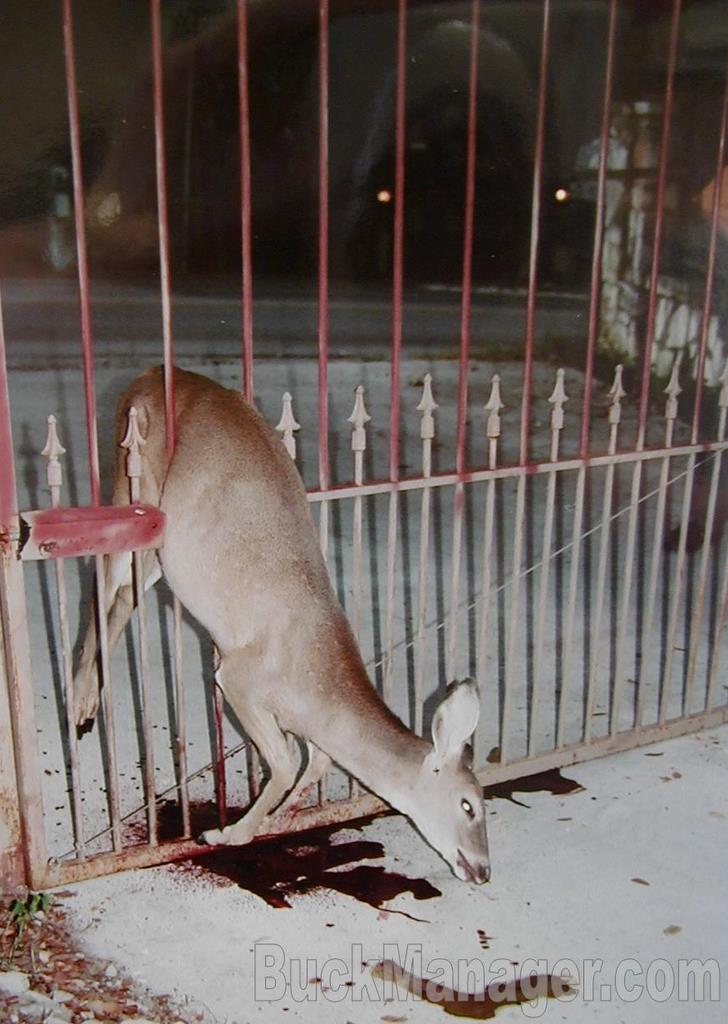
This causes problems due to the increased occurrence of deer-car accidents and other conflicts between the respective deer and human populations. These deer can become “nuisances” to the human population around them, due to limited space. That’s the time when the deer population control options start getting discussed. In these cases, cultural carrying capacity is more important than actual environmental carrying capacity.

Texas Deer Hunting Regulations: Bag Limits in Texas

Methods for Controlling Deer

There are several methods for controlling overabundant deer populations. Options which are considered, when deer population control becomes necessary are as follows: 1) Deer contraception, 2) Trapping and relocation of deer, 3) Removal of deer from the population by hiring sharp-shooters to shoot the deer, and 4) Removal of deer through bowhunting.

Contraception has never been shown to work in a free-ranging deer herd. It’s also expensive to try. Trapping and sharpshooting are also relatively expensive because the methods involve contractors for hire. In all the above situations, the costs of control is directly related to the amount of time ($/hour) someone has to spend carrying out the operation, plus the costs of supplies.

Trapping and relocation can be effective but is also high cost and very time consuming. Most metro city councils, parks departments and home owners associations have very small, if any, budgets for deer population control efforts. The use of sharp-shooters can be effective but, again, the cost will be high and the idea of high-powered firearms being used near residential areas is not popular with residents.

It has been shown through various studies that hunting is a cost-effective means for reducing suburban deer populations when compared with other tactics. In most cases, bowhunting is the method of choice for reducing the herd. The real cost savings come from not having to pay someone to remove or handle deer. Insteads hunting is merely allowed, promoted.

Birth Control in Deer

Deer contraception is conducted by trapping female deer (most of the time), sedating them and placing a contraceptive implant under their skin. These deer won’t become pregnant for a fixed amount of time until the implant becomes ineffective. This tactic has been proven to be high-cost and low effect because the majority of the female deer in an area need to be trapped and the cost of the drugs and the cost of trapping the deer are both high.

Others have tried to sterilize male deer through castration. Whether males or females have been treated, no contraception or sterilization project has succeeded in reducing a free-ranging deer population. Due to the survival instincts of the deer, it is difficult to trap a large enough portion of the deer population to make brith control an effective population control tactic.

Controlling Urban Deer Populations

Controlling Deer and Mitigating Risk

Managing deer numbers means having a goal and mitigating risk. The potential for accidents is not a risk that most city councils and parks departments, not to mention the local residents, are willing to take, regardless of the chosen control method. Again, bowhunting has been proven to be a safe and effective way for the deer population to be reduced. Also, the cost to the city councils and parks departments is minimal.

The deer which are harvested are either taken home by the hunters themselves or donated to local food banks, providing much needed, inexpensive protein for those in need. The hunters involved in these highly organized hunts are volunteers who donate their time. The opportunity to be in the woods is payment enough for them.

Organization of such take of deer (hunting) becomes increasingly important as non-traditional deer habitat increases and deer-population control measures become necessary. Management of deer herds involves removing some of the deer from areas where deer numbers exceed the overall carrying capacity. This reduction increases the health of the remaining deer population and reduce the occurrence of deer herd disease and winter-kill. Hunting is the safest and most economical way to reduce the overall deer population in a given area, but it must first be accepted and then implemented wisely.