Remembering Justin Hurst

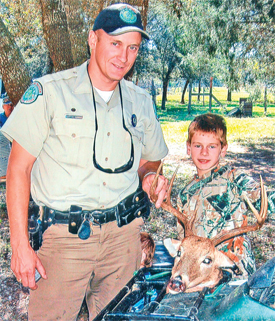
From the time he was a teenager guiding goose hunters on the Texas coastal prairies, probably even before then, Justin Hurst was subconsciously preparing himself to make a difference in natural resource conservation. Those who knew him say he seemed to approach life with that goal in mind. Although his journey was cut short when he lost his life in the line of duty on his 34th birthday, March 17, 2007, Hurst had already made his mark on the Texas landscape. And, the impacts he had on the state’s wildlife resources, as well as on his family, friends, coworkers, and even adversaries, serve as his legacy.

“Game Warden Justin Hurst personified all of what Texas Parks and Wildlife represents,” Col. Peter Flores, TPWD Law Enforcement Division Director, says. “He cared for wildlife, he was a pillar of his community, and he cared deeply for his family and was a faithful public servant. His death is a great loss to the people of Texas.”

Hurst started his career with the Texas Parks and Wildlife Department as a biologist in August 1995 specializing in waterfowl management along the mid-coast. Fellow wildlife biologist Matt Nelson remembers joining TPWD at the same time as Hurst.

“He went to Peach Point (Wildlife Management Area) and I went to Mad Island (WMA), both of us worked on the central coast wetlands project,” Nelson recalls. “We had numerous research projects going on at the same time and spent most weeks together; fish sampling, working up alligators and mottled ducks. A lot of late nights together running around the marsh in air boats. Justin was very enthusiastic, dedicated towards the resource and approached everything full-bore.”

At Peach Point WMA, Hurst was able to submerse himself in his passion for waterfowl and the marsh habitat. For six years, he built a reputation as a wildlife biologist who understood the resource and conservation.

“He got it,” offers Dave Morrison, TPWD waterfowl program leader. “He understood the importance of resource management and conservation and could relate that to others. He was a heckuva biologist.”

That’s why it came as such a surprise when he announced plans to become a game warden.

“No one within the project saw that coming,” says Nelson. “He never mentioned anything to us, and then out of the blue he said he planned on going to the game warden academy. He’ll always be a biologist to us. The thing about Justin, whatever he put his mind to, he’d do it well. We lost a good biologist.”

Hurst became a part of the 48th Texas Game Warden Academy and graduated in August of 2002. While at the academy, Hurst shared his knowledge about waterfowl with fellow cadets and actually taught duck identification techniques. Some of his classmates referred to Hurst as the “Super Cadet” because of his diligence and drive.

After graduation, Hurst served about a year in Brazos County when a game warden slot became open in Wharton County. Hurst met with then TPWD Law Enforcement Division Director Col. James Stinebaugh personally to make his case for a transfer.

Stinebaugh says the decision to transfer Hurst was a no-brainer, but admits it did cause a rumbling in the ranks at the time.

“Typically, we required at least two years experience before letting a warden put in for a transfer, but it just made perfect sense to put Justin back down there because we needed someone who knew waterfowl in that position,” Stinebaugh says. “I took some heat for that move, but it was the right move.”

Hurst’s supervisor, Capt. Rex Mayes, says he knew well ahead of time he would eventually see Justin Hurst working in his district some day and is glad the colonel broke from tradition. “I remember meeting him for the first time when he was still in the academy,” Mayes recalls. “He said he wanted to come to my district because we had the bay that he loved so much. I remember when he left my office that first time; it was a rude awakening for me because I was seeing for the first time a new breed of game wardens, the whiz kids.”

Game wardens who worked in the field with Hurst remember him most for his preparedness, dedication and respect for others; even those individuals he issued citations to for game law violations.

Hurst is survived by his wife, Amanda, and son, Kyle Hunter, age 4 months, his parents, Allen and Pat Hurst of Bryan, a brother, Greg Hurst of Denver, Colorado, and in-laws, Larry and Jeanie Wilcox of Denton, Texas.

Memorial fund donations may be made to Operation Game Thief, c/o Justin Hurst Memorial Fund, 4200 Smith School Road, Austin, TX, 78744. The Houston 100 Club is also accepting donations for the family at: 100 Club Survivor’s Fund 1233 West Loop South, Suite 1250, Houston, TX 77027-9107.

Cajun Boudin Recipe

Recipe:

2 lb Pork meat, 30 % fat (Pork Butt works well)
1 1/2 lb Pork liver
2 teaspoons Salt
2 teaspoons Black pepper
1 large Onion, finely chopped
3 Green onions, chopped
12 cups Cooked rice
2 tablespoons Cajun spice
1 Lot sausage casing

Place meat in enough water to cover and season with salt and pepper. Cook until meat falls apart. Remove meat and reserve some of broth. Grind meat, onion, and green onions. Mix the ground meat mixture with the Cajun spice, rice and enough broth to make a moist mixture. Taste mixture and adjust seasoning. Using a sausage stuffer, stuff the mixture into sausage casing.

Refrigerate or freeze.

Deer Over Abundance in Wisconsion

Deer are certainly an important and enjoyable part of the Pheasant Branch Conservancy and other conservancy areas throughout the City of Middleton, Wisconsion. Indeed, deer are wonderful, beautiful, wild animals which people seem to love to watch and feed. White-tailed deer are also an important part of an even greater plan, an ecosystem more complex than we can ever imagine. So what happens we deer overpopulate their habitat?

As agricultural lands disappear and our urban areas continu to grow, the telltale signs of an overpopulated and un-balanced urban deer herd will be exhibited everywhere through the loss of native plant species (trees, shrubs and herbaceous plants), damage to private residential vegetation (trees, shrubs and herbaceous shrubs), and an increased number of car-kill deer accidents within associated suburban and urban areas.

Maureen Rowe, DNR , a Wildlife Biologist for the Dane County Area, sums it up best by stating:

"The deer herds within management units 76 and 76M, are severely over populated. Scientific studies document that current deer population levels threaten microhabitat, severely impacting native flora and fauna."

Hunting for Shed Deer Antlers

Hunters hunting for shed deer antlers has become a big event in recent years. People search for antler sheds for various reasons and some of those folks are not even hunters. Some want to find shed deer antlers to make various items out of… lamps, knives, etc. And then there are those that are serious about finding shed antlers for buck tracking and management purposes.

Hunting for Sheds

Finding shed antlers (especially both sides) allows the finder to rough-score the bucks to get a good idea of current and future quality. In addition, finding a particular buck’s antlers can let you know if he’s made it through the winter or if he’s still in the area. Also, finding numerous shed antlers over years on a particular piece of property allows you to gain knowledge regarding the areas that bucks are frequenting.

Shed deer antlers

Finding a Buck’s Shed Antlers

So, where are the best places to look? The basics are simple. Look for shed antlers in winter food sources, in bedding areas and along trails in between these two areas. These are the best locations to run across a shed, but timing is of the greatest importance. Start too early in the season and you’ll find nothing. Starting too late means antlers will either be partially or entirely eaten by small mammals and other rodents or vegetation will be well-grown, making antlers even more difficult to find.

So when?

Of course, antler drop varies by region and even likely even within parts of your state. I recommend keeping an eye on the deer herd or using a game camera to document when bucks are losing their head-gear in your area. Then it’s just a matter of getting out there and putting in some time. Good luck!

Sausage Making: A Few Recipes for the Hunters

Ready to make some sausage are you? Congratulations, that means you managed to bag some sort of critter this hunting season! Well, you’ve put in the time and effort to bag your wild game, you took care of the animal in the field and got it home, and now it’s time to create a finished product.

Sounds great, so check out the following recipes:

Each year after we harvest a couple of deer, my family and I will get together and make sausage. This is an annual event, typically starting with a wood duck hunt in the early morning and then getting back to the house in short order to get to work making sausage.

We commonly make sausage out of deer and wild hogs, but you can do a lot of substitution when in comes to making sausage. Usually, our sausage mix is about 50% deer and 50% wild or store-bought pork. Sometimes when we don’t manage to bring porky home, we will also subsitute in beef brisket in place of the pork. This works quite well and what we end up adding to the sausage usually just comes down to what is on sale that week.

Sausage Making: A Few Recipes for the Hunters

You can be imaginative when it comes to sausage making, we’ve even used geese, ducks, and turkey – and they have all turned out great! Venison is lean, so you are definitely going to want to add some fat to give your sausage some moisture and make it better table fare. I recommend making a sausage that is about 85% meat and 15% fat.

The following recipe is one that we use and is based on 5 pound increments so that you can easily adapt it to fit the quantity of sausage that you are making. After mixing, stuffing, and tying, you are ready to smoke it.

Basic Sausage Recipe

5 pounds boneless meat of your preference
2 Tablespoons black pepper
1 Tablespoon + 1 teaspoon salt
1 Tablespoon garlic powder
1 teaspoon modern cure

Sausage Making: A Few Recipes for the Hunters

Summer Sausage

The basic sausage recipe above can also be used to make summer sausage. The only difference is that you need to add at least one more ingredient to the mix. Add 3% nonfat dry milk (by weight) to the mix and this will make the sausage “gel.” If you are making 10 pounds of summer sausage, then you need to add 0.3 pounds of nonfat dry milk.

Also, you can add in other ingredients to kick it up, but this is best determined by personal preference. Whole black pepper, mustard seed, jalepenos, and cheese can be added to your summer sausage recipes to give them a kick. I usually just add whole black pepper and I do this until it “looks” right.

Breakfast-pan Sausage

This is a great pan sausage to eat for breakfast and even works great in chili. This can be made from your 50/50 deer and pork mix or from straight pork. Use the basic sausage recipe, but DO NOT use modern cure. In addition, add 2 Tablespoons of ground sage for every 5 pounds of meat and you are done. Simply grind and pack for the freezer!