Rutting in Whitetail Deer – Early vs. Late

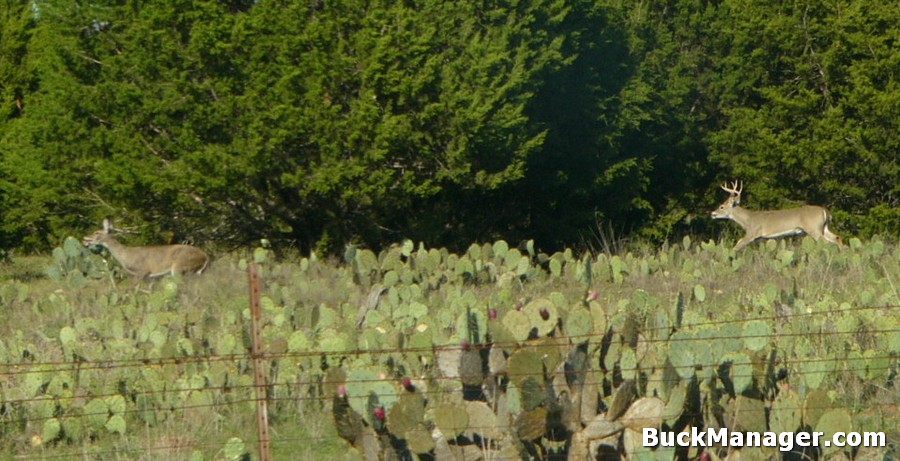
What about the early and late ruts? Hunters often talk about the rut being early or late. In much of Texas at least, the breeding season for white-tailed deer is fairly predictable each year. This is the case just about everywhere there are deer, but it can vary a little. Within a specific area, habitat conditions not only affect fawn survival but can affect the timing of breeding, as well. For example, a doe in poor condition, i.e. not enough deer food, or a young doe may not enter estrus/breed until later in the season when her physical condition improves.

Additionally, a whitetail doe may be found “attractive” by bucks for about five days, but may be willing to breed for a period of only about 24 hours. In areas where there are a low number of bucks compared to does, a doe may not encounter a buck when she is first receptive to breeding so may not be bred until one of her later cycles. If a doe is not bred during her first cycle then she will come into estrus again about 28 days later.

A hunter who sees the late breeding activity may be convinced that there was a late rut. On the other hand, those who see does attended by bucks in the early part of the season believe there was an early rut. This biological reasoning helps explain the wide variety of opinions on the timing of the whitetail rut during a particular year. Although there is typically a peak, it can be ongoing.  Continue reading “Rutting in Whitetail Deer – Early vs. Late”

Digital Game Cameras – Importance of Effective Flash Range

Digital Game Camera - Importance of Effective Flash Range

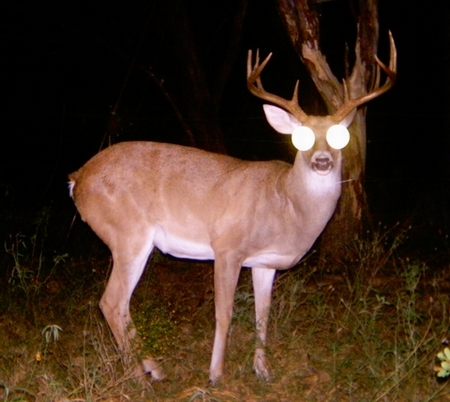
The flash of a digital game camera can be an important thing to consider when looking for a new trail camera. The most obvious reason is because deer move most frequently after darkness settles in. The flash of your camera must be strong enough to cover the subject area, but no so strong that it causes “white out” on the pictures. A good starting point would be to research the “effective flash range” as stated by the manufacturer of all the trail cameras in your price range. And remember, these are still “stated” ranges.

If you plan on using the trail camera on the edge of a crop field you will most likely need a longer effective flash range than say 20 feet. On the other hand, if you set up the deer camera over a bait pile in heavy brush, then a short flash range will be all you need. Why? Well first, the solid background of brush will reflect light back into your picture, so the short flash range works fine. And obvious, the deer will be much closer because of the confined space.

Conversely, the distant tree on the other side of the agricultural field will need a much brighter, more effective flash. Regardless of where your trail camera goes, make sre to clear out the area between the camera and where you expect the deer to be. The most obvious reason (coming from a seasoned camera user) is because if the camera is set out during periods of high temperature then even minor moments in brush and weeds in front of the game camera could trigger “false” pictures. This close brush will also cause “flash back,” resulting in “white out” of your night photos as well.

“Flash back” can be spotted on your scouting photos as looks like a very hot spot on the game camera photo that may or may not be bright enough to white out the entire photo. In short, if you have brush, dead limbs, weeds, or other obstructions close to your digital game camera’s flash, cut it down.

And lastly, when purchasing your scouting camera, make sure to research the available cameras to find one that meets your needs. And of course, price varies based on picture size, opitical quality, memory, options, and effective flash range. Do a little scouting before your camera does some scouting and you will get the deer photos you want without the headache.

Justin Hurst Wildlife Management Area – Info

The Texas Parks and Wildlife Department wildlife management area formerly known as Peach Point Wildlife Management Area (WMA) will be formally rededicated this Friday, Oct. 12 as “Justin Hurst WMA” in recognition of the former game warden and wildlife biologist who was killed in the line of duty earlier this year. As a department biologist in the Wildlife Division, Hurst devoted six years to the 15,612-acre WMA known for its lush wetlands and coastal plains.

As Peach Point’s area manager he was instrumental in the development of many waterfowl conservation projects on the site, including mottled duck research. Hurst switched careers and became a game warden in 2002, and while at the training academy, he shared his knowledge about waterfowl with fellow game warden cadets and taught duck identification.

On March 17, Hurst’s 34th birthday, he was killed while attempting to apprehend a suspected poacher. Employees are invited to attend the rededication, which begins with self guided tours of the WMA from 8 a.m. to 1:30 p.m. Ceremonies begin at 2 p.m. and conclude around 4 p.m. Speakers will include Mike Berger, Col. Peter Flores, Todd Merendino, David Lobpries, Jesse Oetgen, John Thorne, Andrew Sansom, Amanda Hurst and Robert L. Cook.

Get more information by calling Texas Parks & Wildlife’s Bay City office at (979) 244-7697.

Deer Habitat Management – The Fundementals

The management of white-tailed deer and their habitat has become of increasing concern in recent years. Hunters and landowners realize that it takes more than luck to produce outstanding deer on their land, and improved habitat conditions are a major factor in regards to deer development.

Fundamental requirements that must be considered when managing for white-tailed deer habitat include food, cover, water, and the proper distribution of these elements. Habitat management must be directed at maintaining a productive and healthy ecosystem. The ecosystem consists of the plant and animal communities found in an area along with soil, air, water and sunlight. All management activities should be aimed at conserving and improving the quantity and quality of soils, water and vegetation.

Deer Habitat Management - The Fundementals

There is no substitute for good habitat. Good deer habitat makes good wildlife habitat, and it keeps your ranch looking great. First and foremost, managing for plant diversity is essential. A diverse habitat site will have a good mixture of various species of grasses, forbs and browse plants. Many of these plants will be at various stages of growth, which adds another element of diversity.

The diversity of vegetation increases the availability of food and cover for wildlife species. A greater diversity of range plants results in more food being made available during different periods of the year. The volume and diversity of plants protects the soil from erosion. Also, the decomposition of vegetation helps restore needed minerals to the soil to sustain plant life. An abundance of vegetation improves the water cycle by trapping water from rains, thereby preventing excessive runoff which leads to the erosion of soils and flooding of streams.

An ecologically-based habitat management program will serve to improve the plant community of your property by increasing vegetation quantity, quality and diversity. This improvement in the plant community will not only conserve and enhance the soil, but improve the water cycle as well. A greater diversity of all forms of life, including microorganisms, insects, reptiles, amphibians, birds and mammals is achieved under a sound management scheme. The long term health of the land is improved and conserved for future generations to utilize as a source of income, recreation and for aesthetic enjoyment.

In Texas, the climax herbaceous vegetation community of most rangelands is dominated by grasses with a low percentage of forbs. While this may be suitable for livestock and for a few species of “grassland” wildlife, many wildlife species are more dependent on the seeds and foliage of forbs (commonly called “weeds”) than on grasses.

Keep this in mind: plant communities with a diverse array of “weedy” plant species are more productive for deer than a community dominated by perennial grasses. Periodic disturbances such as fire, soil disturbance, livestock grazing, and mowing can set back plant succession and maintain a diverse plant community. Remember, it’s important to mix it up to keep deer habitat healthy and productive.

White-tailed Deer Habitat Management Considerations

When considering the management of white-tailed deer, unless your property is game fenced you should realize that adjacent lands are also included in the home ranges of many of the deer on a property less than several thousand acres in size. Only those deer within the interior of a really large property may have home ranges located totally within the property, while those in a wide band around the property’s perimeter likely move back and forth onto adjacent lands.

The quality of a property’s deer population will in large part be dependent on both the habitat quality and population management strategies (i.e. hunting pressure and deer harvest) on both your and neighboring lands.
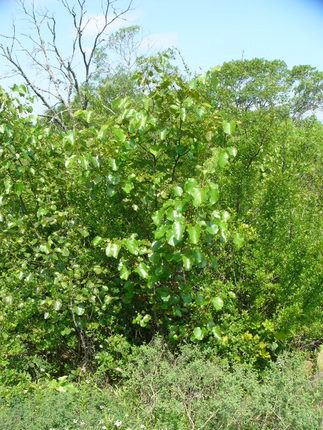
White-tailed Deer: Habitat Management Considerations
The 4 Keys to Deer Habitat Management

The key to producing a productive and healthy white-tailed deer population is dependent upon the quantity, quality, and variety of food plants produced by the habitat or range. Food availability can be improved in the following ways:

1. Harvesting deer, including does, to maintain total deer numbers at or below the capacity of the habitat.

2. Stocking the range with a moderate number of domestic animals, preferably those that do not directly compete with wildlife, and utilizing some form of a deferred-rotation system of grazing.

3. Controlling invading “noxious” woody vegetation, such as excessive brush species that are not needed for cover. This will reduce competition between plants species and increase the production of grasses for cattle and the production and availability of browse and forbs preferred by deer. It is recommended that your property be a mosaic of 50-60% wooded/brush with the remainder in scattered openings and/or food plots.

4. Avoiding the stocking of excessive numbers of exotic big game animals or at least keeping their numbers at a low level, since exotics compete with white-tailed deer for browse, forbs, and mast. If you are really interested in producing trophy white-tailed deer, stay away from competing exotics.
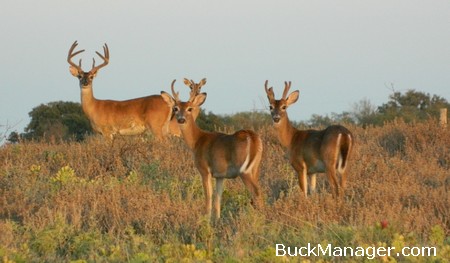
Whitetail Habitat Improvement for Better Hunting

High Quality Foods for Deer Herd Health

Understanding food habits of deer is fundamental to deer management. You can produce large antlered deer simply by shoveling feed down their throats, but a good hunting property also provides and looks like good wildlife habitat. There is no doubt that you can produce a large, trophy-size buck in a pen on top of asphalt if you provide it with adequate food, shelter, and water and let it live long enough to reach its genetic potential, but I don’t think this is your goal if you are reading this article.

Studies have shown that deer prefer forbs and browse (leaves and twigs from trees or shrubs). Grasses make up a very small portion of a deer’s diet (usually less than 10%) and they are utilized only when tender and green. Deer can not digest mature grasses. Forbs are generally high in protein and important to deer size, antler development, and fawn production. However the production, quality, and palatability of forbs is highly dependent on rainfall and the season of the year. Forbs will be absent or unpalatable at least during portions of a year, typically during late summer and late winter.

Managing Habitat for Deer, Nutrition

Browse is the stable component of deer diets and, unlike forbs, is available throughout the year and is relatively drought resistant. Although utilized by deer throughout the year, browse becomes most important during the winter and summer stress periods when forbs are absent or unpalatable.

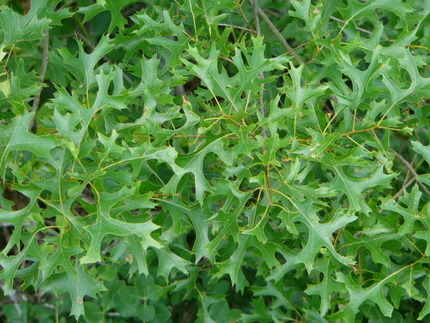
Browse species in a given area will vary with soils and precipitation, local climatic conditions. The best browse plants, as sought out by white-tailed deer, occurring in Central Texas include honeysuckle, downy virburnum, Texas madrone, Texas (Spanish) oak, Texas kidneywood, littleleaf leadtree, Texas sophora, Wright pavonia, chinaberry, mulberry, Carolina buckthorn, true mountainmahogany, cockspur hawthorne, Oklahoma plum, sugar hackberry, cedar elm, and slippery elm, which are rated as preferred species.

Moderately preferred species include skunkbush sumac, flameleaf sumac, evergreen sumac, poisonivy, possumhaw, fourwing saltbush, white shin oak, Lacey oak, blackjack oak, chinkapin oak, post oak, Roemer acacia, Texas redbud, saw greenbrier, common greenbrier, Carolina snailseed, Texas colubrina, escarpment blackcherry, woollybucket bumelia, netleaf hackberry, heartleaf ampelopsis, ivy treebine, sevenleaf creeper, Virginia creeper, and mountain grape.

Many woody plants also produce mast (acorns, fruits, or beans) that is readily eaten by deer, but mast production is erratic and therefore it is not as reliable as a food source as the foliage. Important mast producers are the oaks (including live oak, which is a low quality browse species), and mesquite and Texas persimmon, both of which are low quality browse species. The woody species found in your area is dependent upon the area’s geographic location, soil types, and terrain.

Past management practices, such as excessive goat browsing, cattle grazing, or improper or excessive brush control practices could also be contributing factors. The quantity and species diversity of woody plants are typically greatest on the deeper soils of riparian areas along stream courses and lowest in areas of shallow soils.

Determine the most important whitetail food plants in your area and manage for those plants. Native plants are very nutritious, highly desired by white-tailed deer, and are a renewable resource that will help you produce trophy deer, make your property look great, and save you some feed money over the long haul.