Deer Management: What a Difference a Year Makes

Deer Management: What a Difference a Year Makes

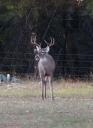
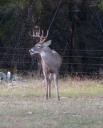
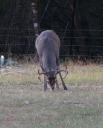
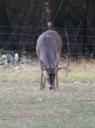
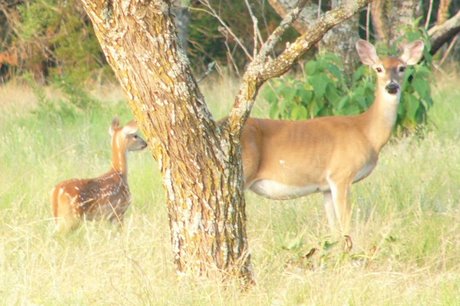
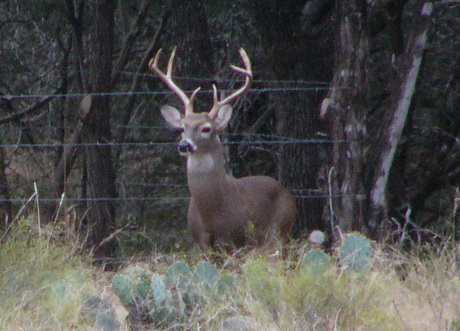
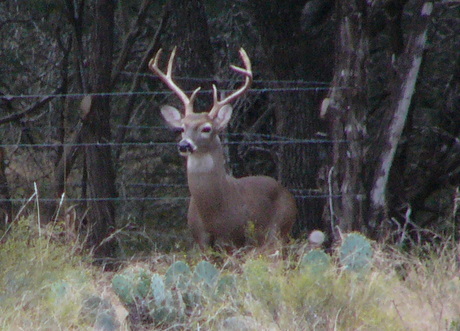
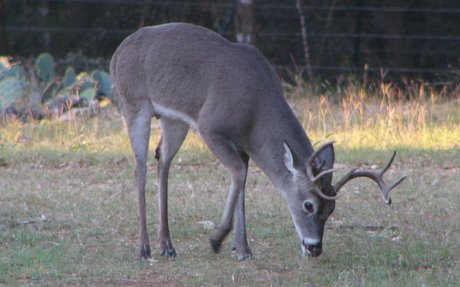
What a difference a year can make! In my neck of the woods, last year was dry, deer forage was low, and deer were in “average” condition. But this year, abundant rains provided a plethora of white-tailed deer food and put individual deer and the deer herd as a whole in great condition. Here is another example of how a year can make a difference – in the life of a buck. Last year (2006), I took pictures of a 3 1/2 year old 8-point buck while hunting one morning. The white-tailed buck wasn’t exactly what I was looking for, so I let the deer go in hopes of seeing something even larger. As it turns out, I only saw the buck that one time, but managed “shoot” him several times and got some great photos as seen below. But guess what? He’s back!

Deer Management: What a Difference a Year MakesDeer Management: What a Difference a Year MakesDeer Management: What a Difference a Year MakesDeer Management: What a Difference a Year Makes

Continue reading “Deer Management: What a Difference a Year Makes”

Patience Pays Off for Coleman County Hunter

Seven point white-tailed buck with 18 1/4 inch spread

When it comes to free-range, open country white-tailed deer hunting, that’s exactly what it is, “deer hunting.” If hunting were a sure thing we’d call it “deer shooting.” In addition to hunting for a deer to harvest, weather and equipment can also impact a hunter’s success on any given day. This was more than true for one Coleman County (Texas) hunter.

Last year, after finding a hunting lease bordered by the beautiful Colorado River, Jon passed on many young bucks, but managed to harvest a cull spike buck and a couple of does to maintain the buck to doe ratio and secure table fare. But this was year two.

It had been a great spring and summer in Coleman County. The lease, like the rest of the area, received ample rain and put deer body conditions and antler quality in great shape. However, after opening weekend Jon returned home without “horns.” Sure, he’d seen some young bucks, but nothing he wanted to prescribe a lead pill.

He couldn’t get back to the lease the second weekend of Texas’ General Season to deer hunt, but the third weekend would prove to be the charm… but it still wasn’t easy. Saturday morning, Jon spotted a spike at 100-yards and, after some contemplation, decided to go ahead and take the genetically inferior 1 1/2-year old buck. He settled in for the shot, but the bullet didn’t connect with its target.

Jon’s confidence was blown, he had missed a textbook, 100-yard shot. He wasn’t sure what the problem was, but he had a hunch it could have been a number of things. Had he pulled the trigger or did he squeeze it? Did he hit a limb or did something else obstruct the bullet’s path? Was the scope off? Did the deer move?

After a process of elimination, Jon suspected the scope must have been comprimised. At 4:30 that afternoon, Jon spotted two raccoons he ranged at a healthy 138-yards away. Here he had the option to implement a little varmint control and see if his gun was “on.” Jon deliberatly placed the crosshairs on the furry omnivore and let some hot lead fly. The bullet just sailed over the back of the ‘coon, so he dialed the scope down about and inch and a half and felt confident in the decision.

Afterwords, Jon settled in for the evening hunt. Not much was happening, but then he detected a hint of movement through the scattered mesquite brush. In his own words, Jon makes his account of the event:

It was a quick shot, he came out of no where. I picked up my binoculars and only saw he was outside the ears, picked up the rifle and made the shot all in about 5 or 6 seconds before he disappeared into the brush. I didn’t have time to range him or anything, another 2 seconds and he would have been gone. I didn’t know if I hit him or not because he disappeared as I made the shot and worked the bolt.

Jon was not sure the bullet flew true, although he felt confident that he had done his part. But was the deer down? Not being sure, he decided to wait a few minutes before making the 250-yard plus trek over to the area where he last saw the buck. However, within 5 minutes of squeezing off on the long-range buck, a spike buck walked into view and Jon knew he had a second buck tag to fill. He put the crosshairs on the kill zone and dropped the spike like a sack of rocks.

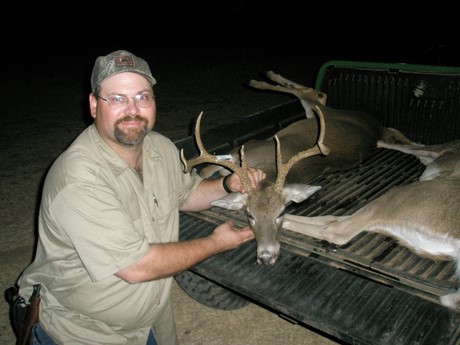
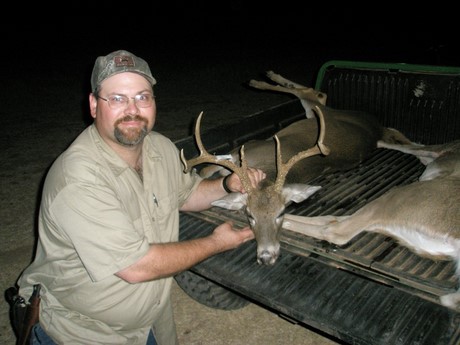
Jon jumped from his position and approached the spike. After tagging him, he ran down the field to find that his “long-range buck” had fallen in a low spot just out of view of where he had shot him. He placed his buck tag on the bruiser with the satisfaction of a well-placed shot on a nice 7-point buck with over an 18″ outside spread. In a matter of a few minutes, Jon had filled both of his buck tags on two Coleman County bucks!

More from Jon and some specifics:

This is not the biggest deer in the world, but it’s pretty good and I waited two seasons before a fellow like this one walked out in front of me. The buck had an 18 1/4″ spread 7 points.

I took him at 255 yards (Leupold rangefinder) walking through some mesquites. Hit him in the neck, DRT with Remington 7mm magnum LH700 BDL with 3.5×10 VXIII Leupold, 150gr green box Remington Core Lokt’s.
Seven point white-tailed buck with 18 1/4 inch spread 2

Effects of Food Availability on White-tailed Deer Reproduction

Effects of Food Availability on White-tailed Deer Reproduction

Very little research has been done with wildlife species in relation to the consequences of suboptimal nutrition conditions on estrous cyclicity and reproductive capability. White-tailed deer in Texas ideal for such research due to the reproductive seasonality and common reproductive failure when food quality and quantity is low. A research study out of Texas A&M University – Kingsville is studying the effects of reduced food intake on white-tailed deer estrous cyclicity through the evaluation of several specific nutritional measurements.

In the first year of the study, mature whitetail does were fed “all they could eat” on a high nutritional diet and bred. In the second year, doe diet was restricted from September through November and even up into mid-January and bred. Continue reading “Effects of Food Availability on White-tailed Deer Reproduction”

Texas Deer Hunting Report – Opening Weekend

Texas Deer Hunting Reports - Opening Weekends

The general season for white-tailed deer hunting opened across most of Texas in the north and central zones this past weekend, sending tens of thousands of hunters to the field in what has become an annual rite of fall stretching back many generations. Texas Parks & Wildlife Department field biologists reported a lot of hunter and staff activity across the state, although much of the data and numbers won’t be available until later in the week.

For example, a biologist in central Texas stated:

“After five years of working that locker, I can say that overall it was about an average weekend. There was warm weather, and a lot of folks saying they weren’t seeing deer – it was too hot. There’s still just tons of acorns on the ground, keeping many deer under cover since they don’t need to come out to other food sources, so I’m surprised it went as well as it did with the warm weather. Deer were in good shape physically; we saw some nice bucks. We were working in some antler-restriction counties, and we were hoping to see some older deer, and we did. Most people seemed to be pleased with the restrictions, some saying they’re seeing bucks on their property for the first time ever.”

Biologists in East Texas counties stated that, overall, it was fairly slow. Opening weekend turned out hot, deer activity was down, and harvest was maybe a little below average in the southern end of the Post Oak Savannah. Now, antler quality was maybe a tad above average. Harvest was still dominated by younger animals, mostly yearlings and two-year-olds. But antler quality of those classes, as well as the few older bucks that came in, seemed to be pretty good, probably a result of all that good summer rain.”

Although warm weather may have challenged Texas deer hunters on opening weekend, good habitat conditions and generally strong deer populations statewide mean that cooler weather coming this week could mean good hunting ahead this fall. Get out there!

Albino Buck Harvested by Minnesota Hunter

Photo of albino buck harvested in Minnesota

Everyone likes to hear about albino deer — and I think everyone would even love the opportunity to harvest an albino buck simply as a novely. But guess what? On this season deer hunting opener in Minnesota, a female hunter managed to harvest one of the rarest colored white-tailed deer around — an albino buck! Yep, hunter Mary Rakotz of Avon got the 6-point buck on Saturday in Mille Lacs County, Minnesota.

The hunter said it was thrilling to see the abnormally-colored animal, but it was 100 times more exciting to be able to actually take the white-colored buck home. Here is what Ms. Rakotz had to say:

“I had heard that it might be in the area, so I thought that here was my chance of a lifetime. So I had to creep a little bit, probably about 40 yards, to get a good place where I could steady myself a little bit. But then I did that and shot and the buck went right down.”

And as rare of a harvest as it is, the hunter says she’s not sure if she has room to mount the buck, but her family and friends are pretty excited for her, and maybe even a little jealous.

The albino buck was only a 6-point deer and I doubt it’s very old (and sorry about the photo, it was the best available). However, in most cases ablino deer just do not get to live very long, because oddly colored deer don’t last long in the woods for obvious reasons. Not many hunters are going to pass on a shot at a once in a lifetime opportunity.