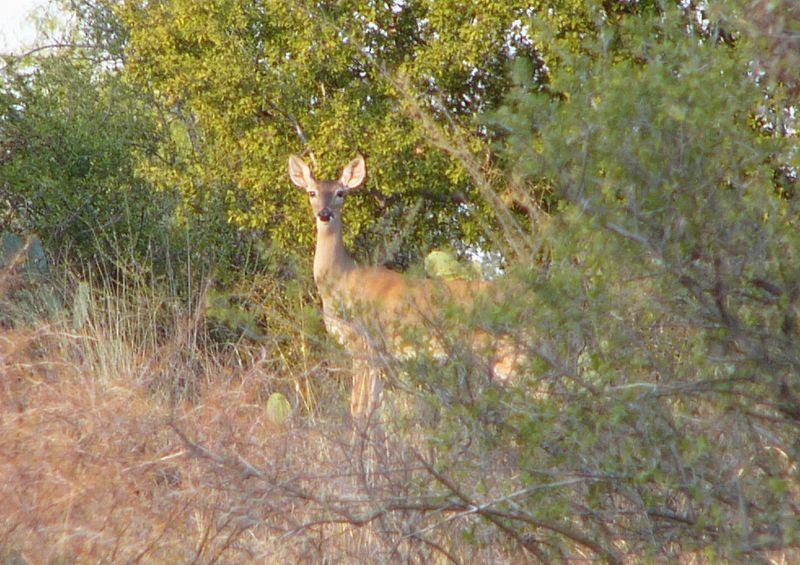
Game Warden Bags Big Non-Typical Buck

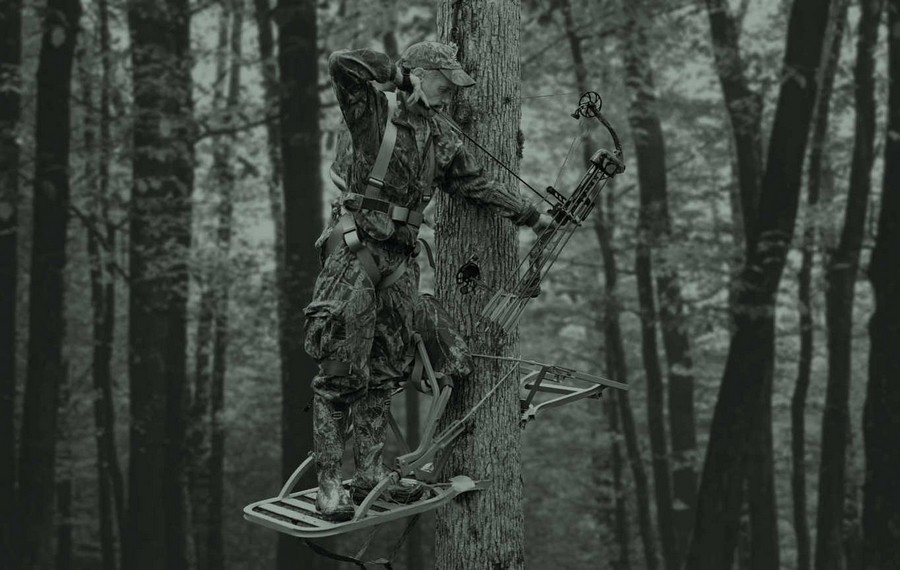
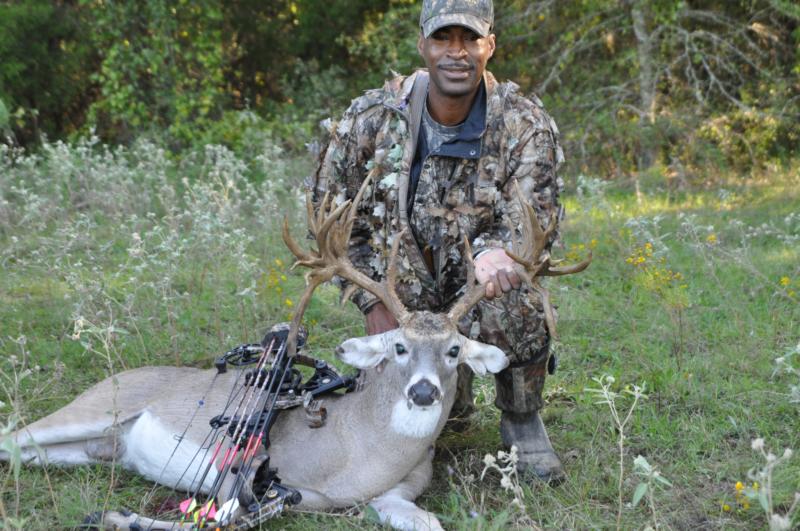
Each fall, deer hunters think of cool, brisk mornings and dream of big whitetail bucks running through the woods. Although every hunter wants to bag a monster buck, I don’t have to tell you that they are not exactly behind every tree. Especially when it comes to huge non-typical East Texas bucks. But like I always say, hunting is hunting and you just never know what will step out. Well, what stepped out for Texas Parks and Wildlife Department’s Kaufman County Game Warden Eric Minter was a big 27 point non-typical white-tailed buck. Not bad. Particulary since this is his first buck with a bow!

That’s because this past Monday (10/19/09) the Kaufman County warden found himself as the lucky hunter staring down the buck of a lifetime from his treestand hung 20 feet high in a creek bottom filled with acorn dropping white oaks. When all was said and done, it was Minter putting his own tag on a whopper 27 point non-typical buck. While there is no firm green score number on the multi-tined monster whitetail yet, photos from the buck would lead one to believe that this deer will score well above the 200-inch mark as non-typical. Well over. Continue reading “Game Warden Bags Big Non-Typical Buck”

Whitetail Rubs Revisited

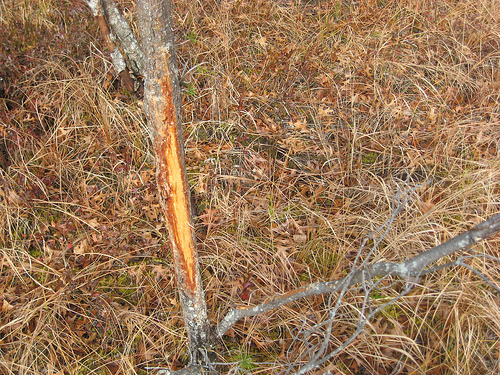
Hunters that have been out in the woods early this fall have undoubtedly bumped into some fresh rubs created by white-tailed bucks. Often times, discovering a new buck rub is enough to get my mind thinking about the deer that left the sign. How big is this whitetail? When was the animal here? Does he prefer the habitat found on this part of the property more? Where is the buck now? And, of course, will he return?

The general thinking on deer rubs is that big bucks rub actual trees and small bucks rub on saplings. This line of thinking suggests that the bigger the tree rubbed the bigger the whitetail buck doing the rubbing. Is this true? I would have to say yes, at least most of the time. The majority of bucks rubbing on larger trees are in fact larger antlered bucks. Bucks with large antlers tend to be larger bodied, mature, stronger, and as a result of all these attributes, dominant animals.  Continue reading “Whitetail Rubs Revisited”

Texas Bowhunters Wet, Whitetail Well-Fed

If Texas’ archery season had opened a few weeks ago when habitat conditions were fair to poor at best, opening weekend might have been likened to shooting fish in a barrel. Well, it probably would not have been that easy, but just a couple of weeks ago range conditions were horrible over much of the state due to severe to extreme drought conditions. A lack of rainfall had resident white-tailed deer hustling to make a living. That is no longer the case. What bowhunters found this past weekend was that they themselves were the fish in the barrel.

Bowhunters that took the field on Saturday and Sunday in search of whitetail found themselves pretty soggy. Sure, the weather opening morning was decent, but rain and clouds literally sat over most of Texas for the rest of the weekend. As a matter of fact, those rain-makers are still out there and weather forecasters are calling for more precipitation for the remainder of the week. So from a bowhunter’s perspective, the archery opener was less than ideal and I suspect deer harvests numbers were way down. Texas’ white-tailed deer, on the other hand, are knee-deep in acorns and succulent fall forbs.

Bowhunters get a soggy, acorn-rich opening weekend

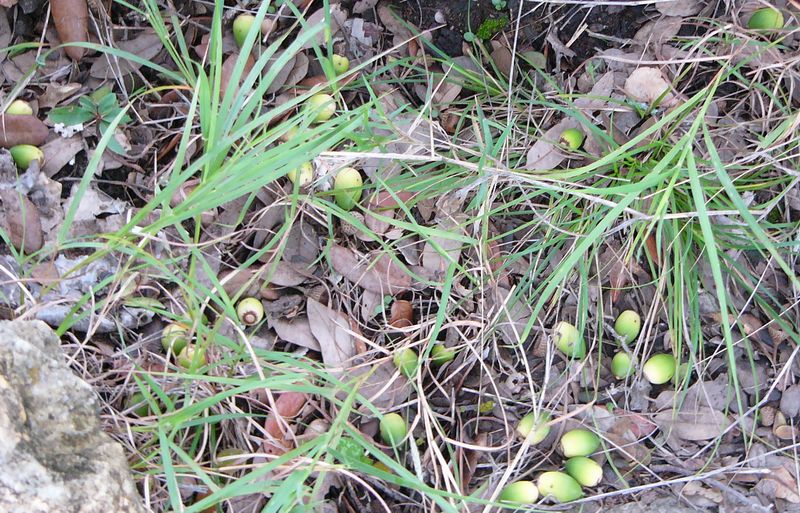
The hot, dry summer had deer scrambling in search of native forage, but recent, abundant rains have turned the once brown landscape Scotland green. Parts of Central Texas have received 12 or more inches of rain in the past couple of weeks—some in a single day! To add insult to injury, oak trees recently dropped massive acorn crops despite dry spring and summer conditions. I call it the bowhunters curse, and it happens more often than not.

Just when hunters think they have the white-tailed deer in patterned, here comes the acorns and fall forbs and then all bets are off. Well, the only thing that you can bet on is that deer will be spread out just like the food—and that if you’re set up near a feeder you will not see a deer. A heavy acorn crop combined with improved habitat conditions make it difficult for bowhunters to pin-point where deer will be feeding, unless there are only a handful of oak trees in an area. That is usually not the case.

But it’s not all bad, particularly for the deer. With fall at hand and winter around the corner, white-tailed deer need to fatten up for hard times ahead. The good acorn crop will help with that. Fifty percent of the calories a deer obtains from an acorn comes from fat; another 40% comes from carbohydrates. The timely rains have boosted habitat conditions and produced a bumper crop of cool season forbs. Forbs are high in carbs, too, but also loaded with protein—as high as 25 to 30 % digestible protein in some cases. So bowhunters may have suffered the early fall curse this past weekend, but Texas’ white-tailed deer have been blessed this fall.

Poor Nutrition: Doe Eats a Fawn?

Whitetail Doe Eats Fawn?!?

White-tailed deer have specific nutritional requirements that can be met through habitat management and by maintaining deer numbers at the carrying capacity for the area. Under these described conditions, deer can get all of the required components of their diet, including energy, protein, fat, vitamins, and minerals, that allow them to function properly. Many deer managers will even provide supplemental forage in the form of protein pellets or food plots that allow for optimal deer performance and health.
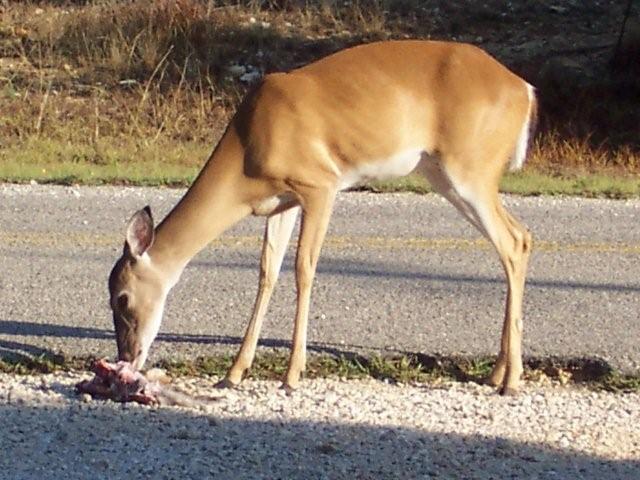
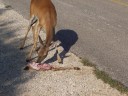
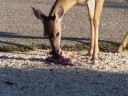
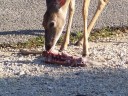
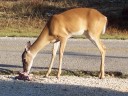
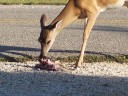
 Whitetail doe eating a road-killed fawn

But what happens when a deer’s diet does not meet their dietary requirements? The answer is simple: Deer suffer. This suffering comes in the form of lower body weights, poor body function, lowered immune systems, and sub-optimal antler growth. As far as deer are concerned, the latter is the least of their worries.

Malnourished bucks will “steal” necessary vitamins and minerals from antler growth to supply critical processes. Does will do the same sort of thing, but malnourished does will abort their fetuses during pregnancy or abandon their fawns during nursing. In short, deer that have poor diets will do things you may not expect. Such is the case in these photos of a white-tailed doe eating a road-killed fawn.

These photos are from an suburban area with a high population of white-tailed deer located near Austin, Texas. And by high, I suspect that the deer density in this area is approaching about 1 deer for every 1 to 2 acres. I don’t care where you go, that’s a very high deer density! To make matters worse, this part of Texas has been under severe drought conditions for the past year. Although high numbers of deer exist in suburban areas throughout the United States, poor environmental conditions can exacerbate the problems associated with deer overpopulation.

One deer for every one acre: I hope that no ranch ever attempts to have this many deer on a property. In most parts of the country, a good rule of thumb is 1 white-tailed deer for every 6 to 12 acres of deer habitat, depending on soil and precipitation. In central Texas, a deer would require a minimum of 8 acres of good habitat to meet its dietary requirements and achieve optimal growth. Because the doe above is found in a suburban area where deer numbers are difficult to maintain (because hunting is not allowed), the the animal can not possibly have a proper diet. The “habitat” is inadequate and, as a result, so are the food sources.

READ: Can Deer Get Mastitis?

Over the years, researchers and observers have reported that white-tailed deer are not strictly vegetarian. In areas where their normal diet is low in essential minerals (particularly calcium) deer have been reported to eat meat, in addition to bird eggs and young birds (whole) found in nests. These unusual additions to the diet are believed to be consumed when minerals are lacking, although actual vitamin requirements in whitetail are unknown, as well.

Obviously, the whitetail doe featured in these photos is not in horrible shape, but she is far from great condition. This doe was reportedly observed eating meat directly from the road-killed fawn. Although meat does not normally comprise the food habits of whitetail, this doe sensed that something she was lacking could be garnered from the flesh of this dead fawn.
Doe Management: Shoot the Smallest?

The proper harvest of animals is a critical component of white-tailed deer management. Although most conversations concerning the harvest of deer are centered around bucks, the harvest of does is just as important. After all, thinning the doe population, when warranted, will improve the buck to doe ratio, slow population growth, and keep white-tailed deer numbers at the proper carrying capacity for the habitat. The management benefits of necessary doe harvest are well documented.

But when it comes to shooting does, which ones do you shoot first? With bucks, hunters typically use antler characteristics combined with the age of the deer to identify potential cull bucks and other shooter deer. Hunters have varying opinions when it comes to buck harvest, but it’s even less straight forward when it comes to shooting does. Interestingly enough, I recently had a fellow tell me that he spares the largest does and shoots the smallest. At first I thought he was just taking a stab at becoming an “armchair” biologist, but then I started to think his theory may have some merit.

Whitetail Deer Management and Doe Harvest

The general rule of thumb in deer management has always been to shoot the oldest does first, the thought being that younger does have been sired by better bucks because of culling practices that take place year after year. The result should be younger does that are genetically better than older does because of gene recombination between better bucks and better does. If this repeatedly occurs on an annual basis, then the last fawn crop should always be genetically superior (even by a small amount) to the year prior.

So, would it make sense to shoot the smallest bodied does? Well, that’s exactly what most deer managers do when it comes to removing cull bucks. White-tailed bucks are judged not only based on their age, but also against other bucks of the same age. Almost without fail, the largest bodied bucks have the largest antlers. On the flip side, bucks that have inferior racks tend to be smaller bodied than other bucks of the same age. Could the same hold true with does?

White-tailed bucks store much of the necessary minerals used for antler formation in their bones. Although they also get a good amount of the material for antler growth from their diet, additional bone bass means the ability to store more antler-growing minerals than the next buck. This explains why larger bodied bucks have better antlers. It would also give some credibility to the “shoot smaller does” theory. A manager should want to pass on the traits for deer with large-framed bodies.

Does also play a large role in the development and initial growth of fawns through rearing, particularly milk production. It would stand to reason that larger bodied does would likely be better “providers” than smaller bodied does, with fawn numbers being equal (both with single or both with twin fawns). From a reproductive standpoint, it becomes beneficial to landowners and fawns to have does with large frames.

When it comes to whitetail deer management, it’s easier to identify potential bucks for harvest than it is does. A hunter can gauge a buck’s genes by the antlers on his head, but does lack these physical yardsticks. However, a hunter can compare does of similar age by body size. Will it really help a deer herd to have a harvest strategy that targets the smallest does? I can’t say for sure, but it makes good sense, especially if you compare does based on age.