CWD Regulations on Red Deer, Sika Deer

Texas has been keeping an eye on Chronic Wasting Disease (CWD) for a number of years now. Whitetail, mule deer and elk are known to be highly susceptible to the disease. CWD poses a significant threat to the social and economic importance of both mule deer and whitetail deer hunting in the state. State agencies have done as much as possible to safeguard CWD from entering into Texas by regulating the movement of deer through the commercial deer breeding industry, but CWD is currently knocking on Texas’s door, found just north of the Texas-New Mexico border in the Trans-Pecos region.

To complicate matters, recent findings have discovered that other ungulates can carry the disease. This has resulted in two more deer species being added to the list of “CWD susceptible” species, the Red deer and the Sika deer, both exotic species commonly found with whitetail deer on hunting ranches across Texas. The Texas Animal Health Commission (TAHC) announced that effective immediately it is has determined that Red deer (Cervus elaphus), and Sika deer (Cervus nippon) are “susceptible species” for Chronic Wasting Disease (CWD) and thereforemust meet the same entry requirements as other cervid species regulated by the agency such as moose and elk.

Deer Hunting in Texas - Red Deer and Sika Deer CWD Regulated Now

The new entry rules for Red deer and Sika deer will require they originate from herds with at least five years of participation in a herd certification program from states where CWD has been detected, and at least three years participation in programs from states that have not found CWD thus far. The TAHC decision was based in part on the disclosure that a farmed Red deer herd in Minnesota was confirmed positive for CWD in May of this year.

Additionally, the United States Department of Agriculture (USDA) released an interim final CWD rule on June 8, which designates Sika deer and Red deer as susceptible CWD disease species. The USDA rule is intended to establish minimum requirements for interstate movement of all deer, elk, moose, and other susceptible cervids, and to also establish a national CWD certification program.

Under the new deer entry requirements, besides originating from a herd with three or five year status as described above, Red deer and Sika deer shippers must also obtain an entry permit and request entry in writing. Proper supporting documentation must also accompany the request for entry at least 10 days prior to the proposed entry date. More information on TAHC entry requirements related to cervids can be found in Texas Administrative Code.

Sika Buck - Deer Hunting in Texas

Native cervid species such as white-tailed deer and mule deer are regulated by the Texas Parks and Wildlife Department (TPWD), not the TAHC. Currently those species are entirely prohibited from entering Texas based on TPWD rules. Will all of these agency regulations prevent CWD from enter Texas? The answer is definitely no, especially since a deer (probably a mule deer) carrying CWD can walk right into West Texas. The bigger question is, “Will CWD ever severely impact deer hunting in Texas?” That I do not know, but I’m definitely in favor of slowing the spread of CWD and waiting as long as possible to find out.

Deer Nutrition Key for Better Hunting & Fawn Survival

A Look at Deer Nutrition

Rainfall (received or not received) during the first half of the year dictates deer hunting season. Although the rains dried up recently, many areas received good amounts of rain throughout the late-winter and early-spring. This will generally improve deer nutrition. However, it’s almost summer and more often than not it’s dry. Strong spring rains equate to better than average body condition in all deer and enhanced antler growth in bucks.

Summer rains are an appreciated bonus and can provide stable nutrition for whitetail deer herds during what is often a hot and dry stress period. The best way to manage for disappearing forage is through supplemental feeding. Thanks in a large part to the rain received this spring, in addition to the abundance of high protein forbs it produced, many deer managers reported sharp declines in protein consumption by deer. This is good for the pocket books and good for the deer, too.

Deer Hunting and Fawn Reproduction Depends on Whitetail Deer Nutrition

“Supplement” to Improve Deer Nutrition

When it comes to quality, nothing competes with the nutrition offered by high quality forbs and new-growth browse. Forbs are weeds and wildflowers. Browse is the leaves, stems and twigs of woody plants. These foods are the best of the best, often packing high protein levels that make pelleted feeds look weak in comparison. Currently, good habitat conditions exists around the state. However, I have a feeling that things get really dry all over again. Now is the time when the “supplemental” part of supplemental feeding comes into play.

Dietary supplements for deer compliment foods naturally available. This helps improve deer nutrition during stress periods. Do not use supplements to provide everything a whitetail needs. Otherwise, that’s called complete feeding. If this is the case, it’s time to reduce the deer population.

Looking at Nutritional Stress

Does start dropping fawns in late-May over much of the whitetail’s range. However, most of the fawns drop during the month of June in Texas. Supplemental forage, which includes pelleted protein, whole cottonseed, roasted soybeans and food plots (irrigated or otherwise), help compliment deer nutritional requirements during the summer. Many provide supplements to deer to increase antler growth. Hunters like big bucks. More importantly, scientific data says supplemental feeding elevates deer productivity and survival, which increases the density of the deer population.

Healthy deer results in an increase in deer density (after fawns are born). This can be correctly diagnosed through deer surveys performed during the late- summer, then properly treated through harvest during the deer hunting season. However, from a nutritional standpoint, early-May is a long way from the fall.  Fall is the next boom of natural foods, but deer nutrition can wane during the summer, especially in Texas.

Deer Habitat Important for Fawn Production

Summer, like winter, is a tough time of the year for deer. It’s important to keep in mind because the the most expensive nutritional part of a doe’s annual cycle is in raising fawns. Mother Nature has already provided for all of her needs to date, but it’s going to get worse before it gets better. A lactating doe that is on a high plane of nutrition can be expected to raise more or at least more healthy fawns. With temperatures heating up and fawns about to drop, this is also the time of year when doe greatly benefit from supplementation.

Rainfall Provides Nutrition

A wet spring season means a strong start to the year for deer. Good spring rains provided a bounty of foods for native wildlife and domestic livestock. Even without another drop of rain (hope not) until the fall, habitat looks better for deer than they did in 2011. Deer in many areas improved in body condition through the fall and winter thanks to heavy acorn crops, mild temperatures and good rains. However, it did make for tough hunting.

READ: Management to Improve Deer Nutrition

If the trend of favorable environmental conditions continues through the spring, then I suspect hunters experience a really good deer hunting season. Let’s hope we catch a few rains throughout the summer to help get these deer through to the other side. Manage livestock grazing to preserve fawning habitat and to bank valuable deer browse into the summer. Again, it’s been a good year to date, which is good for antler growth and fawn production. That’s all good for hunters!

CWD in Texas?

Chronic wasting disease (CWD) is basically the “mad cow disease” of elk, mule deer and white-tailed deer. CWD is not new; the deer disease has been on the radar of state wildlife departments for decades. CWD was first diagnosed in 1967 in a captive herd of mule deer in Colorado and not long after was found naturally occurring in that state as well as Wyoming. It was not until 1996 that the deer disease was found outside of that area. It was at that time when many states started monitoring for the highly contagious CWD.

Hunters are always concerned about wildlife diseases, especially the highly infectious ones such as CWD, that impact game animals. It is also the responsibility of state and federal wildlife agencies to reduce the transmission of all wildlife diseases while attempting to learn more about the problem. Wildlife management – deer management specifically – is about taking the steps necessary to react to an ever-changing environment to reach certain objectives. One of the biggest variables for whitetail deer is food availability, but most hunters control for this factor through deer harvest, food plots and supplemental feeding.

CWD in Whitetail Deer: The Disease May be Found in Texas Soon

More variables = more unknowns. A higher number of variables makes it increasingly difficult to manage for a desired result. CWD has not shown to be the end all of whitetail populations in any area, but it is another variable that does negatively impact deer populations in areas where the disease is found. CWD can drastically reduce a local deer population, but not all animals necessarily die from the disease. In Texas, CWD monitoring has taken place for over a decade, but no positive samples have ever been found. That may be about to change.

Source: “The New Mexico Department of Game and Fish (NMDGF) has informed Texas officials that three mule deer harvested a few miles from the Texas border last hunting season have tested positive for Chronic Wasting Disease (CWD).

The deer were harvested in the Hueco Mountains, which extend into Texas northeast of El Paso in Hudspeth County. New Mexico has been monitoring annually for CWD since it was first discovered 10 years ago and this event is the closest to Texas that the disease has been detected. Texas also has had an active CWD surveillance program for the past decade, and CWD has not yet been detected in the state. However, state wildlife officials have been preparing for the possibility since 2002.

“While this finding is not a big surprise, we’re not going to ignore it,” said Mitch Lockwood, Big Game Program Director for the Texas Parks and Wildlife Department. “We are working with TPWD’s Wildlife Health Working Group to develop a more intensive strategy for sampling, and to determine the geographical extent of the disease if it is detected in Texas.”

The Wildlife Health Working Group is comprised of wildlife biologists, veterinarians and other animal-health experts from TPWD, Texas Animal Health Commission, Department of State Health Services, Texas A&M College of Veterinary Medicine, and USDA. The New Mexico Department of Game and Fish is also involved in the discussion.

While several thousand deer have been tested for CWD in Texas, wildlife officials express concern that the Trans Pecos region is underrepresented because of the very low number of deer and the relatively low deer harvest in that region. Samples are obtained from hunter-harvested deer, deer found dead on public roadways, and deer showing clinical symptoms. TPWD is determining how many more deer need to be sampled and deer hunters in the region could be asked for their assistance during the next hunting season.

“We are using disease models to determine the intensity of sampling that would be required to detect CWD in that deer population if it is present with a prevalence of at least two percent,” said Ryan Schoeneberg, Big Game Program Specialist with TPWD.

CWD was first recognized in 1967 in captive mule deer in Colorado and has also been documented in captive and/or free-ranging deer in nearly two dozen states and Canadian provinces, including New Mexico. Although fatal in deer, there is no evidence that CWD poses a risk to humans or livestock in the natural environment.

“It would be almost impossible to eradicate the disease once it becomes established in a population,” said Lockwood. “But, what we can do is manage the disease and minimize the risk of it spreading.”

CWD is a member of the group of diseases called transmissible spongiform encephalopathies (TSEs). Other diseases in this group include scrapie in sheep and goats, bovine spongiform encephalopathy (BSE or mad cow disease) in cattle, and Cruetzfeldt-Jakob disease in people. CWD is a progressive, fatal disease that affects deer, elk, moose, and other cervid species and there is no vaccine or other biological method that prevents it.”

Deer Aging: Whitetail Aging Chart Uses Tooth Measurement

Hunters interested in producing and growing bigger, more healthy whitetail understand that active deer management is the key to long term success. An important component of a successful deer hunting and management program is being able to accurately age white-tailed deer, specifically bucks.

The selection of bucks suitable for harvest is most often performed by aging deer on the hoof in the field, but that determination is often evaluated by aging harvested deer using the tooth wear and replacement method. Neither of these methods are foolproof.

Determining Age of Live Deer

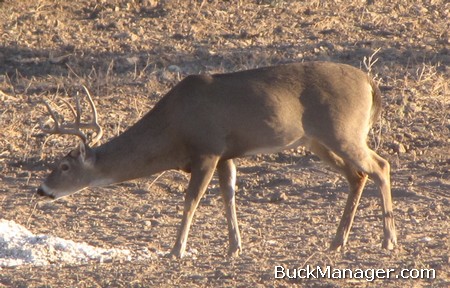
Aging deer on the hoof relies on the observer being able to objectively judge an animal based on physical characteristics. It’s an acquired skill that hunters can get better with over time, but its’ not perfect. This technique can be enhanced by allowing observers more time to look at individual animals, which is often accomplished using game camera photos placed in feeding areas.

Numerous photos from various angles usually allow a hunter to get a good idea of deer’s age before even heading to the field. Observation of the animal before or during the deer hunting season can then be used to confirm or reject the armchair evaluation of the deer’s age.
Deer Hunting - Deer Aging for Whitetail Deer Management

The tooth wear and replacement technique is most commonly used on dead deer, although persons involved in the legal trapping and transporting of wild deer as well as commercial deer breeders may use the method on live deer. There are, however, a number of variables that can impact tooth wear in deer.

The teeth of whitetail found living over sandy soils will wear quicker than those found living over clay soils. Deer that eat a lot of protein feed will wear down slower too. But like most things that require skill to get better, confidence and consistency with the deer aging technique takes time. So is there a better way?

Tooth Aging Chart for South Texas Deer

Source: Researchers at the Texas AgriLife Research and Extension Center in Uvalde have developed a more accurate technique than traditional methods for estimating the age of white-tailed bucks. When owners or managers know the true age of harvested deer on their ranch, it improves their ability to predict the age of live deer on that property.

“South Texas is famous for producing trophy white-tailed deer,” said Dr. Susan Cooper, AgriLife Research associate professor and lead investigator for the new age-estimation research. “Large-antlered deer sell for very high prices, so harvesting a good buck before it reaches its prime or after it begins to decline can represent a significant loss of income to the producer.”

“The traditional method for estimating the age of white-tailed deer has been by visual, tooth-wear patterns,” Cooper said. “This method – known as the Severinghaus technique – was developed using northern deer and is inaccurate for estimating the age of wild deer in Texas beyond the rough categorizations of young, mature or old.”

The new technique also relies on using the animal’s teeth, but involves measuring the width of the dentine — the hard tissue located under the enamel of a tooth — on a specific tooth.

Cooper said over the past 10 years the wildlife team at the Uvalde center has ear-tagged more than 2,000 wild buck fawns on South Texas ranches. During the past decade, ranch owners and operators have kept tabs on ear-tagged deer, collaborating with the center on deer-related research. “When these bucks are harvested, the partner ranch returns any known-age jawbones from tagged deer to us for evaluation and assessment,” she said.

Cooper said research assistant Shane Sieckenius had noted that an actual measurement of tooth wear would be superior and more accurate than a basic visual scoring system would be in aging white-tailed deer.

After discussion and evaluation, the team determined the first permanent molar would be the tooth which was most likely to show age-related wear patterns. Using digital calipers, they took accurate measurements in millimeters of tooth height, as well as all ridges of white enamel and brown dentine on the tooth from jaw samples of harvested known-age bucks 2.5 to 7.5 years old.

“We wanted to see if we could go to just one location in the jaw to reduce the amount of variability of age-related wear within the jaw,” Sieckenius said. “This particular tooth was consistent in showing the true indication of wear.” Cooper said evaluation of measurement data revealed that only the width of the dentine in the tooth’s cusps, pointed ends of the chewing surface, was related to the age of the deer.

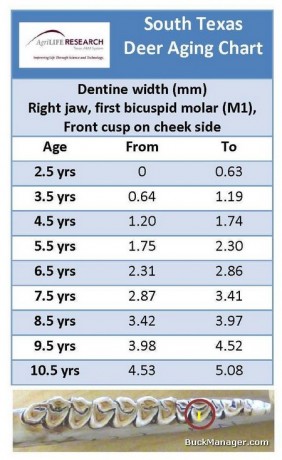
“The best measurement fit for aging was the width of the dentine, which we gave the value D, in the front cheek-side cusp of the first molar on the right side of the jawbone,” she said. “This provided us with the relatively simple formula for estimating age: 1.8 times D, plus 1.8.”

She said the only equipment needed for the study was the digital calipers, which can be purchased from major online retailers for as little as $20 each. “To save doing the math, measurements can be compared to a simple chart that we have developed and will make available to landowners,” she said.
Deer Aging Chart for Deer Hunting and Management

“You have to get the jaws good and clean before measuring, so in our case we boiled the jaws thoroughly to ensure they were free from any tissue, decay or foreign objects that might hinder obtaining an accurate measurement,” Sieckenius said.

Cooper said when tested on a sample jaws of 141 bucks, the formula predicted the correct age for 61 percent of young bucks aged 2.5 to 3.5 years; 53 percent of mature bucks aged 4.5 to 6.5 years, and 25 percent of old bucks aged 7.5 to 8.5 years. She added that all animals were correctly aged within one year of their actual known age.

For comparison, Cooper said, 27 wildlife professionals and students were asked to age samples of the same jaws using traditional visual tooth-wear measurements.

“They estimated the correct age for 40 percent of young bucks, but only 18 percent of mature bucks and none of the old bucks,” she said. “This means the new technique – which we have named the AgriLife Dentine Method – of aging deer provides much greater precision in aging harvested deer.”

Sieckenius said the new aging technique will be of particular interest to ranchers and hunting lease owners who wish to harvest deer at a specific age.

“This new measurement process is very interesting,” said Jim Hillje, a wildlife consultant for many South Texas ranches and a former Texas Parks and Wildlife biologist. Recently, Sieckenius traveled to Encinal to demonstrate the new technique to Hillje and Jeff Pierce, manager of the 7-1 Ranch in Webb County.

“It’s good to have a more precise way of aging a particular deer, and this new method works well in conjunction with the buck ear-tagging we’ve been doing for several years to confirm the deers’ age.”

Hillje said while he is satisfied that the new technique is an improvement in age-estimating methodology, the down side of current age-measurement techniques is the difficulty in applying them to live deer specimens.

“Landowners want to harvest deer at their maximum antler potential,” Sieckenius said. “Some want to harvest them at five years old and some farther south may prefer to harvest when they’re closer to six years old. We’re giving them a means by which to maximize that potential so they can get the most for their hunt.”

The AgriLife Dentine Method of aging deer does provide measurable physical factors for the aging of harvested deer, but the fact remains that the deer must be in someone’s hands, and dead. The method will accurately determine the age of an animal 60 percent of the time or get within one year of age. With this stated, I’m not convinced that this way is really any better than the old-standby Severinghaus tooth wear technique.

Review of the Deer Aging Chart

The technique uses measurable tooth wear, kind of a modified Severinghaus method, so the new deer aging technique will only be applicable to those deer hunting in South Texas or in areas that have very similar soil and habitat conditions to South Texas.

As mentioned earlier, there are many factors that can impact tooth wear in deer. Soil type, plant communities, supplemental foods and even genetics can affect tooth wear in individual animals. This techniques is still far from perfect, but could offer value to those with little experience aging dead deer.


QDMA Says No to Deer Breeding

The breeding of white-tailed deer has been a controversial issue from the very beginning. After all, the commercialization of any game animal is always a touchy subject. To add gasoline to the fire, almost all breeder deer are produced, grown and harvested behind high fences – another subject of debate in many hunting circles. Even though deer breeding and all of the activities associated with it are legal based on state regulations, the whole situation does not sit right with a number of deer hunters.

Enter the Quality Deer Management Association. The QDMA is well known, especially throughout the Southeastern US, for providing information on deer management and is a long-time supporter of increased antlerless deer harvest. This organization has made inroads with deer hunters and landowners over the years by providing guidance on population and habitat management for white-tailed deer. Now the QDMA is taking a stance on whitetail deer breeding in the US: They do not like it.

Deer Hunting: QDMA Opposes Deer Breeding Legislation

QDMA: “The Quality Deer Management Association (QDMA) is urging hunters in seven states to oppose the expansion of the deer breeding industry, which QDMA perceives as a growing threat to wild deer and the deer hunting heritage. Legislation designed to loosen or dismantle regulatory barriers to white-tailed deer breeding and farming is being considered in Georgia, Indiana, Mississippi, Missouri, North Carolina, Tennessee and West Virginia.

“There are no benefits for deer hunters in the growth of the captive deer breeding industry – only risks,” said Kip Adams, QDMA’s Director of Education & Outreach and a certified wildlife biologist. “It is QDMA’s mission to protect the future of white-tailed deer and our hunting heritage, and we oppose anything that puts those at risk.”

In opposing the proliferation of “deer breeding,” QDMA is referring to captive deer facilities where controlled, artificial breeding technology is used primarily to produce whitetail bucks with enormous, often grotesque antlers – an industry that includes sales of semen, artificially impregnated does, and live bucks to other breeders or to captive deer shooting facilities. Current estimates suggest there are nearly 10,000 deer breeding operations in North America, and the number is growing as the industry pushes to expand into areas where it was historically not legal.

“Some argue this is an innocent endeavor with no negative impacts to wild deer or the everyday deer hunter. As CEO of North America’s leading whitetail conservation organization, I emphatically and unapologetically disagree,” said Brian Murphy, QDMA’s Chief Executive Officer. “Not only does this industry undermine the North American Model of Wildlife Conservation in which wildlife is a public resource, it also threatens the health of wild deer and the public’s perception of hunting.”

The distribution map of chronic wasting disease (CWD) – a fatal disease of deer and elk – suggests the disease likely arrived in several new states through transportation of live deer, either legally or illegally, and not through natural deer movements. Legalizing deer breeding in new areas increases the incentive for illegal transportation of untested animals at a time when these human-aided movements must be stopped. Transporting any captive whitetails is risky, as there is no acceptable and practical live-animal test for CWD in deer. Once CWD appears in wild deer in a new area, slowing the spread of the disease requires costly investigation, testing and surveillance efforts for many years and often requires drastic reductions in deer populations. There is currently no known way to decontaminate an environment once CWD is present.

In more than 40 states, regulatory authority over captive deer facilities is held by state agriculture agencies, or shared between agriculture and wildlife agencies. QDMA recommends that wildlife agencies have sole responsibility because they have more experience with wildlife species and wildlife disease issues, and they fully understand what is at stake with regard to transmission of diseases like CWD to free-ranging deer.

“QDMA’s current effort is to halt expansion of the deer breeding industry,” said Adams. “We also want sole jurisdiction for existing facilities to remain with or be reassigned to state wildlife agencies. Considering the implications for our hunting heritage, we can’t afford to allow this industry to expand. The ramifications of being wrong are simply too great.”

QDMA is currently urging resident hunters to oppose existing or potential legislation in the following states:

Georgia: House Bill 1043 – Legalizes the importation of live whitetails into Georgia for breeding purposes and creates a permitting system for deer-breeding operations, all under the jurisdiction of the state Department of Agriculture. Current status: House second-readers as of February 22.

Indiana – House Bill 1265 – Provides for the licensing and operations of hunting preserves on which farm-bred, captive deer and elk will be hunted. Current Status – Senator David Long (President Pro Tempore) refused to hear the bill. It remains in committee.

Mississippi – Senate Bills 2554 and 2555 – Legalizes importation of captive deer, semen and embryos and authorizes deer breeding facilities, under the jurisdiction of the state agriculture department. Current Status – Both bills referred to Wildlife, Fisheries and Parks Committee on February 20.

Missouri – House Bill 1375 – Adds deer to the definition of “livestock” for the purposes of the state sales and use tax law, meat inspection law, Missouri Livestock Disease Control and Eradication Law, and the Missouri Livestock Marketing Law. Current Status – House second-readers as of February 22.

North Carolina – Currently at the proposal stage; no bill number yet. The spoken intent is to loosen regulations to allow for expansion of the captive deer industry. A QDMA staff member will attend a board meeting with the North Carolina Wildlife Resources Commission in Raleigh on March 7 on this topic.

Tennessee – House Bill 3164 – Present law classifies white-tailed deer as Class IV wildlife, which may only be possessed by zoos, temporary exhibitors, and rehabilitation facilities. This bill adds authorization for possession of white-tailed deer by breeding facilities that receive a permit from the Department of Agriculture to breed or ranch such livestock for purposes determined by the Department. Current Status – Placed on calendar for Agriculture Committee for March 6.

West Virginia – Senate Bill 421 – Captive Cervid Farming Act – Transfers regulatory authority over captive white-tailed deer facilities from the Division of Natural Resources (DNR) to the Department of Agriculture. Current Status – referred to Rules Committee on February 17.

Texas: In my home state, white-tailed deer breeding has become common place, with well over 1,000 registered breeder operations. It’s important to reiterate that deer breeders can only start a breeding facility by buying deer from other registered breeding operations. The rearing of pen-raised deer is one thing, but I suspect the QDMA is more concerned about how those animals are handled (hunted) after the leave a commercial facility. Is the idea and the heritage of “deer hunting” threatened by shooting pen-raised animals?