Habitat Management: Managing Grasslands for Deer

Managing Grasslands for Better Deer Habitat

There are numerous methods for land managers to improve the value of the white-tailed deer habitat found on their property. Habitat management is the foundation of managing whitetail. Hunters and land managers often contact me to ask about ways to enhance habitat for white-tailed deer, but that is a wide-open question with an answer that will vary widely between properties.

If the plan is to help deer and other wildlife on your land then the very first thing should be to take inventory of what you do have. What assets does the property currently provide for deer and other wildlife?

More often than not, the plant communities found on a farm or ranch offer more than one might expect. There is value in just about every plant when it comes to wildlife in general, but obviously some specific plants are better for deer than others. Before we get too far along, let me clarify a couple of the terms that I’ve already used. Plant communities and habitat are two different things. Most animals, whitetail included, require a number of plant communities to comprise the habitat that they need.

Plant Communities & Deer Habitat

Examples of plant communities would be forest, grassland, marsh, riparian (river/creek) area. The collection of plants that comprises each plant community is often different from one another (though some plants can be found in different communities). We could even get more specific and have oak forest and pine forest or tallgrass prairie and shortgrass prairie.

Wikipedia: Plant community is a collection of plant species within a designated geographical unit, which forms a relatively uniform patch, distinguishable from neighboring patches of different vegetation types. The components of each plant community are influenced by soil type, topography, climate and human disturbance.

Now that we are on the same page, let’s talk specifically about grassland communities in terms of habitat management for white-tailed deer.

Managing Grasslands for Deer Foods

Whitetail are not cows. Grass does not make up a large part of a deer’s diet. Whitetail really only eat grasses when the grasses are very young, palatable and often most nutrient-rich. This is even the case in food plots that are planted to small grains such as oats an wheat. Deer use them readily when the plants first begin grow. As long as deer continue to feed in the plots they are steadily provided with new growth, but will shy away from them once the plants become more mature.

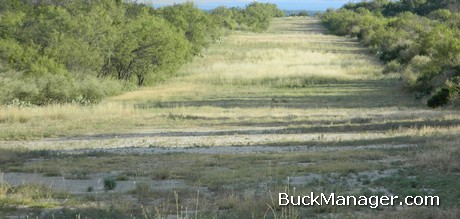
So grasslands are of little value, right? Wrong. Although grasses tend to dominate grasslands (that’s obvious), grasses are not the only plants found there. Forbs (weeds) are also found in these areas and are typically in high supply during the spring and fall or just about anytime when there is enough rain. When we see deer in a pasture it is often the forbs they are eating, not the grass.

Deer habitat management should include manipulation of native grasslands and pastures to promote more foods. Plant succession is the change in species structure of an plant community over time. Low succession plants offer a higher food value for deer and other wildlife, namely seed eating songbirds, Bobwhite quail and doves. Managers can promote early succession forbs within un-grazed grasslands by disking and/or mowing at least 10 percent of their open land each year, either just before Spring or Fall.

Managing Grassland Habitat for Whitetail Cover

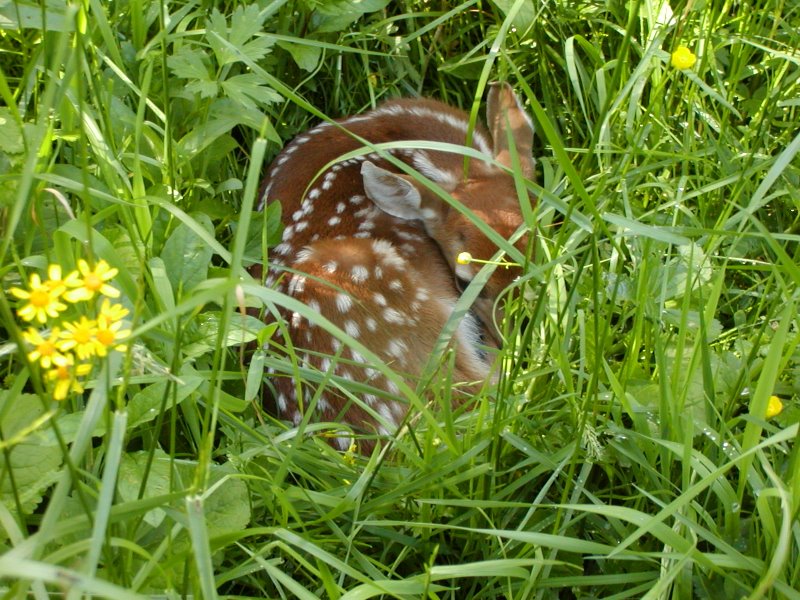
If deer do not eat grass then why have it at all? Well, it does provide decent screening cover for adults and it’s used heavily by fawns. Grass is a commodity that is, unfortunately, not always readily available on on properties. On lands that graze cows using a continuous grazing system composed of one herd and one pasture then often there is just not a lot of grass cover at all. A rotational grazing system is best for the habitat when it comes to the management of white-tailed deer.

Cows are an automatic, biological mower and disk combined. Not only do cows consume much of the grass but their hooves disturb the soil, both actions that promote forb growth. As long as the cows are rotated off the forbs have their day in the sun and then the grasses grow back.

The problem with a pasture that is only a few inches tall is that it neither provides screening cover for adults nor resting cover for fawns. In some areas, tall grasses (~3-feet) can provide a significant amount of screening cover for deer. Think of areas like the Texas Panhandle, Oklahoma and western Kansas. This is also true in farm country, especially during the winter months, when deer need just a little cover to facilitate movement.

Grass Cover, Fawns & Deer Hunting

At the time of writing, it’s mid-May and there have already been a number of reports of fawns on the ground. Good grass cover is critical for their survival as well as future deer hunting opportunities on your land. It takes good deer habitat to produce and recruit white-tailed deer year after year. It’s key that you learn how to improve deer habitat on your hunting property if you are interested in managing whitetail.

Proper management of grassland communities should be a part of an overall habitat management plan. Deer need a little bit of everything in terms of major plant communities, and healthy grasslands add both food and cover. Small changes can make big differences of properties of any size when it comes to managing white-tailed deer habitat.
Contraception for White-tailed Deer Management in Developed Areas

Contraception for Deer Management

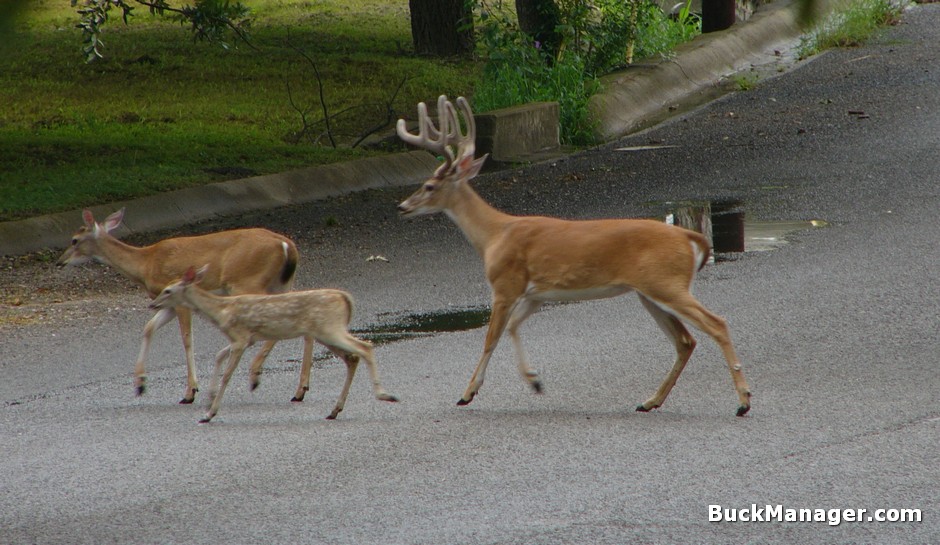
Much of what we discuss on this site concerns managing white-tailed deer populations for optimal health, which leads to increased fawn survival and improve antler growth. That’s great for hunters and sustainable, rural deer herds, but people living in suburban areas that chock-full with overabundant deer have a completely different perspective when it comes to whitetail management—and the number one objective there is to decrease the deer population.

It’s interesting that deer herd reduction is the common prescription for two goals that are just about 180 degrees from one another; managers are aiming to produce more and healthier deer while deer management in developed areas is strictly about reducing deer numbers, deer reproduction.

Deer Birth Control?

A lot of the people that live in suburbs are a bit different than the folks that live out in the country. I understand that plenty of deer hunters find themselves living in the ‘burbs, but it’s important to realize that only about 5 percent of the US population actually hunts. That means the overwhelming majority of Americans, which could be you or the bulk of your neighbors, do not. Nothing wrong with that (because there is already a lot of competition for hunting lands), but since we are in America everyone gets to have their say, right or wrong. Case in point: Birth control for a free-ranging deer herd.

Suburban Deer Management: Contraception and Birth Control Do Not Work

Source: “My decision to pursue this is ultimately a practical one. If it works, we will finally have accomplished what other communities have failed to do and found a non-lethal approach to the deer issue that would work in a dense village like ours,” Swiderski said.

Swiderski said the five-year study, which also involves the Cummings School of Veterinary Medicine at Tufts University in North Grafton, Mass., will cost the village about $10,000 this year and possibly less next year.

Researchers hope to treat 60 deer this year and during the next two winters, and to continue to monitor them. Captured does — tranquilized first with a drug-filled dart — will have a numbered ear tag attached, blood drawn for a pregnancy test and an initial vaccine dose. Known as PZP, the vaccine uses a doe’s immune system to stop her eggs from being fertilized.

But after about a week of looking for deer, Naugle and Grams had tagged and treated just one. They can fire at deer no more than 20 yards away with their air-powered rifles, and they are still learning where the animals spend their days.

“It’s a slow process. But next year, by the time we come back here, we’ll have everything figured out,” Naugle said.

Contraception for Free-Ranging Deer

To get to the point, contraception does not work on free-ranging white-tailed deer herds. It barely works on captive deer herds because of either the inability to get an appropriate dose of birth control to the deer on a daily basis or because enough of the deer can not be “treated” within a short enough period of time (i.e. more females are added annually). In this case, I’m going to have to claim insanity for this town because the most telling words in the entire article were these, “If it works, we will finally have accomplished what other communities have failed to do…”

It’s a shame to throw away good money. If anyone who reads this lives in an area with overabundant deer, whether you are a community leader looking to control the deer population or now simply an informed citizen, stand up and let your neighbors know that contraception for deer does not work unless you are willing to build a deer-retardant fence that is at least 8-feet tall around the problem area, then drastically reduce the population through either deer hunting or trapping, and then maybe there is at least a chance that some type of birth control can work.

If all of that is not an option, then the most cost-effective way to control suburban deer populations is through regulated hunting. Unless you have unlimited resources, hunters are your only hope. Be nice to them.

White-tailed Deer Management: Habitat on the Edge

White-tailed deer do quite well in a variety of areas. They’re always found in association with forests or woodlands of some type, but the plants that make up their habitat vary quite substantially across their range. While out searching for sheds this morning, I noticed a family group comprised of an old doe, a middle-aged doe that was probably one of her fawns from a few years back and a couple of last year’s fawns (now yearlings). They had a fair amount of plants at their disposal, but they were feeding at a point where the woodline butted up against grassland, an edge.

We all know that a huge component of deer management is creating, having and maintaining good habitat. Habitat is kind of a big idea. Although property owners and hunters that manage for deer want to have good habitat for the animals in an area, I’m not sure deer think about it the same way we do. Habitat is made up of a variety of plant communities, such as woodlands mixed with pastures or grasslands, riparian areas and maybe even agriculture fields and the such. No matter the types of plant communities, white-tailed deer are always attracted to the edges. Continue reading “White-tailed Deer Management: Habitat on the Edge”

Deer Hunting with Drones

Deer Hunting with Drones?

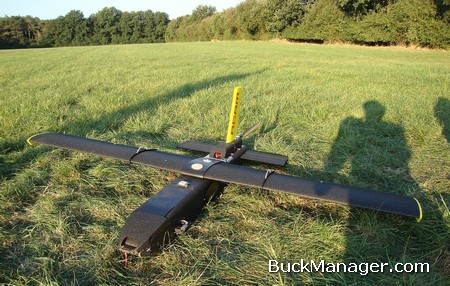
The use of drones for all sorts of things continues to increase. But, what about deer hunting with drones? Like me, I bet most think deer hunting with drones is a bad idea. However, some think drones add an exciting element to finding and hunting deer, especially big bucks. Starting to sound sketchy yet? I see some legitimate applications for using drones for deer surveys and other wildlife management activities.

If you’re like me, then at least part of the reason you head out hunting is to get away from technology, not to use it while out in the field hunting deer. Admittedly, I do use motion-triggered game cameras to document deer using the areas that I hunt. That sounds like an unmanned, immobile drone.

Deer Hunting with Drones?

In case you missed it, the Boone and Crockett Club release their official position on the use of of unmanned drones for hunting white-tailed deer and other big game animals. As you may have already guessed, B&C is not in favor of hunters using advantageous, real-time views from the sky to bag their bucks.

B&C Club: No Drones

Source: Trophies scouted or taken with the assistance of drones/unmanned aerial vehicles (UAV) are not eligible for entry in Boone and Crockett records, the Club announced today. “These highly sophisticated, remote-controlled aircraft have no place in fair-chase hunting,” said Richard Hale, chairman of the Club’s Big Game Records Committee.

“The Boone and Crockett Club stands with state wildlife agencies, the Pope and Young Club and hunter-conservationists everywhere who are discouraging the use of drones in hunting.”

In the early 1960s, the Boone and Crockett Club barred trophies taken with use of aircraft. “Spotting or herding game from the air, followed by landing in its vicinity for the purpose of pursuit and shooting” was deemed unethical. The Club’s policy spawned regulations in Alaska and elsewhere designed to protect the integrity of hunting and
conserve game.

Hale said Boone and Crockett is always on alert for new technologies that could erode the time-honored traditions of fair chase. Fair chase is defined by the Club as the ethical, sportsmanlike and lawful pursuit and taking of any free-ranging wild, native North American big game animal in a manner that does not give the hunter an improper advantage over such animals.

No Deer Hunting with Drones

Hunting in it’s purest form has always been about trying to kill something to eat. Deer hunting with drones seems far removed from such a simple idea. The thought of scouting with drones makes sense on some level, but it also sounds weird. Envision the western skies full of drones looking for the biggest mule deer, elk or pronghorn.

A lot of value gets put on the largest-antlered or largest-horned animals by recreational hunters. Here’s a thought: Do we blame hunters or B&C?

BUCK FEVER – Reporters Take an In-Depth Look at Whitetail Deer Breeding and Hunting Industry

Without a doubt, white-tailed deer hunting in the US has changed dramatically over the past few decades. That initial interest in deer management spurred both hunters and property owners to get involved doing things to help whitetail, which over time lead to the development of better habitat, monitoring of deer populations on private lands, harvest management and ultimately better, bigger deer. The benefits of whitetail management are numerous, but the one take-home-point on top of everyone’s head is that bucks on managed properties grow larger antlers.

Ask any deer biologist and they will tell you that there are a multitude of factors involved when it comes to managing a deer herd for trophy bucks. And that’s the truth, if someone is managing a deer herd. But what if that someone is just managing individual deer? Well, that simplifies things. Or does it? The topic of commercial deer breeding is a hotly debated topic within the deer hunting community, around campfires, on internet hunting forums and at family reunions. The non-hunting community, which vastly outnumbers hunters, also has its eyes on those involved in deer breeding and hunting.

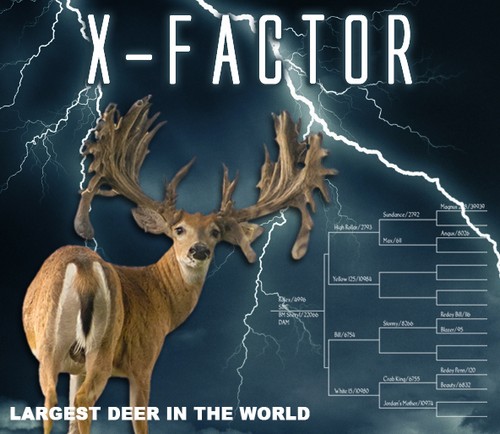
X-Factor: Are Mega-Bucks Good for Deer Hunting?

The following article, based on a self-proclaimed 18-month in-depth investigation, states that the commercial deer breeding industry is entirely responsible for the spread of deer diseases and is costing tax payers, both those that hunt as well as those that don’t, millions of dollars each year. It’s definitely interesting reading material.

Source: “It looks like a caricature of a deer, this dainty white-tailed buck whose neck slumps under the weight of the gnarled antlers sprawling from its head. This is X-Factor, an Indiana deer that in his prime was worth an estimated $1 million. His value as a stud comes not from research and not from the quality of his venison. Instead, his value is in those freakish antlers, the product of more than three decades of selective breeding.

In less than 40 years, a relatively small group of farmers has created something the world has never seen before — a billion-dollar industry primarily devoted to breeding deer that are trucked to fenced hunting preserves to be shot by patrons willing to pay thousands for the trophies.

An Indianapolis Star investigation has discovered the industry costs taxpayers millions of dollars, compromises long-standing wildlife laws, endangers wild deer and undermines the government’s multibillion-dollar effort to protect livestock and the food supply.

To feed the burgeoning captive-deer industry, breeders are shipping an unprecedented number of deer and elk across state lines. With them go the diseases they carry. Captive-deer facilities have spread tuberculosis to cattle and are suspected in the spread of deadly foreign deer lice in the West. More important, The Star’s investigation uncovered compelling circumstantial evidence that the industry also has helped accelerate the spread of chronic wasting disease, an always-fatal deer disease similar to mad cow. CWD now has been found in 22 states.

CWD’s spread roughly coincides with the captive-deer industry’s growth. In half of the states where CWD was found, it first appeared in a commercial deer operation. Officials in Missouri, Nebraska, New York and Canada think captive deer or elk introduced the disease to the wild.

So far, government programs have failed to halt CWD’s spread, largely because there is no reliable way to test live animals for the disease. So infected deer may be shipped into disease-free states, where they can infect other animals, captive or wild. The Star’s investigation uncovered examples of deer escaping from farms, shoddy record keeping and meager penalties for those caught breaking the rules, which further undermine state and federal efforts to contain the disease. Plus, in less than a decade, more than a dozen people have been charged with smuggling live deer across state lines.

Although CWD’s risk to humans is considered minimal, scientists say it’s unwise to allow it to spread unchecked. No human is known to have contracted CWD. But scientists and government health officials say the chances of it jumping the species barrier to humans, as they suspect mad cow did, increase as more deer are infected.

In the first comprehensive examination of the growth and associated risks of deer breeding and farming by a major newspaper, The Star submitted public records requests to all 50 states and the federal government, reviewed at least 20 studies and conducted more than 100 interviews.

What emerges is a picture of an industry made up of at least 10,000 farms and hunting preserves in the U.S. and Canada, a boutique business that’s part livestock and part wildlife and often falls into a regulatory gap between agriculture and natural resource agencies. And, when it comes to hunting deer in fenced preserves, the owners are often free to set their own rules. Read the rest…