Mountain Lion Really Killed This Buck

Mountain Lion Dragging Buck

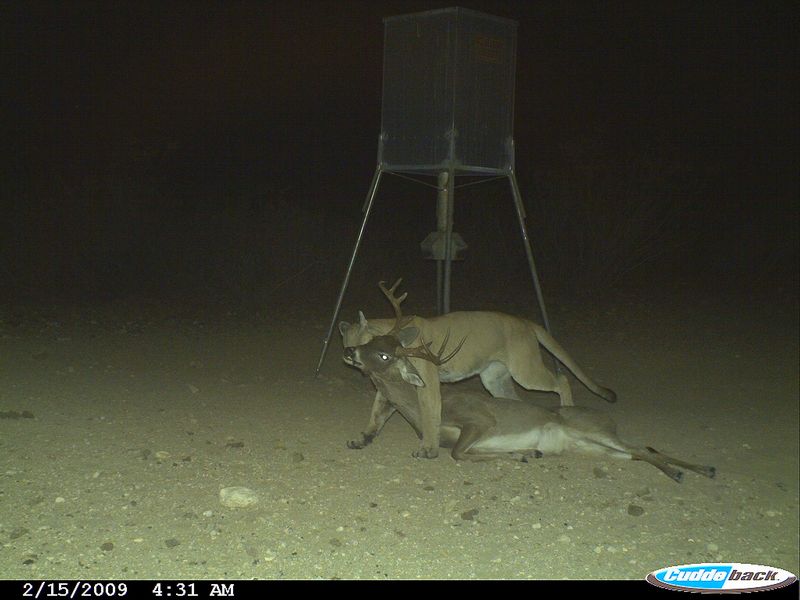
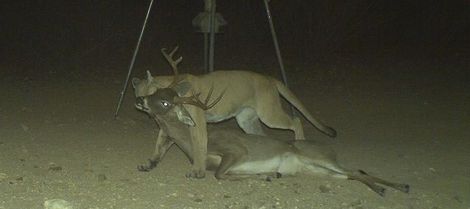
Have you seen the game camera photo of a mountain lion that killed a buck at or near a feeder?  It seems quite amazing that the lion and his kill were caught on camera. However, the mountain lion dragging buck photo appears to be legit. It’s rather lucky photo for the owner of the game camera, but not as fortunate for the buck.

Readers of this site know that I normally write about deer management and anything related to hunting white-tailed deer. In addition, I do my best to get the facts correct before publishing content that I feel is accurate and helpful to hunters and landowners managing the deer and habitat found on their hunting properties.

Well, about a month ago I wrote an article that featured the photo below. It’s a perfect game camera photo of a mountain lion dragging a dead buck directly in front of a feeder. It seemed so perfect, I stated that surely the photo was a fake. As it turns out, the mountain lion dragging a buck photo is not fake. Rather, it’s an actual, amazing trail camera photo taken on a ranch in South Texas.

 This photo caught a mountain lion near a feeder after killing a whitetail buck

Mountain Lion Kill Caught on Camera

Every deer hunter that has spent any amount of time in the woods, or more appropriately around a campfire with other hunters, has heard stories related to mountain lion sightings.  This can include the alleged black panther sightings that your buddy/uncle/friend/nephew claims he saw, too. The stories always get better as the night goes on.

One of the best things about getting outdoors and into the wildlife woods is that you really never know what you are going to see. And speaking from experience (and the mountain lion photos further below), there are some amazing things going on outside all of the time. After all, nature never really sleeps.

Photos, like campfire stories, are not always truthful. Before writing the first article about this photo of a mountain lion dragging a buck, I did a little research regarding the photo. If this photo had been faked, it would not have been the first. To make a long story short, someone initially admitted that they had “made” the photo. Just to get some attention, someone actually claimed to have faked a real-to-life photo. Wow.

Mountain Lion Dragging Buck After Kill

As it turns out, the real owner of the mountain lion photo saw the article, contacted me, gave me the real story that took place on his South Texas property and even provided me with additional photos to corroborate the mountain lion kill.

The ranch owner even said he found the whitetail buck’s head and remains about 6 weeks after these game camera photos were taken. He confirmed that the buck had been killed by the lion.

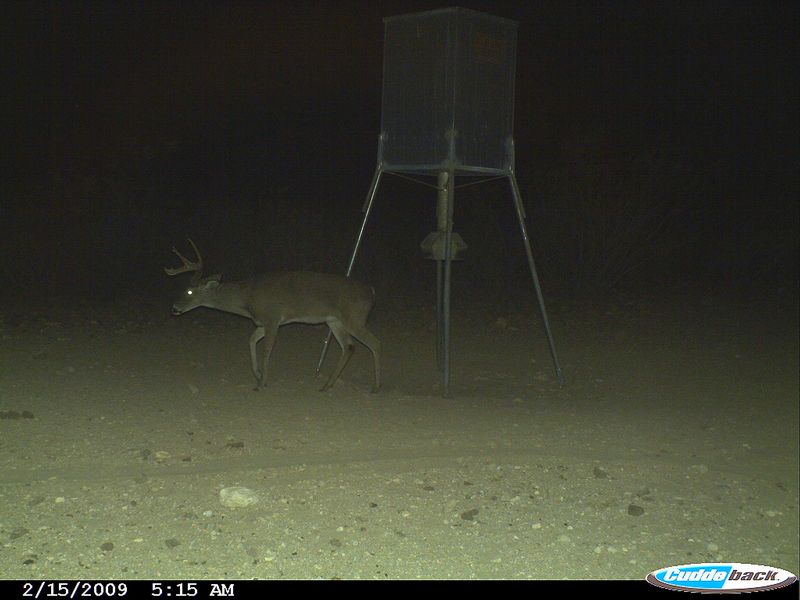
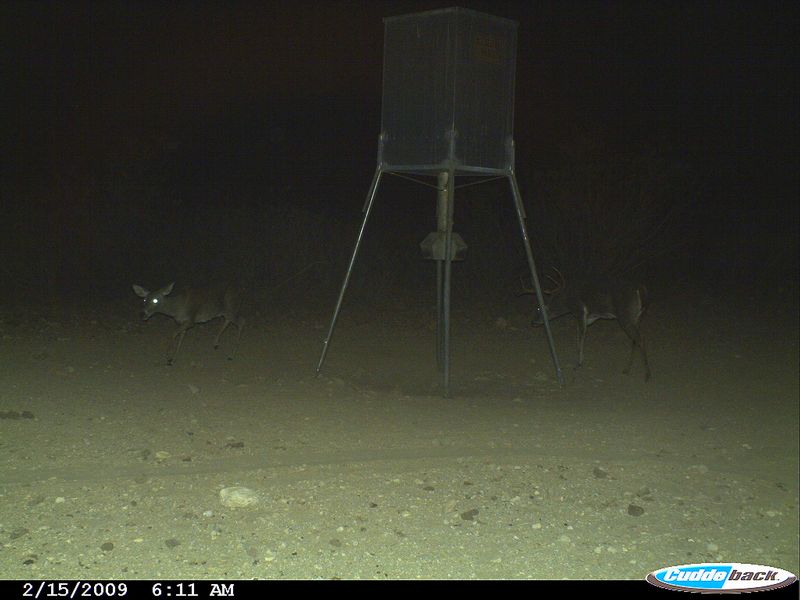
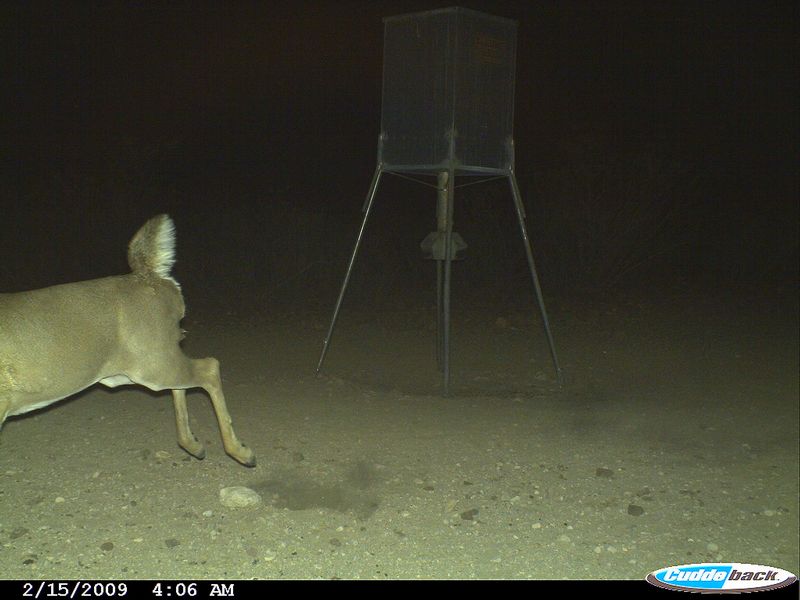
The photos below are in time succession and show a deer fleeing the area prior to the buck being killed. You can even see the drag marks in the dirt after the mountain lion walks right in front of the game camera.  A truly remarkable occurrence, especially since it was caught on film. A special thanks to Chet Markgraf for his story and these photos!

Photos Document Lion & Whitetail Buck

Mountain Lion Kills Whitetail Buck

Mountain Lion Dragging Buck in Photo

Mountain Lion Attacks Buck

Mountain Lion Kills Buck at Feeder

Video: Mountain Lion Kills Deer

Hunting Land in Texas is Shrinking

The popularity of white-tailed deer hunting in recent decades has not only spurred an increase in deer management, but also a greater demand for deer hunting lands. And since everyone in the United States lives in a supply and demand economy, the price of whitetail hunting has continued to rise year after year. Unless a hunter owns his or her own property, they either know someone who does (that lets them hunt) or they are forced to lease private land for deer hunting.

If you’ve looked for a lease lately you know that quality hunting leases are getting harder and harder to find. In addition, many have found themselves priced-out of deer hunting. So what if I told you that the amount of huntable land in Texas could decline because of new legislation?

Deer Management at Buck Manager: New hunting laws possible in Texas

Well, Senate Bill 1742 and House Bill 3766 could do just that, to some extent, by increasing the buffer area between hunting lands and “occupied” areas. In short, this legislation proposes to increase the minimum size of a huntable tract with a rifle from 10 acres to 50 acres. Not only could this legally prohibit some hunters from hunting their own property because of suburban sprawl, but these new laws would also inhibit the ability of landowners to control white-tailed deer numbers, particulary in the Texas Hill Country. Continue reading “Hunting Land in Texas is Shrinking”

TPWD Adopts New Deer Hunting Regulations

An important part of any ranch’s deer management program is informed and proper harvest. Without sufficient population data, improper white-tailed deer harvest is inevitable, and management objectives will never come to fruition. Managing proper harvest often means managing deer hunters.

At the big ranch called Texas, the Texas Parks and Wildlife Commission has adopted a series of hunting regulations that expand special buck antler restrictions and liberalize doe harvest opportunities in dozens of Texas counties. The new rules take effect during the 2009-10 hunting seasons.

Citing strong support for the changes during the public comment period, Texas Parks and Wildlife Department (TPWD) staff said the new regulations reflect a shift toward biologically-based communities for managing deer populations. One of the biggest changes involves further expansion of the department’s successful antler restriction regulations into 52 additional counties where biologists have identified a need to provide greater protection of younger buck deer.
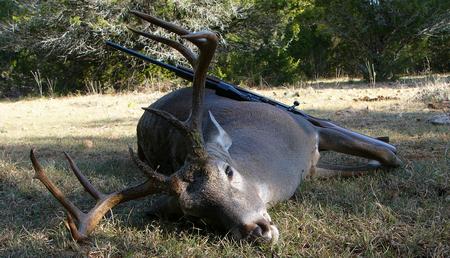
Texas gets new Deer Hunting Regulations

According to Clayton Wolf, TPWD big game program director, the antler restrictions have significantly improved age structure while maintaining ample hunting opportunity, based on data to date in the 61 counties where the rule is currently in effect. New counties under the antler restrictions regulation this fall include: Anderson, Angelina, Archer, Atascosa, Brazos, Brown, Chambers, Clay, Cooke, Denton, Ellis, Falls, Freestone, Grayson, Grimes, Hardin, Harris, Henderson, Hill, Hood, Hunt, Jack, Jasper, Jefferson, Johnson, Kaufman, Liberty, Limestone, Madison, McLennan, Milam, Mills, Montague, Montgomery, Navarro, Newton, Orange, Palo Pinto, Parker, Polk, Robertson, San Jacinto, Smith, Stephens, Tarrant, Trinity, Tyler, Van Zandt, Walker, Wichita, Wise, and Young.

In addition, the department got overwhelming support to increase whitetail bag limits in several areas of the state with growing deer numbers or populations sufficient to support additional hunting opportunity. The department is increasing the bag limit in most Cross Timbers and Prairies and eastern Rolling Plains counties from three deer (no more than one buck, no more than two antlerless) or four deer (no more than two bucks and no more than two antlerless) to five deer (no more than 2 bucks).

Counties affected include: Archer, Baylor, Bell (West of IH35), Bosque, Callahan, Clay, Coryell, Hamilton, Haskell, Hill, Jack, Jones, Knox, Lampasas, McLennan, Palo Pinto, Shackelford, Somervell, Stephens, Taylor, Throckmorton, Wichita, Wilbarger, Williamson (west of IH35), and Young.

The department is increasing the bag limit from four deer to five deer in Pecos, Terrell, and Upton counties. The justification for this change is that white-tailed deer densities throughout the eastern Trans-Pecos are very similar to densities on the Edwards Plateau, where current rules allow the harvest of up to five antlerless deer.

Another change increases the bag limit from three deer to five deer (no more than one buck) in selected counties in the western Rolling Plains. Counties affected include: Armstrong, Briscoe, Carson, Childress, Collingsworth, Cottle, Crosby, Dickens, Donley, Fisher, Floyd, Foard, Garza, Gray, Hall, Hardeman, Hemphill, Hutchinson, Kent, King, Lipscomb, Motley, Ochiltree, Roberts, Scurry, Stonewall, and Wheeler.

The department also extended whitetail hunting from 16 days to the full general open season in Dawson, Deaf Smith, and Martin counties (three deer, no more than one buck, no more than two antlerless). Increased deer estimates equate to longer and more liberal deer hunting seasons.

Areas of the state having sufficient doe populations that warrant additional hunting opportunity will be getting more doe days this fall: from 16 days to full-season either-sex in Dallam, Denton, Hartley, Moore, Oldham, Potter, Sherman and Tarrant counties; from 30 days to full-season either-sex in Cooke, Hardeman, Hill, Johnson, Wichita, and Wilbarger counties; from four days to 16 days in Bowie and Rusk counties; from four days to 30 days in Cherokee and Houston counties; from no doe days to four doe days in Anderson, Henderson, Hunt, Leon, Rains, Smith, and Van Zandt counties.

The department is also expanding the late antlerless and spike season into additional counties. Counties affected include: Archer, Armstrong, Baylor, Bell (West of IH35), Bosque, Briscoe, Callahan, Carson, Childress, Clay, Collingsworth, Comanche, Cooke, Coryell, Cottle, Crosby, Denton, Dickens, Donley, Eastland, Erath, Fisher, Floyd, Foard, Garza, Gray, Hall, Hamilton, Hardeman, Haskell, Hemphill, Hill, Hood, Hutchinson, Jack, Johnson, Jones, Kent, King, Knox, Lampasas, Lipscomb, McLennan, Montague, Motley, Ochiltree, Palo Pinto, Parker, Pecos, Roberts, Scurry, Shackelford, Somervell, Stephens, Stonewall, Tarrant, Taylor, Terrell, Throckmorton, Upton, Wheeler, Wichita, Wilbarger, Williamson (West of IH35), Wise, and Young. In Pecos, Terrell, and Upton counties, the season would replace the current muzzleloader-only open season.

In East Texas, the department is establishing a special muzzleloader season in additional counties, lengthening the existing muzzleloader season by five days to be equivalent in length with the special antlerless and spike buck seasons in other counties, and altering the current muzzleloader bag composition to allow the harvest of any buck (not just spike bucks) and antlerless deer without permits if the county has “doe days” during the general season.

New counties affected include: Austin, Bastrop, Bowie, Brazoria, Caldwell, Camp, Cass, Cherokee, Colorado, De Witt, Fayette, Fort Bend, Goliad (North of HWY 59), Goliad (South of HWY 59), Gonzales, Gregg, Guadalupe, Harrison, Houston, Jackson (North of HWY 59), Jackson (South of HWY 59), Karnes, Lavaca, Lee, Marion, Matagorda, Morris, Nacogdoches, Panola, Rusk, Sabine, San Augustine, Shelby, Upshur, Victoria (North of HWY 59), Victoria (South of HWY 59), Waller, Washington, Wharton (North of HWY 59), Wharton (South of HWY 59), and Wilson.

TPWD also added one additional weekend and 10 additional weekdays in January to the current youth-only deer season. They also established a one buck only, antlerless by permit, nine-day mule deer season for Parmer County — the first ever deer season for that county.In other action, the commission approved a temporary, indefinite suspension of the current lesser prairie chicken two-day season in October until population recovery supports a resumption of hunting.

With all the changes, TPWD is encouraging hunters to check the Outdoor Annual of hunting and fishing regulations for county and species specific rules before going afield this fall. The annual will be available online and wherever hunting licenses are sold beginning August 15.
Last Shot at Finding Shed Antlers

Spring has officially sprung and although a few white-tailed bucks may still be holding onto last year’s antler growth, the vast majority of bucks have already shed their antlers. The timing of an individual buck’s antler development depends upon many things, but the primary factor is the buck’s hormone levels. In short, areas where local deer populations breed earlier always shed antlers earlier. And although looking for deer sheds is not an important part of a deer management, it can be awfully fun!

This is an exciting time of the year, not only because whitetail bucks are beginning to grow new velvet-covered antlers, but also because their antlers from last year are lying on the ground… somewhere. A lot of hunters may have their spring food plots in the ground or their supplemental protein feeders filled, but then neglect to get out in the field during the spring. I was once guility of this. Following the close of deer season I would just shut her down and stay out of the field until mid-summer, but that was many years ago.

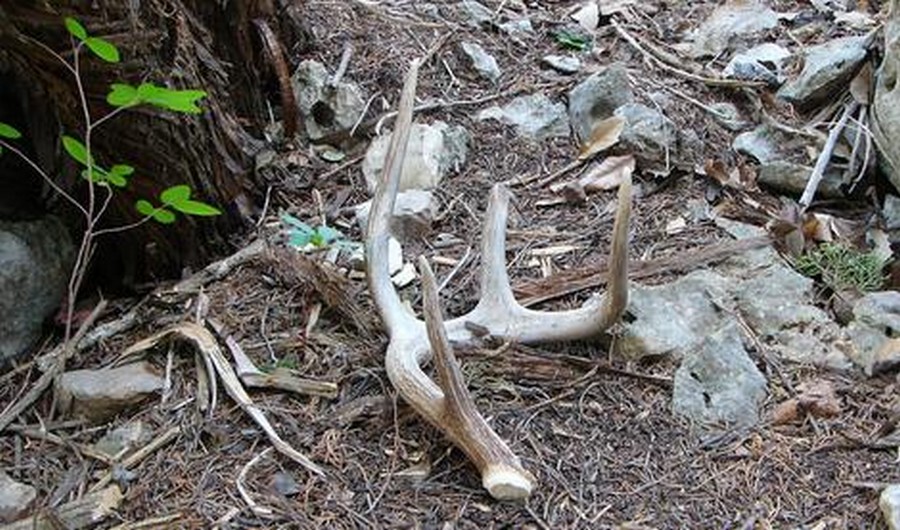
Finding shed antlers can be fun and informative

Since that time, early spring has become one of my favorite times to get out into the deer’s world. Not only can I get a good assessment of late-winter habitat use, but I have waited long enough that most bucks have shed the last year’s antler growth. And that gives me my best chance at finding a few shed antlers. With short green grass, sparse brush, most antlers laying on the ground, and favorable weather, early spring is my best opportunity to cover some country and see what I can find.

The best spots to find shed “horns” year-in and year-out continue to be food plots, in the general area around supplemental feeders, watering sources, draws, woodlines, and well-traveled corridors. In areas with thick brush cover, I always have good success in tree-covered (closed canopy) areas with an open understories (no brush), primarily because deer often use these spots as bedding areas. In fact, two of the four whitetail sheds I found yesterday were in these types of areas. The other two were along woodlines, where the edge of a wooded area turned into open field.

Since finding shed antlers is not always easy, especially in an area with a low deer density, it is a good idea to look in areas that you think deer reguarly visit. Yesterday, I spent 2 1/2 hours of continuous walking who-knows-how-many miles and covering an untold number of acres to find 4 sheds, and one of those was from the year prior. And this was even after narrowing down my search to areas that I believed deer frequented. Of course, I have spent longer days in the field looking for sheds and have come back with less, often zero.

But yesterday I found 4 sides, no matches, and none of them were exceptional by any stretch of the imagination. It was still enjoyable, and there is always something about standing exactly where something notable happened, at least in a buck’s life anyway. Currently, the deer is without his most notable defenses. His testosterone levels are low, there is no need to battle for receptive does, and the buck has started a new antler growing cycle.

The next time I stand over his antlers they may still be attached.

Expanding Deer Hunting Opportunities in Grayson County

Deer Hunting in Grayson County

With an estimated statewide deer population of 4 million animals, many Texas hunters take white-tailed deer hunting for granted. However, there are still parts of the state where gun-hunting seasons does not exist. For example, the use of firearms for deer hunting in Grayson County is not allowed. That regulation may change soon.

The Texas Parks and Wildlife Department (TPWD) is considering a proposal to open a general firearms deer season in Grayson County. A public scoping meeting to gather additional landowner and hunter feedback is scheduled in Grayson County on Thursday, January 8, 2009.

Grayson County Judge Drue Bynum has been invited to open the meeting. TPWD Executive Director Carter Smith will facilitate the remainder of the meeting, which will include a short presentation on TPWD’s regulations process. In addition, TPWD will explain the rationale for contemplating a gun deer season in Grayson County.

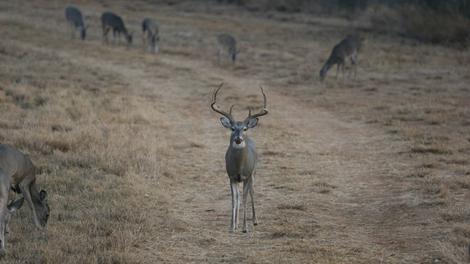
Large scale deer management is achieved through hunting regulations

The Grayson County general firearms deer season issue is part of an extensive suite of potential regulation changes in deer harvest TPWD is considering throughout much of the state. Like many state wildlife departments, TPWD uses hunting regulations to manage hunter harvest on a county level to achieve statewide deer management goals.

Due to increases in deer numbers across the state, and the continuous decline in the average number of animals harvested per hunter, TPWD has proposed more liberal hunting regulations for white-tailed deer over the past few years.

The meeting will take place at Grayson County College’s Center for Work Place Learning Auditorium near Sherman. The auditorium will open at 6 p.m. and the public meeting will begin at 7 p.m. All comments will be recorded and used for the final decision, which will take place at a public commission meeting at TPWD Austin headquarters on March 25-26, 2009. By the next season, those deer hunting in Grayson County may have another option soon.