Importance of Dominant Bucks in Breeding

Dominant Bucks & Breeding

It was once thought that large, mature bucks dominated the breeding in deer herds. The premise was that the largest individuals would successfully defended all receptive does (does that are in estrous) from other bucks in the area. Of course, genetic testing came along and that allowed researchers to identify what exactly is happening out there in the woods. During the breeding season whitetail bucks search for individually receptive does. And understand this, it is not uncommon for a buck to court a doe for up to a day prior to her being receptive and then breed her repeatedly over the 24 to 36 hours (while she is in estrous).

The buck then searches for another doe and repeats the process. Therefore, bucks that successfully breed may spend as much as 24 to 48 hours with a single doe before looking for another. Due to the time spent with an individual doe, and because the most does in a balanced population are bred over a relatively short time frame, a single buck just can not monopolize the breeding.
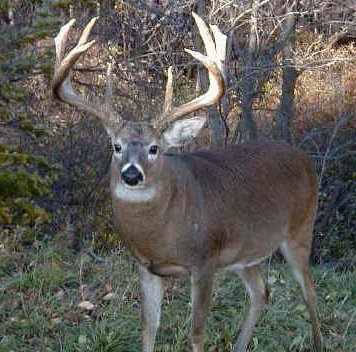
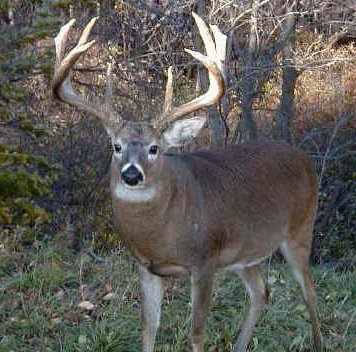
Mature buck

Whitetail Bucks & Breeding

In a Texas study, the most prolific buck sired six fawns in a single year. In another study, successful bucks averaged less than three fawns per year over an 11-year period. Similar research in Michigan found that 17 bucks sired 67 fawns for an average of 3.9 fawns per buck. Individual bucks sired anywhere from one to nine fawns in her study, so everybody is in the game. This just shows that “dominant” bucks don’t monopolize the breeding. And this may surprise you, but bucks don’t even sire all of the fawns from each doe they breed.

One study revealed multiple paternity occurred in about 24 percent of compound litters (twins and triplets). Approximately one in four sets of twins or triplets had two fathers! This further shows that does are breeding with multiple bucks, which further clarifies that individual whitetail bucks do not monopolize breeding.

Buck Harvest & Breeding

All the bucks on a property participate during the breeding season. This fact makes selective harvest of a buck herd that much more important. In addition, in deer populations with balanced sex ratios it also ensures most does are bred during their first estrous cycle,. As a result, fawns will be born during optimal fawning dates the following spring.

The important thing to remember is that young bucks do in fact participate in some of the breeding, but mature bucks do most of it in populations with good age structure. But then again, if you have more mature bucks, then you naturally expect them to do more of the breeding. Past research showed bucks 3½ years of age and older sired 70 and 85 percent of fawns, respectively, in populations with reasonable age structure and sex ratios.
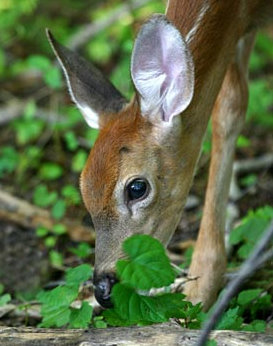
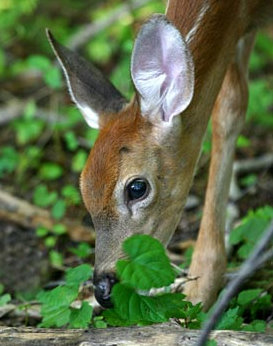
Deer Over Abundance in Wisconsion

Deer are certainly an important and enjoyable part of the Pheasant Branch Conservancy and other conservancy areas throughout the City of Middleton, Wisconsion. Indeed, deer are wonderful, beautiful, wild animals which people seem to love to watch and feed. White-tailed deer are also an important part of an even greater plan, an ecosystem more complex than we can ever imagine. So what happens we deer overpopulate their habitat?

As agricultural lands disappear and our urban areas continu to grow, the telltale signs of an overpopulated and un-balanced urban deer herd will be exhibited everywhere through the loss of native plant species (trees, shrubs and herbaceous plants), damage to private residential vegetation (trees, shrubs and herbaceous shrubs), and an increased number of car-kill deer accidents within associated suburban and urban areas.

Maureen Rowe, DNR , a Wildlife Biologist for the Dane County Area, sums it up best by stating:

"The deer herds within management units 76 and 76M, are severely over populated. Scientific studies document that current deer population levels threaten microhabitat, severely impacting native flora and fauna."

Food Habits – What Whitetail Deer Eat

What do deer eat? Deer eat mostly browse (leaves, twigs, shoots of woody plants and vines) and forbs (weeds and other broadleaf flowering plants). They do eat some grass, but only when it is young, green, and succulent. Sheep, goats, and exotic game species compete directly with the whitetail for preferred deer foods. Deer food shortages usually occur during late summer and winter months.

Adequate forage is usually available during the spring and fall seasons because of mild temperatures and increased rainfall. A variety of foods and habitat types is essential to good deer production and survival.

Deer eat a variety of plants, and different plant species become more important at different times of the year and importance can even vary year-to-year depending upon environmental conditions. The following plants are examples of some good deer foods which are readily eaten by deer when and where they are available.

What exactly do deer eat?

Browse:oak leaves and acorns, yaupon, greenbriar, hackberry, mulberry, sumac, hawthorns, poison oak, American beautyberry, wild cherry and plum, wild grape, honeysuckle, dogwood, elm, blackberry and dewberry, acacias, walnut, and chinaberry.The will utilize additional plants species depending upon the area you are located.

Forbs: Illinois bundle flower, euphorbias, bayflower, tickclovers, clover, verbena, wild lettuce, wild onions, old man’s beard, wildbean, snoutbean, lespedezas, spiderwort, vetches, lamb’s quarters, plantain, groundcherry, pigweed, carelessweed, and partridge pea.

Grasses: rescue grass, wintergrass, witchgrass, panic grasses, sedges, and rushes, as well as wild and cultivated rye, oats, and wheat.

Hunting for Shed Deer Antlers

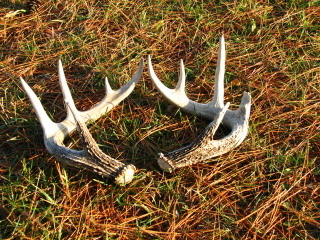
Hunters hunting for shed deer antlers has become a big event in recent years. People search for antler sheds for various reasons and some of those folks are not even hunters. Some want to find shed deer antlers to make various items out of… lamps, knives, etc. And then there are those that are serious about finding shed antlers for buck tracking and management purposes.

Hunting for Sheds

Finding shed antlers (especially both sides) allows the finder to rough-score the bucks to get a good idea of current and future quality. In addition, finding a particular buck’s antlers can let you know if he’s made it through the winter or if he’s still in the area. Also, finding numerous shed antlers over years on a particular piece of property allows you to gain knowledge regarding the areas that bucks are frequenting.

Shed deer antlers

Finding a Buck’s Shed Antlers

So, where are the best places to look? The basics are simple. Look for shed antlers in winter food sources, in bedding areas and along trails in between these two areas. These are the best locations to run across a shed, but timing is of the greatest importance. Start too early in the season and you’ll find nothing. Starting too late means antlers will either be partially or entirely eaten by small mammals and other rodents or vegetation will be well-grown, making antlers even more difficult to find.

So when?

Of course, antler drop varies by region and even likely even within parts of your state. I recommend keeping an eye on the deer herd or using a game camera to document when bucks are losing their head-gear in your area. Then it’s just a matter of getting out there and putting in some time. Good luck!

Sausage Making: A Few Recipes for the Hunters

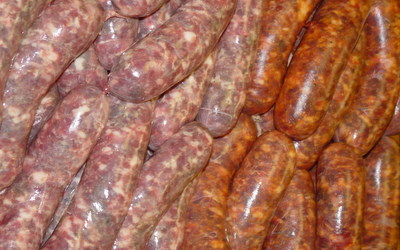
Ready to make some sausage are you? Congratulations, that means you managed to bag some sort of critter this hunting season! Well, you’ve put in the time and effort to bag your wild game, you took care of the animal in the field and got it home, and now it’s time to create a finished product.

Sounds great, so check out the following recipes:

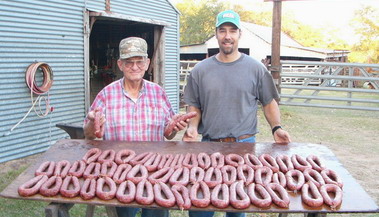
Each year after we harvest a couple of deer, my family and I will get together and make sausage. This is an annual event, typically starting with a wood duck hunt in the early morning and then getting back to the house in short order to get to work making sausage.

We commonly make sausage out of deer and wild hogs, but you can do a lot of substitution when in comes to making sausage. Usually, our sausage mix is about 50% deer and 50% wild or store-bought pork. Sometimes when we don’t manage to bring porky home, we will also subsitute in beef brisket in place of the pork. This works quite well and what we end up adding to the sausage usually just comes down to what is on sale that week.

Sausage Making: A Few Recipes for the Hunters

You can be imaginative when it comes to sausage making, we’ve even used geese, ducks, and turkey – and they have all turned out great! Venison is lean, so you are definitely going to want to add some fat to give your sausage some moisture and make it better table fare. I recommend making a sausage that is about 85% meat and 15% fat.

The following recipe is one that we use and is based on 5 pound increments so that you can easily adapt it to fit the quantity of sausage that you are making. After mixing, stuffing, and tying, you are ready to smoke it.

Basic Sausage Recipe

5 pounds boneless meat of your preference
2 Tablespoons black pepper
1 Tablespoon + 1 teaspoon salt
1 Tablespoon garlic powder
1 teaspoon modern cure

Sausage Making: A Few Recipes for the Hunters

Summer Sausage

The basic sausage recipe above can also be used to make summer sausage. The only difference is that you need to add at least one more ingredient to the mix. Add 3% nonfat dry milk (by weight) to the mix and this will make the sausage “gel.” If you are making 10 pounds of summer sausage, then you need to add 0.3 pounds of nonfat dry milk.

Also, you can add in other ingredients to kick it up, but this is best determined by personal preference. Whole black pepper, mustard seed, jalepenos, and cheese can be added to your summer sausage recipes to give them a kick. I usually just add whole black pepper and I do this until it “looks” right.

Breakfast-pan Sausage

This is a great pan sausage to eat for breakfast and even works great in chili. This can be made from your 50/50 deer and pork mix or from straight pork. Use the basic sausage recipe, but DO NOT use modern cure. In addition, add 2 Tablespoons of ground sage for every 5 pounds of meat and you are done. Simply grind and pack for the freezer!