More Black Deer Spotted in Texas

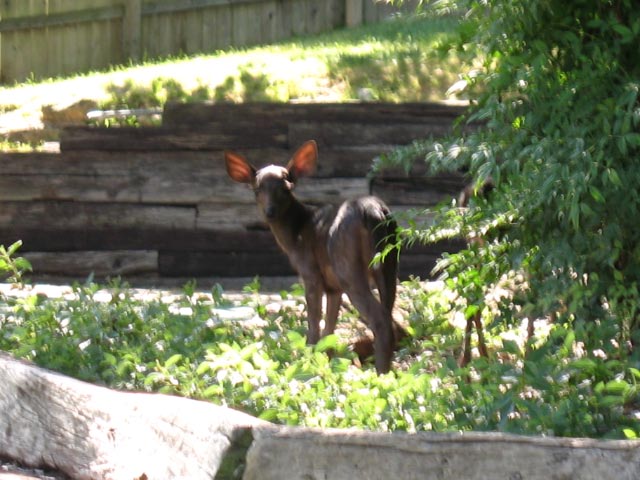
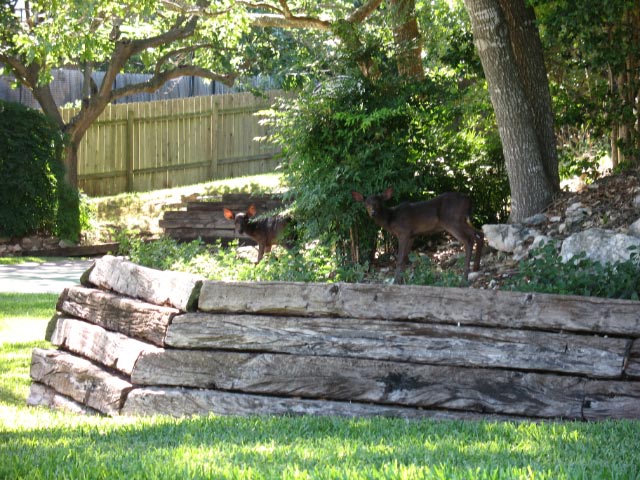
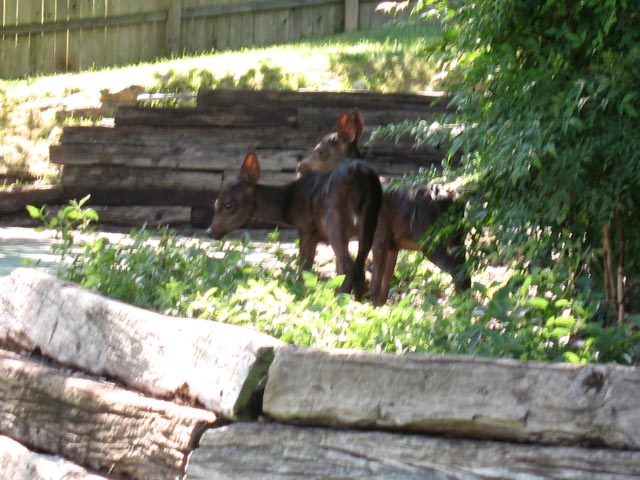
While “black” deer, more accurately referred to as melanistic deer, are very rare across North America, it seems they are being spotted more frequently in central Texas. A few weeks ago I posted some photos of a melanistic buck in Austin, Texas, but it seems that animal is not the only white-tailed deer in the area with a color abnormality. Just check out the photos of these twin white-tailed deer fawns that were taken in the Northwest Hills area of Austin.

Dr. John Baccus, director of the wildlife ecology program at Texas State University, has been studying melanistic deer for over 13 years now. And as it turns out, Texas is a good place to study the dark colored deer. That’s because there just happens to be more black deer in eight Texas counties than in the rest of the world combined!
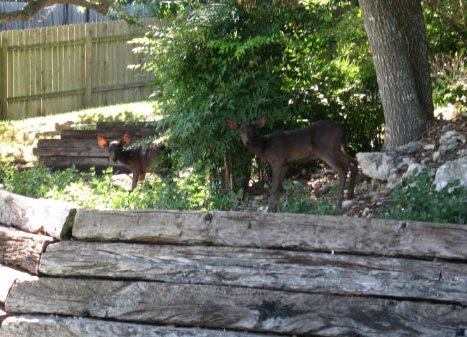
 “Black” white-tailed deer fawns

Black Deer are Really Rare

And as staggering as that statistic may be, most Texans still haven’t seen one! There may be more abnormally dark white-tailed deer in the central part of Texas than everywhere else combined, but don’t go there expecting to see one.
Dr. Baccus had this to say about Texas’ melanistic deer:

“Even though we have more melanistic deer here than in the whole world, they’re still extremely rare. It’s the rarest of the white-tailed deer, even rarer than the big-antlered deer. I get the harvest records every year from the Texas Parks and Wildlife Department, and generally, there are fewer than five of these melanistic deer that are harvested in any given year.”
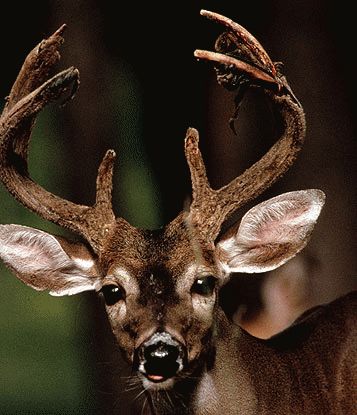
Texas Public Hunt Applications are Online

Texas Public Hunt Applications Online 

The Texas Parks and Wildlife Department will be conducting special drawings for hunts and applications for these quality, affordable hunting experiences are available online now. Application booklets are also being mailed to last year’s primary hunt applicants and will be available at TPWD law enforcement offices.

During the upcoming hunting seasons, more than 5,700 hunters will be selected through random computer drawings allowing access to some of the state’s high-quality managed wildlife habitat. Wildlife management areas, state parks and leased private property will be available for these quality supervised hunts for white-tailed deer, mule deer, pronghorn, javelina, alligator, exotics, feral hog and spring turkey. Continue reading “Texas Public Hunt Applications are Online”

Melanistic Buck Spotted in Austin, Texas

When it comes to white-tailed deer, we all know how they are supposed to look. Most are brown and white. But occasionally in nature we get genetic abnormalities and end up with something that looks totally different — which is usually white (albino) or even more rare, black. All mammals, including white-tailed deer, can have black fur and these animals are referred to as melanistic.

They are called melanistic because their body produces too much melanin, a dark pigment that causes their hair to be very dark brown or black. This variation is obvious to even a casual observer, but I’m not sureit impacts the deer itself or if the difference is even noticed by other animals in the herd.

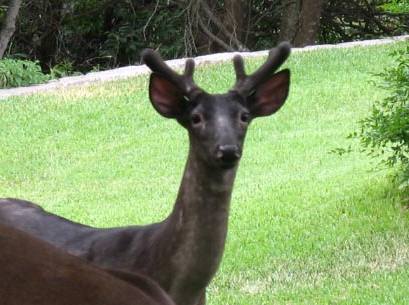
Melanistic white-tailed deer

Melanistic whitetails are the most rare color abnormality that deer can have — even more rare than piebald or albino deer. The photos seen here were sent to me and they allegedly came from somewhere around Austin, Texas. The photos are that of a melanistic white-tailed buck. The pictures where taken in a residential area so this rare buck may have lucked out.

Melanistic white-tailed deer Melanistic white-tailed deer

Movement and Survival of Translocated Deer

Survival of deer after transport 

In the US, white-tailed deer were originally transported to restore populations that were “shot out” during the early 20th century.  Today, land managers continue to move deer from one area to another, but not just to restore populations. The driving force behind today’s deer translocations is primarily twofold: to augment low-density deer populations and to promote genetic improvement. However, a third option for translocation is an alternative to harvest — to manage overabundant populations; remove deer found in high deer-density urban areas, transport them, and release them elsewhere.

But regardless of why deer are moved, how do they cope? What is the survival rate and performance of transported deer after they are “liberated” at their release site? These are good questions and a study out of Texas A&M University-Kingsville hopes to answer them. We know that for a translocation program to be successful we need two things, a high survival of released deer and for the animals to remain in the area where they were released. Without achieving these two objectives, the overall goal will not be met. Continue reading “Movement and Survival of Translocated Deer”

Unicorn Deer Found in Italy

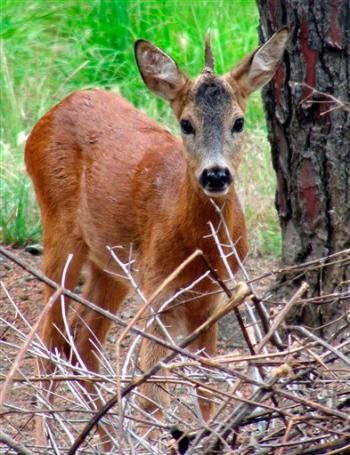
A single unicorn buck was found in Italy

Well, it’s not a white-tailed deer and it’s not located in the US, but a yearling (1 1/2-year old) Roe Deer was spotted in Italy with only a single antler protruding from the center of it’s head! The director of the Center of Natural Sciences in Prato told the press:

“This is fantasy becoming reality. The unicorn has always been a mythological animal.”

The 1-year-old buck, who not coincidentally is nicknamed “Unicorn,” was born in captivity in the research center’s park in the Tuscan town of Prato, near Florence. Obviously, the buck was born with a genetic flaw because his twin, like other Roe bucks, has two horns.

Single-horned deer are rare but not unheard of — but even more unusual is the central positioning of the horn. The location of the horn is probably the result of trauma early in the animal’s life, but the scientific director of Rome’s zoo said:

“Generally, the horn is on one side (of the head) rather than being at the center. This looks like a complex case. This shows that even in past times, there could have been animals with this anomaly. It’s not like they dreamed it up.”

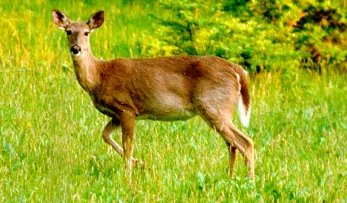
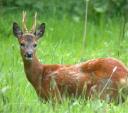
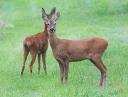
Photos of a Normal Roe Buck and Doe:

Roe Deer BuckRoe deer doe