Two Big Whitetails Lock Up and Drowned

As hunters, we hate to see dead deer that are not hunter-killed. This includes deer hit by cars, deer hung in fences by their hind legs, and locked bucks. To non-hunters, it probably does not make sense — because each fall hunters harvest hundreds of thousands of white-tailed deer across the US. The big difference is that most hunters have a good understanding of how wildlife management, specifically deer management, really works and why it is necessary. But there’s much more lost than just hunter satisfaction.

 Whitetail bucks lockup and drowned in pond

Hunters and non-hunters that see the photos of these two dead bucks will consider it a bad thing. However, deer hunters realize that not only has some excellent table fare been lost, but the satisfaction of two successful harvests has vanished, as well. But nature can be cruel — and a bit ironic. Was each of these bucks fighting for the right to pass on their genes, or simply to prevent the other from passing on his? If it was the former, they both lose. If it’s the latter, they both, unfortunately, win.

These two whitetail bucks were found dead on a ranch near Tilden, Texas. They apparently drowned in a stock tank after getting locked together in a fight that really was a brawl for it all. From the photos, the bucks do not appear to be severely locked, but it only takes about 10 seconds to drown. The larger buck scored 166 Boone and Crockett inches and the 12 point buck went 154. Two good bucks, some happy hunters, hamburger meat and a lot of sausage lost.

Whitetail bucks lockup and drowned in pondWhitetail bucks lockup and drowned in pondWhitetail bucks lockup and drowned in pond

Chronic Wasting Disease Monitoring Continues

State wildlife departments across the United States have continued with their annual Chronic Wasting Disease (CWD) monitoring in wild deer populations. Although numerous research studies are underway, there is currently no vaccine or other biological method of preventing CWD in a free-ranging deer herd. The only tool wildlife biologists and hunters have is to prevent the spread of CWD to new areas, because once an infected prion is deposited into the environment through either an infected carcass or from a live deer, it can remain viable for a decade or more!

Texas Parks and Wildlife Department (TPWD) wildlife biologists and technicians have continued their annual testing of tissue samples (brain stems) from hunter-harvested and road-killed white-tailed deer during the 2008-09 hunting season. To date, Texas has had no documented case of CWD within the State. Many of the samples collected over the hunting season are being prepared for analysis at the Texas Veterinary Medical Diagnostic Laboratory at Texas A&M University in College Station, Texas.

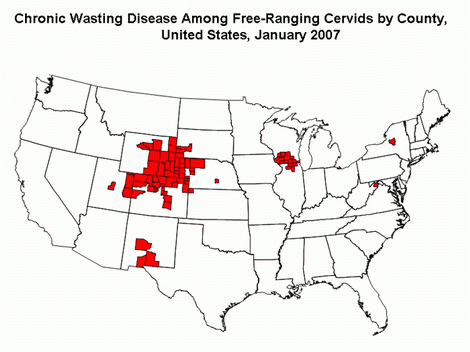
Map of known CWD locations

Although CWD has yet to be found in Texas, three hunter-harvested white-tailed deer in Kansas have tested positive for CWD in recent weeks according to the Kansas Department of Wildlife and Parks (KDWP). In the past few years, numerous cases of CWD have been documented in other states located in the central part of the U.S., including Oklahoma, New Mexico, Colorado, Nebraska, and Wyoming.

CWD is a progressive and fatal disease that results in small holes developing in the brain, giving it a sponge-like appearance under a microscope. Decreased brain function causes white-tailed deer, mule deer, and elk to display neurological symptoms such as depression, a droopy head, staggering, loss of appetite, and a lack of response to human disturbance. The continuing deterioration of the brain leads to other symptoms such as weight loss, drooling, and excessive thirst. If hunting in an area where CWD is known to exist, caution is advised. With that said, no human health risks have been discovered where CWD occurs.

The symptoms of CWD in deer include loss of body weight, stumbling, holding the head at an odd angle, circling, non-responsiveness to people, and pneumonia. Hunters can help protect the health of their local deer herd by taking the following steps to avoid accidentally transmitting CWD to new areas. First, do not transport deer carcasses far from the area where the deer lived, especially from areas where CWD has been detected. Secondly, if a deer carcass is transported, the hunter should make sure that carcass waste is not dumped in a location where other deer can come into contact with it. Carcass waste can also be disposed of by bagging and taking it to a landfill.

Texas Deer Hunters Have One Last Shot

Texas’ Late Season Allows Managers to Harvest Does and Spikes 

The General Deer Hunting Season has ended across much of Texas, but whitetail hunters still have an opportunity to take some deer during the Special Late General Season for spike bucks and antlerless deer. Although deer are very wary right now after a full season of being hunted, the late season gives deer managers one last chance to harvest the few remaining deer needed to achieve their deer harvest goals. Now, not all Texas counties have a Late Season in place for white-tailed deer, but most 5 deer counties do have the special season that runs from January 5-18. Make sure to review your county’s deer hunting regulations before heading out into the field.

As valuable as Texas’ Late Season may be for some hunters,  it’s not the only option for harvesting white-tailed deer outside the General Season. For deer managers looking for some additional flexibility, the Texas Parks and Wildlife Department has the Managed Lands Deer Program (MLDP) that not only allows for an early start in some cases, for the early harvests of does, spikes, and other undesirable bucks, but for an extended season that runs until the end of February. I would recommend that any landowner interested in sound deer harvest and habitat management look into the specifics of the MLDP program. The winter weather is cold as I write, so deer are moving. Get out there and take advantage of Texas’ late season — and pray for rain! 

Small Acreage Deer Management: Part 2

Small Acreage Management Continued

Part one of this two part series on small acreage deer management discussed how selective harvest on properties less than 500 acres in size is difficult to control. Most deer in an area have home ranges that encompass neighboring ranches. The best remedy for combating the small acreage dilemma is to create cooperative, working with adjacent ranches to increase the quantity, and ideally quality, of land under a common white-tailed deer management program.

Increasing the reach of a small acreage management program is the first priority of any small landowner, or even large landowner for that matter. I also want to touch on the other important deer herd issues that were asked about in the first part of this series—estrus cycles, spikes, and buck to doe ratio.

Deer Management & Herd Parameters

First, with regard to the estrus cycles of deer, whitetail does cycle every 28 days. Late-born fawns result from does that cycle later than normal, or does bred on their second or third estrus cycle into the breeding season. Although born later than usual, late-born whitetail fawns are not genetically inferior to fawns born earlier in the fawning season.

In addition, research has shown that fawning date is not a factor in the antler production of yearling (1 1/2 year old) white-tailed bucks. Genes are genes and can not be changed, but antler production is influenced by environmental conditions. This circles back to the importance of managing for and maintaining high quality white-tailed deer habitat.
Small Acreage Deer Management

Buck Harvest on Small Tracts?

This brings us to the long-debated discussion about spike bucks. Some hunters believe spike must be harvested. Some are adamant that the protection of spike bucks is a necessity. There is no single, correct answer to this debate. The harvest approach depends on a specific deer population and the goals of the small acreage land manager. The thoughtful harvest of deer is important to be successful at managing deer and their habitat.

I mentioned that environmental conditions influence buck antler quality. This is true for all age classes, but some bucks in each age class will be better or poorer than average. Research has found that some yearling (1 1/2 year old) bucks on poor diets (simulating poor habitat conditions) still developed into 5, 6, 7, and 8-point deer. This is interesting from a research perspective. However, harvesting spikes will not change the genetic composition of a deer herd on a large or small property. Why? Females contribute at least on-half of the genes found in every fawn.

Furthermore, bucks must be allowed to age if the land manager’s goal is to grow and produce mature, quality bucks. That means not shooting bucks when they are young during the deer hunting season. There are situations when the harvest of spikes is warranted, however.

Deer Harvest is Essential

There is a time when shooting spikes is a good idea. It’s not a situation that all properties face. Reducing the overall deer population is important when the deer density of an area is extremely high, even on small acreages. Too few acres per deer leads to low quality habitat, smaller deer, smaller antlers and fewer fawns. Too many deer creates a nutritional stress in deer which leads to more 1 1/2 year old bucks showing up as spikes.

It’s a feedback loop that has to be broken. Too many total deer for the habitat means more (higher percentage) yearling spike bucks. In this situation, the selective harvest of bucks throughout the ag classes is recommended. This means shooting spikes on the yearling end so that those bucks with 5, 6, 7 and 8 points get to pass go. A high deer situation also means the selective harvest of does throughout the ag classes. Deer management is not just shooting bucks!

While we are on the topic, the study found  that 95% of spike bucks are yearlings (1 1/2 years old). There is an occasional 2-year old spike out there, but old spikes are very, very rare.

More than Shooting Deer

I understand why managers tend to focus on buck harvest. Love it or hate it, let’s use the commercial deer breeding world as an example. Again, this is just an example. There is not a single deer breeder out there lining up to buy spike-antlered yearling bucks. Why? Because they, like you, know that antler characteristics are highly heritable. The difference is that deer breeding and movement is controlled within a pen.

White-tailed deer management on small acreage is different from management on large acreage. Wild deer move around a lot during the breeding season. There is a good chance that bucks spending a lot of time on your property do not breed the does that spend a lot of time on your property. Furthermore, does can get bred multiple times during an estrus cycle. They can have twin fawns with different sires.

Avoid High Grading Bucks

The standard operating procedure outside of a deer management program is for hunters to shoot the bucks with the most antler points. Under this scenario, these good bucks get harvested early and are not allowed to pass on their much-desired genetics. Under a managed scenario, high-quality young bucks should be protected for later harvest.

Only in high deer density situations should bucks with lower quality antlers be harvested. Again, the objective is not to change the genetics of the deer herd, only to reduce the deer herd and save some young bucks for later harvest. Most small acreage deer management programs will want to protect all young bucks.

Deer Management & Buck:Doe Ratio

I’ve covered t the importance of buck to doe ratio in the past, so review the article for more in-depth information. Buck to doe ratio is very important in determining fawning dates and small acreage managers should shoot for about a 1:2  buck to doe ratio. Larger and/or game-fenced properties can shoot for a more equal buck to doe ratio (1:1), but smaller ranches should carry a few more does than bucks.

In the case of a 1:10 buck to doe ratio, the number of bucks compared to the number of does is not likely not that bad. It’s difficult and rare to have a ratio that skewed. However, do collect deer survey data in late-summer and early-fall. Develop harvest recommendations based on those estimates based on the goals and objectives of the small acreage deer management program. Since it does sound like the land manager has many more does than bucks, it’s high time to trim down the female segment of the deer herd.

Removing excess does (and bucks) will improve fawning dates. The remaining female deer will get bred earlier, during the first estrus cycle. As a result, this will increase fawn survival by providing less competition and more summer food for nursing does. This works perfectly if the property is providing high quality deer habitat. Better fawn survival means more bucks in the future. Better habitat means bigger bucks and a healthy deer herd.

Piebald Buck is From East Texas

Remember the piebald buck that was reportedly harvested in East Texas. Well, the uniquely-colored buck was harvested near Palestine, but it was actually shot this year as opposed to last year, as my original research found. Photos of the deer have hit the deer hunting web and the stories of where this deer was harvested are as numerous as the buck’s spots! In order to clear things up about this news-making buck, here is rest of the story:

“My husband (James Curtis) is the one who killed the piebald buck in East Texas that has created quite a bit of interest on the Internet. I just wanted to give you the facts so that you can update your website. You can actually see the buck on the Texas Big Game Awards website, as well as on their TropyWatch.

Piebald buck harvested near Palestine, Texas, in November 2008

The deer was actually killed November 2, 2008, on a privately owned ranch outside of Palestine, Texas. The piebald deer scored 138 5/8 gross with a total body weight of 195 pounds. My husband is getting the deer full body mounted. Anyways, I just wanted to give you this information since there are lots of emails going around saying the deer was harvested in Michigan, Arkansas, West Virginia, and Georgia just to name a few. One email even says that the deer was sold to Cabelas for $13,000! It is crazy.”

Piebald buck harvested near Palestine, Texas, in November 2008