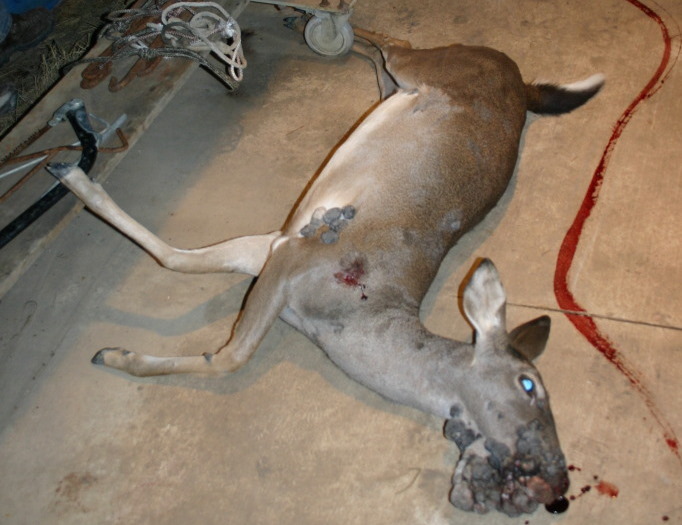
A deer hunter never expects to see giant warts or tumor-like growths on a white-tailed deer, but they do occur. Over the years I’ve seen many of photos of both live and harvested deer with “tumors,” although I’ve never seen one while in the field. The technical term for these growths is cutaneous fibroma and it’s caused by a virus. From a deer management perspective, there is not much you can do to keep wild deer from getting fibroma.
What are External Deer Tumors?
First, they are not tumors at all — they’re warts. Cutaneous fibromas are caused by a naturally occurring virus of the deer’s skin. The virus that causes these unsightly warts in deer is believed to be transmitted through biting insects and/or direct contact with damaged skin. Once the virus enters the skin, warts begin to form.
As the warts increase in size, the skin surrounding them is typically hairless and grayish in color. The number of warts on an infected animal can vary from one to several hundred, they can sometimes clump, and can in some cases end up covering much of the deer’s body.
Do Warts Bother Deer?
For the most part, these warts will not cause a white-tailed deer any major problems. However, sometimes the growth of the wart can indirectly cause problems by restricting the consumption of food or the deer’s breathing depending on where the growths are located.
Although death from fibromas in deer can occur, death from warts is not always imminent it seems. There have been many hunter testimonials of white-tailed deer with warts “shaking them off,” so to speak. In those cases, where they really the same deer? I can’t say for sure. I could see a situation where a deer with an isolated wart could recover, so to speak.


Deer Warts, Deer Hunting
From a deer hunter’s perspective warts are quite unsightly. Since fibromasts are a virus of the skin, they will be removed if the deer is skinned. Notice I said IF the deer is skinned. Although the meat of a deer is typically not affected, most hunters that harvest a deer with a large number of warts are hesitant to put the meat in the freezer.
This is understandable and probably the safest thing to do. Some research reported that a buck with external warts also had internal and cancerous fibromasts. Again, if an animal does not appear healthy then use your own, conservative discretion.
The take home message on warts is that they do occur naturally in white-tailed deer across their range. Fibromasts can occur on any deer, healthy or otherwise. With that said, these warts occur rather rarely and there is nothing that can be done from a deer management standpoint to manage against them. Deer are the only host for the virus, so fear not for yourself should you find yourself standing over an infected, wart-covered animal.
I went hunting Saturday and killed a buck. While I was skinning him I noticed he had a tumor on his neck and beside it there was a black thing that looked like cancer. When I was cutting the meat, I found some more. Should I keep the meat or trash it? Is it safe to eat?
Timmy, it’s up to you on the deer. If you keep the meat and prepare it properly, then there should be no problem. If you keep it, then (obviously) cut out the areas that look problematic. However, if all of the meat looks sketchy, toss it out.
Are any of these pictures from deer in the state of Pennsylvania?
The middle photo is now being bandied about on Facebook as supposed proof that fracking in Dimock, PA supposedly caused the warts:
Correlation vs. causation aside, any info on where the photo came from?
Just thought you should know that people are taking one of the photos on this web site and sharing it around facebook and saying that it is a deer with cancer, and that the cancer was caused by Fracking (hydraulic fracturing). I tried to debunk this as misinformation on my blog but I don’t know if people will read it. Here is the link:
Fibromas, commonly referred to as warts and/or tumors, are naturally occurring in white-tailed deer. Fibromas are commonly caused by the papillomavirus. Fracking does not cause a virus.
I just witnessed a deer on my horse farm with this skin disease. I am concerned if it is transferable to my livestock and other animals on my farm. Does anyone know the answer to this?
Does anyone know if baby fawns can be born with these warts?
I too saw on Facebook and trying to debunk. Not cool for people to use these photos for unrelated agendas.
Made it all the way up to Canada. Now claims are that these are Albertan deer affected by the oilsands.
Those Frack’n Canadian deer, Do’h!! The problem with liberals is, Bahahaha they ju- Baaaa -st believe whatev- Baahaa -er they’re Baaa, Baaaa, told!!!
While watching Wild Justice on Nat Geo Wild,I saw a deer with growths covering it’s eyes. It was bumping into trees,fences and everything else it came in contact with.Sadly, it had to be put down. How prevalent are these tumor/warts in the deer population?
We seen a deer in our yard with about 5 of these bumps on her already. I live in Upper Michigan. I mentioned it to a coworker this morning, she has a couple of deer near here with these same bumps. I guess it is not only in PA.
I just got back from a hunt in Kendall County in Comfort, Texas, and shot a 8 point buck that had tumors on it. I decided not to keep the meat and buried it. I was not sure with whether or not it was safe to eat or not. Didn’t want to take a chance.
Shot a dear in New Jersey wildlife management area middle of the state warts all over its body eating away at its ear. A week before same place friend shot one skinned it out tumors under skin.
I was told that these warts can dry up and fall off after time, is this true? I had some farmed deer that had them and I had to dart him and tie fishing line tightly around the base of the wart to shut off the blood supply And they dropped off after awhile. But I recently saw one on side of the road that had it bad, I don’t think he could even see me. I don’t know why he hasn’t got hit by car or taken by coyote.
I shot a doe weighing around 90-100 lbs on 10-30-14 near Rocky Point, North Carolina, that was covered in these growths. It was the second time that I had seen her. I saw her three weeks prior and the growth under her left eye was about half the size that it was when I shot her. She probably couldn’t see out of that eye. That growth was the size on my fist. Some of the spots looked like craters instead of warts. They were swollen around the outside, but a crater in the center. She also had marble size growths all up and down her legs.
It kinda freaked me out. I had never seen one like this before, so I called the Game Warden to tell him about it and he said it had this viral skin decease and didn’t even care to see it, so I buried her yesterday. Next…
Some sites are claiming that these warts are literally warts from the papilloma virus. Other sites treat them more like “skin tags” we see on our dogs’ hineys and our grandmother’s necks. The Alaska vet treating a reindeer with an over abundance of them interfering with the reindeer’s eyesight. She cordoned them off to limit blood loss and cut as few as possible because of the danger of major bleeds and possible infections from flies, mosquitos, and bacteria. What concerns me is that I have been observing white tail deer since the 50s and the warts were rarely if ever seen back then. As the years have gone by, these warts have become quite common or rampant, which makes me wonder what has happened to their immune systems, or what insects are carrying the bite or whatever causes the wart, or is it a genetic weakness that predisposes the deer to be unable to fight the virus, or is there a DNA change that has weakened the species. Something has grown stronger in the environment or weaker in the deer, and I believe it is a matter of concern. Species have tended to move from strength to strength unless something (not fracking) interferes. Since, the deer do not have the immune system strength to fight off a rapid spread of papilloma virus or whatever these deformities are coming from, I believe that they have grown weaker, or that something perhaps new to their habitats has grown stronger.
North Carolina here. Today I viewed pics from my deer camera. I have a doe with the warts. Looks like the front leg inside has one about the size of a tennis balls and smaller ones on the outside shoulder. Sure hope it don’t spread like the net said it could to the rest.
Rod, it happens naturally so you just have to sit back and see what happens, but you I think everyone agrees with you.
Could the decline in the immune system be caused by sprays in the fields or on lawns? Sounds a lot like the cancer I beat, years after being sprayed by timber co. in Northern California. I have always lived amongst the deer and never saw this till now. Many of the deer around here have these growths, and many seem to die or just vanish. I am now in Montana.
I harvested a doe with a fist sized black growth on her right hind quarter. Was glad to take her out of the herd. She was healthy otherwise and delicious. I’ll let you know if I come down with anything.
Teri, I think you will be just fine. Fibromas are sealed off from the remainder of the deer’s body. If you do feel a little off, probably not due to the delicious venison you’ve been eating!
I harvested a young buck maybe 4 years old or so this afternoon with one of these warts under his front armpit. The bump was kind of flat and round, like the shape and size of a roll of electrical tape, it was kind of hangy too. I have never seen this before now, and wanted to make sure he’s safe to eat. Sounds like as long as the meat looks good it’s safe to eat it? North Eastern Washington state.
Lisa, yes the deer you shot is good to eat. I would have no hesitation since any infection caused by external trauma./etc. is contained within the growth.