Many landowners and hunters consider supplemental feeding an important factor in deer management and a source of nutrition when native forage is inadequate either in quantity or quality. Under certain conditions, a supplemental feeding program can help keep the deer herd in better condition and help meet some of your management objectives. However, most deer feeding programs which provide sufficient additional nutrients to be of value are quite expensive.
Are You Feeding or Just Baiting?
There is a distinct difference between feeding and baiting white-tailed deer. Maintaining deer feeders from October through December is a common practice on many properties to attract deer to hunting locations during the whitetail hunting season. Unfortunately, most of these baiting efforts cease just before additional the additional feed is really needed by the deer — in late winter.
Supplemental feeding is most-beneficial during stress periods. Stress periods for deer are usually encountered when the protein content of the forage is at a low level. This is almost always during winter and summer or as a result of prolonged period of drought.
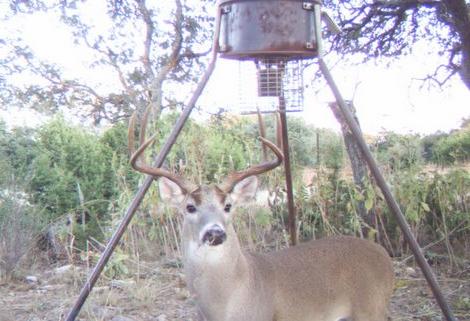
As mentioned, supplemental feeding of deer is expensive, and unless properly done it may be of little or no benefit to the deer. The most efficient means of insuring adequate nutrition is through a good habitat management program that provides sufficient cover and a variety of browse plants as well as forbs. This is done by reducing deer numbers and domestic livestock numbers to levels that allow the plant communities to recover and remain in good condition.
Before Supplementing Deer…
A common mistake made by many managers attempting to develop a habitat management plan is to disregard the number of animal units of deer present when calculating use of the range. If deer are present, they will also be using available forage and must be considered as part of the stocking rate. If large numbers of deer are desired, domestic livestock must be reduced to prevent damage to native plant communities.
This also holds true for farmlands. There is plenty to eat during the growing season, so the limiting factor for deer occurs when food sources are low following the hunting season in the winter.
Under good habitat conditions, white-tailed deer and cattle do not compete for food. However, deer, sheep and goats are in direct competition for the available food supply. When habitat is in poor condition, deer and cattle will compete for forb and browse plants.
True Supplemental Feeding Has Benefits
The supplemental feeding of deer may be beneficial if the herd is harvested adequately each year and the habitat is maintained in good condition or constantly improved through management practices. Only under managed conditions will supplemental feeding benefit the growth-rate of a deer’s body and a buck’s antlers.
The benefits of a supplemental feeding program may be more quickly realized when feeding is done within game-fenced areas that allow the manager to closely control the white-tailed deer population, but most of us are managing and hunting under free-range conditions. Feeding can work just about anywhere, but it takes proper implementation and a higher level of manager involvement to be effective.
I have a choice to supplementally feed deer with corn or oats. I understand that corn overall is not very nutritious for deer, but oats has about twice the protien and more crude fiber for digestion. Is it the better choice when baiting or feeding deer?
I am wondering what is a good feeder method is best for distributing cotten seed to deer?
Gene, try something like this cottonseed feeder. All you need is a couple of t-post and some 2 x 4 inch welded wire.