What’s a G2, G3, etc.?
The majority of hunters know that the Boone & Crockett Club measuring system is the most common way to score white-tailed deer antlers, but many don’t know how to properly score a harvested buck. Of course, hunters also score shed antlers or dead bucks they have found somewhere.
In order to correctly score a buck you first need to understand how to take the required antler measurements, and that calls for the clarification of some B&C terminology. It’s relatively simple once you learn the lingo, but not something that’s easy to recall unless you score deer on a regular basis.
Learning the proper terms will help tremendously when discussing antlers in general and specific measurements with another hunter that is experienced with scoring deer antlers. Otherwise, one will not understand they other and that just means at least one of you will be completely lost — kind of like going anywhere without knowing the native language. Knowing what terms refer to will not only help you “get it,” but lend you and others confidence that you know what you’re doing.
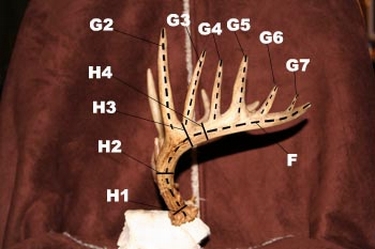
Boone and Crockett Terms
Point – To be a point the projection must be at least one inch long, with the length exceeding width at one inch or more of length. All points measured from tip of point to nearest edge of beam. The beam tip is also counted as a point, but it is not measured as a “point” since its length is included in total beam length.
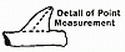
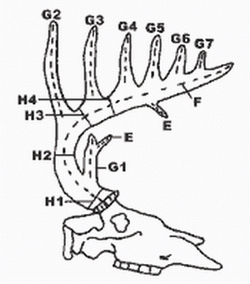
Abnormal Point – Abnormal points are those non-typical in their location, such as points originating from a normal point, the bottom or sides of the main beam, or extra points beyond the normal pattern of points. For an example of an abnormal point, look at item E in the photo below. There are two examples.
Burr – The end of a buck’s antler that flattens out at the at the base of the head.
Beam Length – The measurement from the bottom of the burr to the tip of main beam. Item F in the photo is an example of the main beam measurement.
Gs – The letter G is used to name normal antler points. G1 refers to the first point on an antler. This is typically the location of the brow tine (if the brow tine is missing, the G1 is missing). G2 is the next tine, then G3, and so on (see photo above). A normal 8-point buck would have a G1, G2, and G3. A normal 10-point buck would have a G1, G2, G3 and G4. The end of the main beam IS NOT referred to as a G, although it does count as a point.
Hs – The letter H is used to refer to circumference of a buck’s antler. H1, H2, H3, and H4 refer to the locations on an antler where circumference, or mass, measurements are taken. Regardless of the number of points, only 4 H (circumference) measurements are taken on any buck. Circumferences are taken at the narrowest place as in the photo above. In the example above, the H1 measurement for a buck’s right antler would be the smallest circumference between the burr and G1. The H2 measurement would be the smallest circumference between the G1 and G2.
Eighths – You’ve probably noticed that deer scored using the B&C method have scores such as 134 5/8 or 176 2/8. Keep in mind that all measurements are taken to the nearest eighth inch. Record 1/2 inch as 4/8 inch and it will make the math easier, especially if you don’t have a calculator!
If two points have a common base then one of the points is non typical. So why do they show a circumference measurement being taken between the G2 and G3? It would appear they have a common base.
Bowmaster-
Points are either normal or abnormal, but just because two points have a common base that does not make them abnormal, especially if they are matched (both sides of the antlers). If the points did not have a common base, such as one point actually coming off the other, then one point would be abnormal. It’s confusing, but I will clarify in an article later this week.
What do the G’s and the H’s stand for?
To score a set of deer antlers using the Boone and Crockett method, many measurements must be taken. This series of measurements consists of 8 different variables that are named “A” through “H.” All of the measurements are added together to get the gross score.
The G measurements are the legth of the various antler points on each beam. G1 (or G-1) is the length of the first point, G2 the second, and so on and so on. The H1 (or H-1) is the circumference (or mass) and the first location where circumference measurements are taken, H2 is the second, and so on and so on.
The letters are used to eliminate confusion (A – H instead of 1 – 8), because there are already enough numbers on a page when you start scoring a deer.
How many points can be scored on a buck?
Lainie, every point is measured on a buck. However, how those measurements play into the score depends on whether or not the points are normal or abnormal and whether the antlers are scored typical or non-typical. It can be confusing. What type of buck are you trying to score?
Is there an H4 measurement when scoring an eight point or 4×4 buck?
Clayton, the answer to your question is yes! There are four and only four circumference measurements taken on each antler, regardless of the number of points. The H4 measurement on an 8 point buck is taken at the mid-way point on the main beam between the G3 and the tip of the beam.
The question was asked: What does the letters A-H mean. Such as Define the letters. Not where they are located. I never thought of asking that myself and have hunted for years. But I also have never tried scoring my deer. Thanks, Tom.
Tommy, Buck Manager answered that question, but it can be confusing if you’ve never seen a score sheet. “A-H” are letters designated for each measurement category. The letter “F” is the length of the main beam, “E” is the total length of the abnormal points per side, “B” is your tip to tip spread (although that is not counted in your score). Only D-H are counted in the gross score. The letter “D” is the inside spread measurement. The letters themselves do not represent a specific word.
I hope that answers your question.
WHAT ARE THE DEDUCTIONS ON A NON TYPICAL DEER?
The difference between all the normal tines, G-1 through G-whatever and the difference between H-1 through 4 (mass measurements). Non-typical buck scores (net) are still based symmetry, then the abnormal points are added in. This is why there is a gross score and a net score. Gross takes into account the sum of all measurements. Net score deducts the differences between normal points and mass.
I recently killed a nice buck that is a main-frame 10 point, but he has a kicker off of each G-2. Each kicker is 3 1/2″ long and symmetrical in location, I was told that they will not count in the gross score but will be deducted in the net score. Is this true?
Steven, this is true if the deer is scored as a “typical” buck. Most hunters use the term “gross score” as the total of all measurements and point, normal and abnormal, that a buck has. However, this is not the case when deer are scored using B&C or the Texas Big Game Awards system. Abnormal points penalize typical deer. Bucks scored non-typical will have abnormal points included in their gross score.
I shot a buck that has a 9 point frame with 3 kickers on the base would this be score non typical? And would the 9th point be a deduction to score?
Lincoln, the antlers should be scored both typical and non-typical,then you can see how they add up each way. With three abnormal points, the deer will likely score well as a non-typical if the points are of any length. And yes, the ninth point will be deducted, as well as the difference between each matching point, whether the deer is scored a typical or non-typical.
Why do they ask for measurements that are not added into your score? Such as tip to tip, outside width and number of points?
Ryan, these measurements are for identification purposes. If a buck scores really high then the measurements can be used to verify the identity of the deer/rack.
My question is the use of the online scoring system @ B&C. There are not clear directions for the data entry into the forms. If I enter the inches and eighths with a space in between, I get a much lower score than if I enter them into the system with no spaces. All of the cells will take the measurement either way, and I cannot find any definitive instruction on this. It seems like this is a flaw in the set up of the online scoring tool.
Are tine positions hereditary? For instance will a buck’s male offspring exhibit drop tines or kickers in identical locations?
Laura, the answer to your question is both yes and no. Antlers are highly heritable so that means a lot of what you see will be passed on to offspring. However, the offspring will not look exactly alike, partly because they get some other genes from the doe, but partly because of gene recombination in general. Buck offspring will be predisposed to look like their dad, but may not have all of the same antler features.
If there is no G3, is H4 the same as H3 or is H4 zero?
Barry, I think you are correct. If G-3 is missing then H-3 and H-4 are the same for mass measurement on the main beams.
I’m just wondering…..where did the lettering “E, F, G, H” come from? Did the letters come from a persons name or stand for something besides what is shown above? Looked on site and Google searched and found nothing to explain?
If there is a G4 on one side and not on the other can that be counted as an abnormal point in “E” when doing non typical? Otherwise, it is deducted and may as well not have it.
Caleb, if the G4 is located in a normal position then it is a normal point and should be measured as such. The opposite antler gets a 0 since there is no G4. When you take the difference between the matched points (G4) on each of the antlers the difference will be the length of the unmatched G4. The G4 adds to the gross score, but not to the net score. B&C is based on symmetry with net score, but the gross score really reflects what the deer has on its head.
I have a question regarding missing brows or G1’s. Is there a rule of thumb that dictates what a G1 or G2 is? Reason I ask is in a certain game cam pic this buck has what appears to be about a 9″ G1, but it’s about 3 inches away from the base. It started a discussion on whether it was a G2 or a huge G1. Haven’t heard of a distinguishing rule.
Brandon, I can not cite a specific rule off hand but I do know that to be considered a “normal point” the point must be in the location where it is generally found on the species in question. I can understand a buck having G1s closer to the burr or possibly slightly further up the beam, but anything out of the ordinary is considered an abnormal point, especially if it is an unmatched point.
I have a main frame 8 point it has a drop tine on each side coming from the same place on each main beam. Both are 5″. Do these count in the net score since they are the same?
Mikes, drop tines are abnormal points so they are not additive for a typical buck. For bucks scored non-typical, the drop tines are included in the net score.
I have a deer I would like to send you a picture of and see how you would score it? It is gathering some controversy over his G2 G3 points. If you could email me that would be great! Thanks.
Ty, you’ve got mail! Look forward to checking out the antlers in question.
If I have a buck with a G4 that is protruding from the inside of the beam, so where do I take the H4 measurement? The point originates from the main beam but angles slightly to the inside. I’m not sure if it’s considered an abnormal point or a G4. Either way I’m not sure where to take the last mass measurement on that side… halfway from that point to the end of the main beam or in between that point and the G3?
The buck has one other abnormal point and does have a “regular” G4 on the other side if that makes a difference. I’m just trying to correctly calculate the gross score bc obviously if I take the mass measurement in between these points it’s more than from that point to the end of the main beam. Thanks.
Josh, where you take the H4 measurement depends entirely on whether the point in question is normal or abnormal. If the point is not on top of the beam, as normal points should be, then it sounds like the point must be considered abnormal. It sounds like the point is matched, that is there is a G4 on the other side. If the spacing of the G4 in question is similar to the other side then it could be a normal point. Since I do not have a photo it’s difficult to give a conclusive answer here.
1. If the G4 is an abnormal point, take the H4 measure on the main beam exactly halfway between the G3 and the tip of the antler.
2. If the G4 is a normal point, the H4 measurement would be the smallest circumference of the main beam between the G3 and the G4.
I took a main frame 8 point with a drop tine from each main beam, same location. When I had it scored in a GA Buckarama event, the drop tines were not added to the gross score, but was subtracted. I was told that it could not be scored as a non-typical because the abnormal points(drop tines) did not total over 10 inches. Total gross was 135 3/8 including the 8 0/8 for the drop tines. 127 3/8 was the typical gross. There was 2 3/8”s difference for symmetry between left and right (scored as a typical). For a final net score of 117”s. Is this correct? Can I email you a picture of the deer and the score sheet?
What if a deer or a few deer have the G1s and G2s missing completely. Say for instance it’s a small 6pt or a tall 6pt with no G1s or G2s We have a few deer that are missing those to catchers in the middle.
Luis, then the deer gets no measurements for the missing tines. If both G1s are missing then 0 for the left G1 and 0 for the right G1.