
If you’re not familiar with antler restrictions, let me just say that they do work! In Texas, certain counties have restrictions on white-tailed bucks, meaning only bucks with inside spreads equal to or greater than 13 inches OR bucks with at least one unbranched antler (i.e. spike on at least on one side) can be harvested. Growing up, I spent a considerable amount of time hunting a parcel of land located in Colorado County.
From the time I was old enough to hunt up until 2000, the county bag limit was 1 buck per hunter. After that time, antler restrictions were implemented. Why, you ask? Well, under a 1 buck bag limit apparently only the best young bucks were harvested each deer hunting season and the cull (inferior) bucks were left on the range.
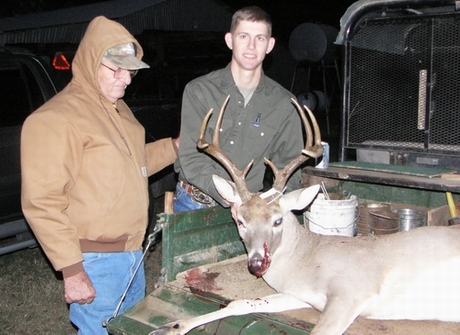
With legal bucks now limited to unbranched antlered bucks and those with an inside spread exceeding 13-inches, many young bucks now enter older age classes and inferior spikes are harvested. Of all those years I spent hunting that tract of land in Colorado County, rarely did I see a buck over 2 1/2 years old. Now, to see several high quality, young bucks in a hunt is common place. In fact, the hunter pictured above was lucky enough to harvest the 4 1/2 year old 9-point buck on that same parcel of land.


Yep, those restrictions work! My neighbor hunts DeWitt county, and every year he hunted the first weekend and brought back the first buck he saw, which usually was a smallish fork-horn. The last two years he’s taken two pretty nice bucks with about 15″ to 16″ racks on the two, so now instead of shooting the first thing with horns that steps out, he has to wait for a legal shooter.
Makes perfect sense to me, is if you don’t shoot your younger, smaller bucks, you will have to be more patient, and wait for a legal deer, which might take a few weeks, or longer, so I would have to say I’ve seen the proof and it works!
BTW he hunts on the family farm and he’s a meat hunter, and complained about having to pass those smaller bucks and that he could have had his sausage meat already and been tagged out, but now, he even admits he likes the new rules, since those are the biggest deer he’s taken in years, and say’s the horns don’t make the sausage taste any different, but it just reminds him of the old days, and the big bucks he used to kill!
I live and hunt in Louisiana. I was wanting to know about a buck spike. I’ve heard that once a spike always a spike. Is this true? Or does a spike grow up to be a trophy buck? And why do some spikes look funny? One larger than the other? I thank you and appreciate your time.
I have hunted a 100 acre parcel of land in Colorado County, Texas, for the past two years pretty much every weekend and have yet to see a buck over 13 inches wide. I’ve had some that were close, but then again its hard to judge them on the hoof. I have elected to pass on them and I am not a big fan of the restrictions. Hunters should judge deer by their age and not the width of their horns.
Billy, if you find it hard to judge the width of a bucks’s antlers, then how can we expect that you can age live deer any better? I think without the antler restrictions you would not be seeing any bucks. Antler restrictions have improve our deer herd.
its easier to tell the age by certain feature. like the neck or if there legs look to big for there body. i have a question tho. its says u need an mld permit to harvest does during general season why is this. i must see 30 does a day.
Billy, I hunt a small 150 acre plot in Dewitt county and have asked the same question. Some counties are no does and bucks only with the antler restrictions. The answer is this: You must call the local number of the TPWD biologist and let them know how much land you have. They normally issue 1 doe per 75 acres
and you will be able to shoot it during the span of the entire General Season, OR you can harvest 2 does (or what ever the limit is in your area) legally by bow during the archery season. If you hunt on a large piece of land, it would be worth getting doe tags. I choose to take does with a bow, as I have family members that mainly bow hunt.
It depends on where you are hunting as to whether the antler restrictions work. Here in Indiana, the bucks get good sized. An average buck is an 8 pointer. I shot a 16 inch spread 9-pointer and my brother shot a 18 inch 10-pointer this year on our property. Here in Indiana, we have the 1 buck rule. My dad shoots the older, smaller deer most of the time. If you leave the smaller, older deer in the herd, they will produce more offspring and the antler size of the overall herd will decrease with time. I guess it depends on how much hunting pressure is involved in the area to decide whether these antler restrictions will work.
I forgot to say that my buck is probably around 2 1/2 years old (with 9 inch tines) by looking at the lower jawbone and my brothers is 4 1/2 years old (with 11 1/2 inch tines). So they are getting pretty old without antler restrictions.
Frank, Texas’ antler restrictions are in place because of extreme hunting pressure and fragmented landscape that consists of numerous small ranches (20 to 300 acres). Some tracts of land may be 100 acres in size and have 3 to 4 hunters on it. Thus, these antler regs allow the better bucks to be harvested down the line. The regs also allow the poorest bucks (spikes) to be harvested at the very first opportunity.
Your harvest strategy allows the poorest bucks to breed for 3 or 4 years before your father harvest them. These poor, old bucks breed does the entire time. By the way, in a wild deer herd, 80% of bucks become 8 point deer.
Very nice buck!
I dont like the restrictions. A lot of your inferior bucks will not reach 13 inches, therefore allowing them to breed there whole life, if there never a spike. Your better two year olds will have 13 inches or better and get shot then, so your best genetics are lost and the inferior genetics keep breeding. The same people shooting the best 2 year olds are the ones shooting the first bucks they see. If you really want to better the herd, make everybody pass a deer aging class or something like that. Either way, restrictions or not, it’s still the same. Hunt hard and God bless.
Guys, the most important thing when managing these deer is age and nutrition. The antler restriction law is somewhat a good thing for inexperienced hunters, but a seasoned hunter needs to harvest only mature animals. By harvesting these mature animals we give these younger 2 1/2, 3 1/2, and 4 1/2 year old deer time to mature. If everyone focused on harvesting mature deer (in the 5 1/2 and up range), then everyone would benefit. Genetics plays a part, but I am telling you it all depends on age and nutrition. I wish they would only allow does to be taken and no bucks for a season or even two, I promise you our big buck (mature) numbers would go through the roof.
I am not so sure they work. I have seen too many old bucks, with little basket racks, that need to be taken out of the herd. It should be through hunter education and personal responsibility that we acomplish a healthy herd.
I can tell you one thing here in Missouri. We have a four point restriction, which means the buck must have at least four points on one side. This has exploded the population of big bucks. What I mean by big is 130 class and up. The past few years I’ve seen multiple bucks over 150! Before this point restriction rule you were lucky to see one buck all season that would go over 120, and thats if you were lucky.
This year I’ve already seen four bucks in the 150 class just driving down the road. It just keeps getting better with each year. I gaurantee that Missouri will be a hot spot for monster bucks in the nation in the near future, if it isn’t already, because of this rule implimented five or six years ago.
Any deer manager knows there are 3 fundamentals to producing quality bucks: age, food source, and genetics. In the case of the antler restrictions, you are only managing for one of these fundamentals (primarily age). I hunt in Lavaca County where this restriction has been in place now for 6 years. For the last several years, I have video and game cam pictures of several generations of 2 specific antler types on our property. None of these deer are legal to shoot and they are very poor representations of a quality buck. Likewise, every year the number of these animals appears to increase. In my opinion, this is exactly what one would expect from the antler restrictions: Increased hunting pressure on spikes and uniform racked deer, but no pressure on the buck population in between. This will undoubtedly lead to the proliferation of the antler type with no pressure. This is genetics 101.
TPWD touts increased antler scores and age as success for their program. In my opinion, it should be incumbent on TPWD to do a follow up study to see how this restriction is affecting the overall deer population.
Sorry folks! It might work, but the people who want to hunt deer are screwed! I saw 8 deer this week, 7 were illegal. Thanks to this restrictive actions and unfair chase laws, we regular hunters are left with nothing.
Fred, I totally agree. I hunted with my son for the first time this season. I had to tell him not to shoot the big buck, as I could only count three points on each side. And my brother comes out from Michigan, pays hundred’s of dollars to hunt here in Missouri, and goes home with nothing. He passed on a two and a four point buck. This antler regulation may be great in the future for attracting big antler hunters, but does absolutely nothing to put meat in my freezer.
As an avid hunter, age 45, I have been hunting as long as I can remember, owning my first gun, a 410 shotgun, at 6 years old. With regards to the article above, I beg to differ. I live in and hunt alot in Dooly County, Georgia. We have a 15″ restrictions which has ruined big bucks in this county for years to come. We have alot of out of state hunters leasing hunting land here that are “looking for the big one”.
What we have in Dooly County now is a LARGE amount of small, deformed racks that are left for our breeding bucks. Not to mention the over population of does because everyone is “looking for the big one”. Yes, we do have some big bucks here, but what the restriction has caused will only take years to correct.
I’m not goinh to type as much as they did, but that’s cool!
I am not a fan of the restrictions. It is sometimes hard to tell. I shot what I thought was a spike only to find out when we tracked it down that there were 4 points and the spread was nowhere near 13 inches. Well, between the county fine and the states civil restitution it cost me about $900. At least the warden was nice enough to let me keep the meat. It will make me think twice about wasting my time hunting next season.
I feel that the point rule is the best kind of rule. I, like a lot of the others, live in Texas (Bowie County) and have the 13 inch rule in place. I am all for herd management, but feel the rule will make a honest hunter illegal very quickly. I wish we would go to a 4 point or 3 point rule. When you have a deer trotting by that is tall but doesn’t give you a look at his spread it is just a guess and it’s not really fair to the hunter. I also wish they would put a rule into place for younger hunters. If my 6 year old sees a 7 point that is 12 inches wide he probably should be able to shoot it.
I have the misfortune of living and hunting in Pennsylvania. The Game Commission implemented both Antler Restrictions and a Herd Reduction program in 2002. They screwed up!
We now have turkeys and bears out the wazoo, but about 1/4 of the whitetail deer we used to have. The AR’s might work just fine if there were enough of a buck out there to grow antlers, but since the breeding population of bucks has taken such a major hit, the only ones left are the 1 1/2 year olds.
Consider yourselves down there in Texas lucky. It could be a lot worse.
I lived in Louisiana 40 years and now I live in Missouri. People say that with good food most spikes and 3, 4, and 5 points will start to grow equal or larger racks at later years. The antlers come from the bones. If food is scarce one year you will see more spikes as the minerals go to bone growth, so in some cases the 1 1/2 and 2 1/2 buck’s big rack is lost because of the cost of bone growth. Hunters will not know unles they let the bucks reach maturity — 4 years old and up.
I have hunted for the last 42 years in Colorado County. It’s one of the 6 original counties that had antler restrictions in Texas. There is no doubt that the restrictions work. Hunters need to learn to grab their binoculars when they see a deer instead of their gun. Have a little patience; you don’t have to kill a deer every time you hunt. If you feel you do, then you’re out there for the wrong reasons.
I think that hunters are getting so bad about big bucks. I mean don’t get me wrong, I would like to shoot a big buck, but with all the rules and antler restrictions and the younger kids lose interest in hunting. They want to have fun, but they have to sit still in a blind all day and then they can’t shoot the deer that step out. A big let down for the kids. People say that it’s the kids that will keep hunting going, but with all the stuff going on they just don’t want to go hunting. Hunter 4 life.