Successful deer management is rooted in habitat, not harvest strategies or short-term food sources. White-tailed deer are a product of the land they inhabit, and their health reflects the condition of the soil, plant community, and population balance on that landscape. While food plots and supplemental feeding practices can play a role, long-term success depends on understanding native forage systems, rainfall response, and the biological limits of carrying capacity.
This article serves as foundational content for deer and deer habitat management. It explains how deer obtain nutrition, why native forage is irreplaceable, how soil health and rainfall influence plant growth, and why overpopulation undermines even the best habitat improvements. These principles apply across regions and property sizes and form the basis for sustainable, science-based management.
Deer Nutrition: Selective Browsers
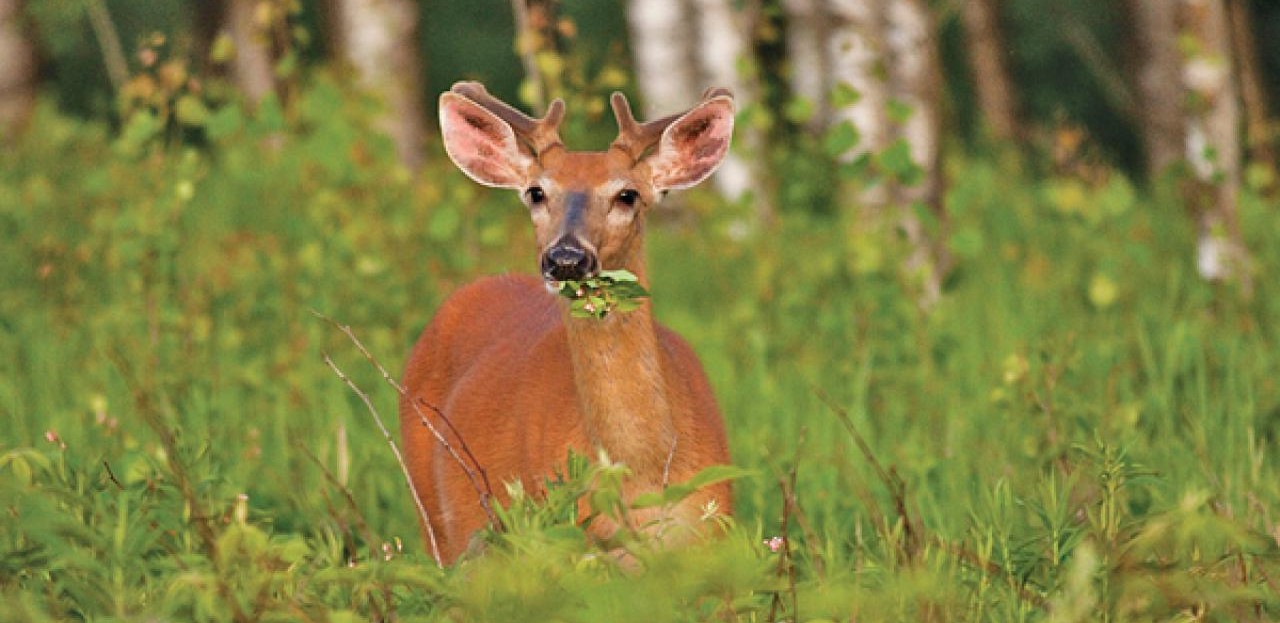
White-tailed deer are not grazers. They are selective browsers adapted to consuming a wide variety of plant species, focusing on the most digestible and nutrient-dense portions available at any given time. Deer select leaves, buds, tender stems, forbs, fruits, and mast rather than large quantities of coarse grass. Their small rumen and rapid digestive process require high-quality forage rather than bulk.
Because of this feeding strategy, deer depend on diversity. No single plant species or crop can meet their nutritional needs year-round. Instead, deer shift their diet seasonally and even daily in response to plant growth, weather conditions, and availability. A healthy habitat supports this flexibility by providing a broad range of forage types across all seasons.
Understanding deer as browsers rather than grazers is fundamental. Many management failures stem from applying agricultural thinking—focused on monocultures and fertilizer inputs—to an animal that evolved in complex, diverse ecosystems.
Native Forage as the Nutritional Foundation
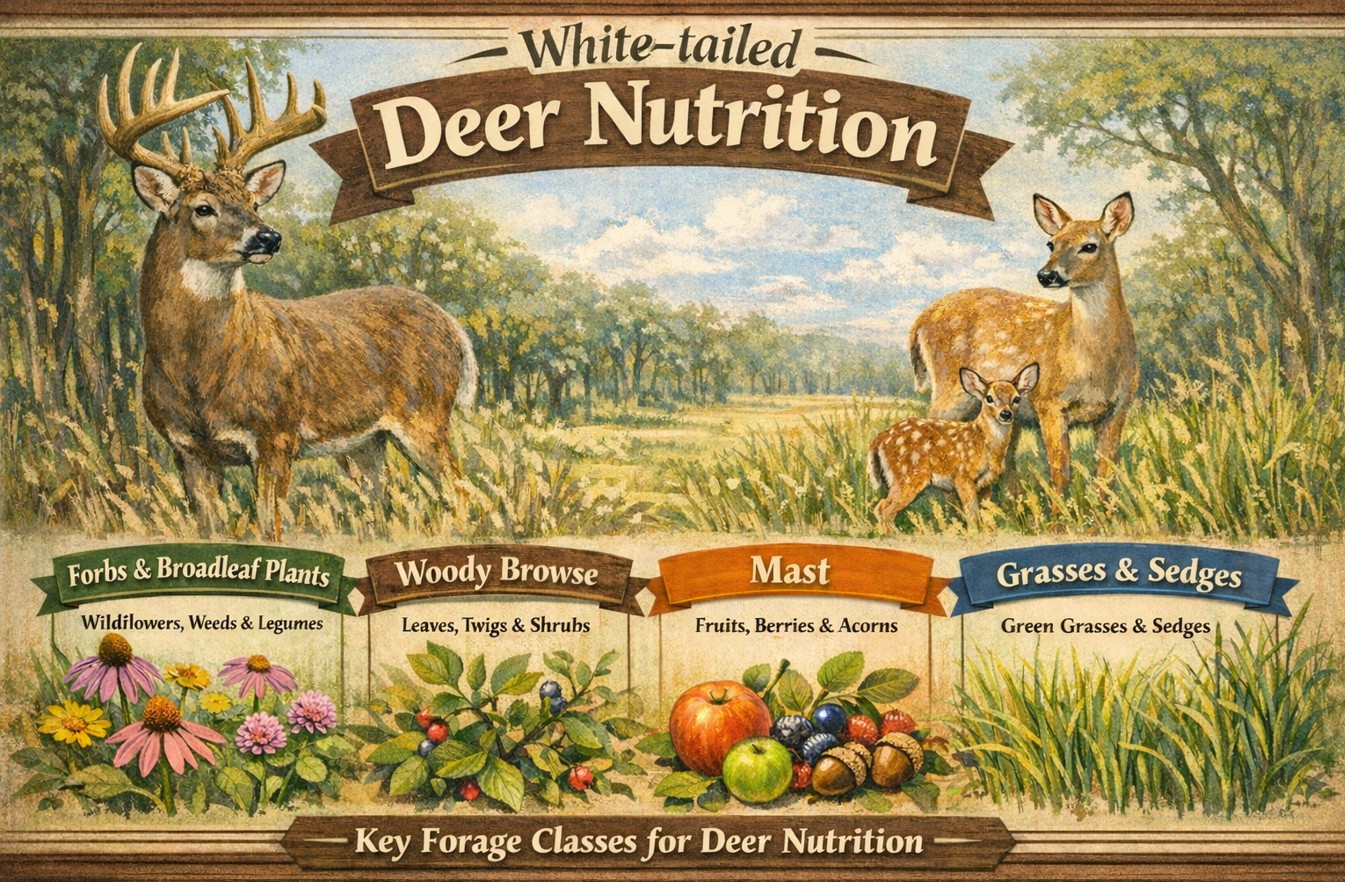
Native forage is the backbone of deer nutrition. It includes forbs, woody browse, vines, shrubs, and naturally occurring mast-producing trees that have adapted to local soils and climate over thousands of years. These plants grow in response to rainfall, disturbance, and sunlight and are resilient to environmental variability.
On most landscapes, native forage provides the majority of a deer’s annual diet. This is especially true outside the fall and winter months when planted crops are emphasized. Ideally, native plants distribute optimal deer nutrition across the entire property rather than concentrating it in a few acres, reducing competition and social stress while allowing deer to feed naturally.
Native forage systems also support other wildlife, improve soil health, and require far fewer inputs than planted systems. When managed correctly, they regenerate continuously and respond quickly to favorable growing conditions.
Native Browse vs. Food Plots
Browse consists primarily of woody vegetation and shrubs whose leaves, tender stems, buds, and new growth are eaten by deer. This component of the plant community provides a dependable food source across all seasons, particularly during periods when herbaceous plants are limited or dormant. Because woody plants store energy and structural tissue year-round, browse remains available even during winter and extended dry conditions, making it one of the most stable sources of nutrition on the landscape.
In well-balanced systems, browse is continuously renewed through natural growth and disturbance, providing deer with access to highly digestible plant parts at varying heights and stages of development. When deer populations are in balance with available habitat, browse pressure stimulates moderate regrowth without suppressing regeneration. However, when browsing exceeds the land’s capacity to recover, woody plants fail to recruit into higher size classes, leading to reduced forage availability and long-term habitat degradation.
Browse: A Critical Deer Food
Too many deer on a landscape suppresses important food plants. For this reason, the condition of woody browse is one of the most reliable indicators of overall habitat health and population balance. Examples of common native browse species include:
- Greenbrier
- Blackberry and dewberry
- Honeysuckle
- Sumac
- Dogwood
- American beautyberry
- Elm, hackberry, and ash saplings
Food plots, by contrast, are intentionally planted crops designed to supplement nutrition during specific seasons. Clover, brassicas, cereal grains, and soybeans can provide high-quality forage, particularly during nutritional stress periods. However, food plots occupy a small portion of most properties and are vulnerable to overuse when deer densities are high.
A common misconception is that food plots can replace native forage. In reality, food plots can only supplement a functioning native system. On properties with excessive deer populations, food plots are often browsed to failure, providing little nutritional benefit and masking deeper habitat problems.
Effective deer management prioritizes native browse and uses food plots strategically, not as a substitute for habitat.
Mast and Seasonal Energy Availability
Mast production plays a significant but highly variable role in deer nutrition. Hard mast, such as acorns, provides concentrated carbohydrates and fats that support body condition, breeding activity, and winter survival. White oak species are particularly valuable due to their lower tannin levels and higher digestibility, while red oaks and other mast producers contribute later in the season.
Key hard mast species include:
- White oak
- Red oak
- Chestnut oak
- Hickory
- Beech (regionally)
Soft mast, including persimmons, plums, blackberries, muscadines, and apples, provides seasonal nutrition, moisture, and energy during warmer months. These foods can be especially important during late summer and early fall when other forage may decline in quality.
Mast production is strongly influenced by rainfall, temperature, and tree health, leading to dramatic year-to-year fluctuations. Because mast is unreliable, deer cannot depend on it as a consistent food source. When mast crops fail, pressure shifts immediately to browse and forbs, often revealing whether a property’s habitat can support the existing deer population.
Forbs: The Nutritional Powerhouse
Forbs are among the most important and overlooked components of deer habitat. These broadleaf, non-woody plants are typically high in protein, minerals, and digestibility, making them especially valuable during spring and summer. During these seasons, nutritional demands peak due to antler growth, lactation, and fawn development.
Native forbs frequently exceed the nutritional value of planted forages. They respond rapidly to rainfall and disturbance and often regenerate multiple times within a growing season.
Common native forbs include:
- Ragweed
- Partridge pea
- Beggar’s lice
- Tick trefoil
- Pokeweed
- Sunflower species
Despite their value, forbs are commonly suppressed through mowing, herbicide application, or management practices that favor grasses. Encouraging forb growth through timber thinning, prescribed fire, or light soil disturbance can dramatically improve deer nutrition without additional inputs.
Woody Browse and Regeneration Dynamics
Woody browse is the most critical long-term component of deer nutrition and often the first to decline under excessive deer pressure. Shrubs, saplings, and regenerating trees provide consistent forage across seasons and form the structural foundation of healthy forests.
When deer numbers exceed carrying capacity, woody regeneration fails. Saplings are repeatedly browsed, shrubs disappear, and forests lose their understory. Over time, this leads to simplified plant communities dominated by mature trees with no replacement, reducing both forage availability and habitat diversity.
Healthy properties exhibit multiple age classes of woody vegetation, visible regeneration below deer reach, and a diversity of browse species. Achieving these conditions requires both habitat management and population control.
Soil Health as the Base of the System
Soil health underpins all aspects of deer habitat. Healthy soils support deeper root systems, improved water infiltration, greater nutrient availability, and increased resilience to drought and flooding. Native plants play a critical role in building soil health through deep roots and organic matter accumulation.
Rainfall timing often has a greater impact on plant growth than total rainfall. Native plant communities are adapted to local precipitation patterns and recover more reliably from drought than planted crops. Poor soil health, compaction, and erosion reduce the effectiveness of even the best rainfall years.
Improving soil health involves reducing disturbance, increasing plant diversity, maintaining ground cover, and allowing natural nutrient cycling to occur. These improvements benefit the entire ecosystem, including deer.
Rainfall Response and Forage Availability
Rainfall directly influences forage production, but its effects are mediated by soil condition and plant community composition. Native forage systems respond quickly to timely rainfall, producing flushes of forbs and browse that deer can exploit immediately.
Planted systems often require precise timing and adequate soil moisture to succeed. When rainfall is inconsistent, food plots may fail entirely, while native plants continue to provide baseline nutrition.
Understanding rainfall response helps managers set realistic expectations and reinforces the value of resilient native systems over input-dependent plantings.
Fertilizer Myths in Deer Management
Fertilizer is often viewed as a shortcut to improved deer nutrition, but its benefits are frequently overstated. While fertilizer can increase plant growth under certain conditions, it does not address underlying issues such as poor soil structure, lack of plant diversity, or excessive browse pressure.
In native systems, fertilizer often provides limited benefit and may favor undesirable species. Deer nutrition improves more reliably through increased forage diversity, healthier soils, and balanced populations than through increased fertilizer inputs.
Fertilizer should be considered a targeted tool, not a foundational strategy.
Carrying Capacity and Overpopulation
Carrying capacity is the number of deer a property can support year-round without degrading habitat quality. It is influenced by soil productivity, plant diversity, rainfall patterns, and management practices. Carrying capacity is not static and can change over time.
When deer populations exceed carrying capacity, habitat degradation accelerates. Signs include declining body weights, reduced antler development, low fawn recruitment, heavy browse pressure, lack of woody regeneration, and increased disease risk. Monitoring native plants, collecting survey data, and population management through deer hunting are the keys to managing deer and their habitat.
Food plots can temporarily support higher deer numbers, but they do not increase true carrying capacity. Instead, they often allow populations to exceed the limits of native forage, leading to long-term decline.
Measuring Browse Pressure with Exclosures
Browse exclosures are one of the most effective tools for assessing habitat condition. By excluding deer from small areas, managers can directly compare plant growth inside and outside the exclosure.
Differences in plant height, density, and species composition provide clear evidence of browse pressure. Exclosures remove guesswork and help managers make informed decisions about harvest and habitat management.
They also serve as powerful educational tools, visually demonstrating the relationship between deer density and habitat health.
Integrating Habitat and Population Management
Effective deer management integrates habitat improvement with population control. Habitat work alone cannot overcome overpopulation, and harvest strategies alone cannot fix degraded habitat. Both must be addressed together.
Native forage, soil health, rainfall response, and carrying capacity form the ecological framework. Food plots, fertilizer, and supplemental feeding practices can enhance management when used appropriately, but they cannot replace balanced systems.
A Long-Term Perspective on Deer Management
Deer management is a long-term endeavor focused on stewardship rather than short-term results. Healthy deer herds are a reflection of healthy landscapes. When native plant communities are diverse, soils are functioning, and populations are balanced, deer express their full genetic potential naturally.
The most successful deer managers work with ecological processes rather than attempting to override them. By prioritizing native forage, respecting carrying capacity, and managing habitat holistically, landowners create resilient systems that benefit deer, other wildlife, and the land itself.
This approach forms the foundation of sustainable deer and deer habitat management.