Wildlife habitat can be greatly enhanced through proper grazing management. Of course, deferred-rotational grazing of livestock (we are talking cattle here) is the best grazing system for wildlife, but some factors must be considered. Since rotational grazing requires mutliple pastures, livestock confined to individual pastures in a deferred-rotation grazing system, each pasture needs to have at least one source of water available when livestock are in that pasture.
Creeks may provide adequate water during most of the year, but water from seasonal streams may become limited or inaccessible during extended dry periods. Also, concentrated livestock activity around creek waterholes can cause excessive damage to the plants and soils in the area. Earthen stock tanks and/or water piped to troughs from a well may provide better, more reliable, sources of water. One water source can serve several pastures if properly located.
For example, one water trough could serve two pastures if straddled by a cross-fence, or a trough in a separately fenced “waterlot” constructed at the juncture of several cross-fences could serve numerous pastures. Also, permanently or seasonally protect the vegetation and soils in riparian areas (low areas on either side of stream courses) from damage such as can be caused by excessive, long-term livestock trampling.
Riparian area protection and enhancement can include providing livestock with alternate watering sites, deferring livestock grazing in pastures with riparian areas during critical periods of the year, total exclusion of livestock from pastures with riparian areas, and separately fencing riparian areas to exclude livestock or provide short duration grazing.
A deferred-rotation grazing system will fail to produce the desired results of maintaining a healthy and diverse plant community if the range is overstocked with animals, both domestic and wild. The appropriate livestock stocking rate for a specific ranch is dependent on that ranch’s herbaceous plant productivity and past grazing history. The stocking rate can vary from year to year, and seasonally within a year, depending on environmental factors. The impact of grazing animals should be closely monitored and the number of livestock on a ranch may need to be frequently adjusted to account for the variations in a ranch’s grazing capacity.
A good rule-of-thumb livestock stocking rate for native rangelands in much of east-central and north-central Texas is 1 animal unit (a.u.) per 15-20 acres. Recommended stocking rates decrease in a westward progression across the regions in association with decreases in the average annual rainfall. Stocking rates in central portions of Texas is 1 animal unit for about 25-35 acres, while it is 1 animal unit to 40-50 acres is more realistic for the further west.
The combined total of all animals on the range, including all classes of livestock as well as deer, must be considered when determining stocking rates. Weaned calves up to yearlings are classified as 0.6 animal units, steers and heifers up to 2 years old are considered 1 animal unit, mature cows are 1 animal unit, and bulls over 2 years of age are classified as 1.3 animal units.
With regards to deer management, sheep and goat operations are not recommended. It is commonplace for many “ranchers” to carry more livestock than the range can actually support. This is evident in herds of cows when individual animals look to be in below average condition. This can also be seen on rangelands that are comprised mostly of “weeds.” The reason over grazed pastures soon become fields of weeds is because over grazing occurs at the individual plant level, not at the pasture level. This may sound confusing, but hang in there.
Grasses are adapted for grazing pressure, but they are not foolproof. In the past, grasses did not adapt under continuous grazing pressure. Buffalo were the primary grazers over much of the United States and they migrated with weather patterns and seasons. As a result, a grass plant would therefore be grazed upon and then moving herds would move on to to fresh grass. Now, put a fence around an area of rangeland, add cows, and you have a contiuous grazing scheme. Bad move for grass, bad move for wildlife.
After a grass plant is grazed, much if not all of its leaves are removed, and therefore, the energy converting mojo of the plant is removed. Thus, the plant relies on energy reserves stored in the roots to refoliate and keep growing. No problem…unless your pasture is overstocked. With continuous grazing pressure, individual grass plants are repetitively grazed, never refoliate, and eventually energy reserves in the plant run out. The end result is a dead plant. This can happen over years of weakening the plant or over a much shorter time, depending upon the stocking rate.
Now, since we all know that cows prefer grass over weeds, the pasture soon becomes a field of weeds as individual grass plants die out and weeds benefit from the lack of competition. All this from continual grazing. By cross-fencing your ranch into mutliple pastures, you can rotate cattle through many pastures and give plants time to recover and regenerate through deferral periods.
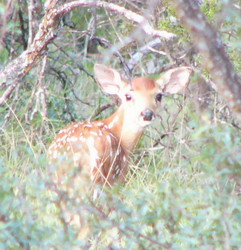
Although deer do not consume very much grass (less than 9% of diet and only on young, new growth), they do require it for fawning cover and tall grass can also provide bedding and screening cover. Grazing your ranch is not a bad idea, but make sure you do it properly and it can be a great benefit to your overall deer management and cattle ranching program.