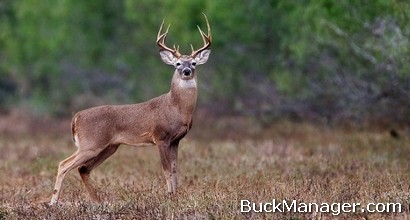
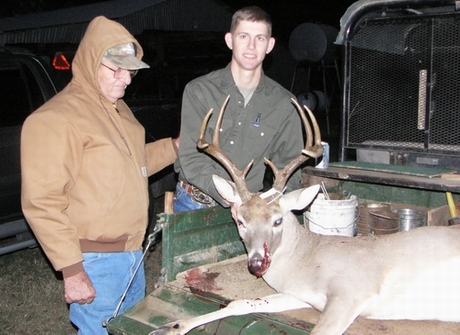
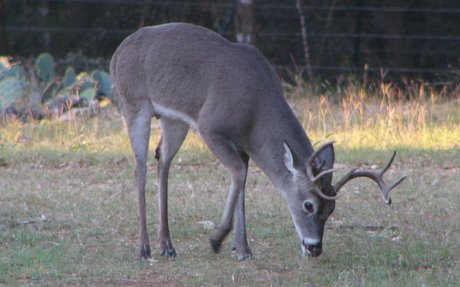
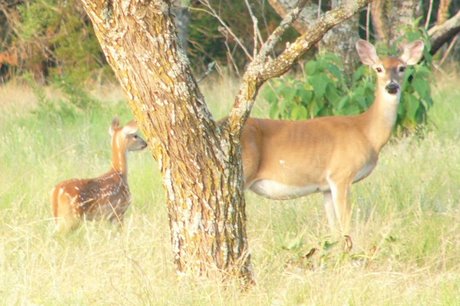
When considering the management of white-tailed deer, unless your property is game fenced you should realize that adjacent lands are also included in the home ranges of many of the deer on a property less than several thousand acres in size. Only those deer within the interior of a really large property may have home ranges located totally within the property, while those in a wide band around the property’s perimeter likely move back and forth onto adjacent lands.
The quality of a property’s deer population will in large part be dependent on both the habitat quality and population management strategies (i.e. hunting pressure and deer harvest) on both your and neighboring lands.
The 4 Keys to Deer Habitat Management
The key to producing a productive and healthy white-tailed deer population is dependent upon the quantity, quality, and variety of food plants produced by the habitat or range. Food availability can be improved in the following ways:
1. Harvesting deer, including does, to maintain total deer numbers at or below the capacity of the habitat.
2. Stocking the range with a moderate number of domestic animals, preferably those that do not directly compete with wildlife, and utilizing some form of a deferred-rotation system of grazing.
3. Controlling invading “noxious” woody vegetation, such as excessive brush species that are not needed for cover. This will reduce competition between plants species and increase the production of grasses for cattle and the production and availability of browse and forbs preferred by deer. It is recommended that your property be a mosaic of 50-60% wooded/brush with the remainder in scattered openings and/or food plots.
4. Avoiding the stocking of excessive numbers of exotic big game animals or at least keeping their numbers at a low level, since exotics compete with white-tailed deer for browse, forbs, and mast. If you are really interested in producing trophy white-tailed deer, stay away from competing exotics.
High Quality Foods for Deer Herd Health
Understanding food habits of deer is fundamental to deer management. You can produce large antlered deer simply by shoveling feed down their throats, but a good hunting property also provides and looks like good wildlife habitat. There is no doubt that you can produce a large, trophy-size buck in a pen on top of asphalt if you provide it with adequate food, shelter, and water and let it live long enough to reach its genetic potential, but I don’t think this is your goal if you are reading this article.
Studies have shown that deer prefer forbs and browse (leaves and twigs from trees or shrubs). Grasses make up a very small portion of a deer’s diet (usually less than 10%) and they are utilized only when tender and green. Deer can not digest mature grasses. Forbs are generally high in protein and important to deer size, antler development, and fawn production. However the production, quality, and palatability of forbs is highly dependent on rainfall and the season of the year. Forbs will be absent or unpalatable at least during portions of a year, typically during late summer and late winter.
Managing Habitat for Deer, Nutrition
Browse is the stable component of deer diets and, unlike forbs, is available throughout the year and is relatively drought resistant. Although utilized by deer throughout the year, browse becomes most important during the winter and summer stress periods when forbs are absent or unpalatable.
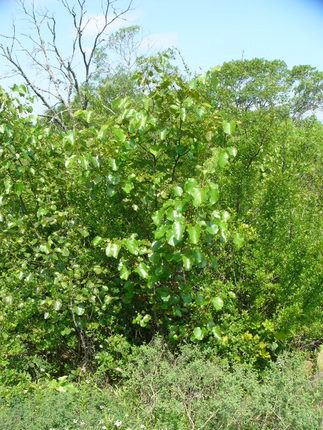
Browse species in a given area will vary with soils and precipitation, local climatic conditions. The best browse plants, as sought out by white-tailed deer, occurring in Central Texas include honeysuckle, downy virburnum, Texas madrone, Texas (Spanish) oak, Texas kidneywood, littleleaf leadtree, Texas sophora, Wright pavonia, chinaberry, mulberry, Carolina buckthorn, true mountainmahogany, cockspur hawthorne, Oklahoma plum, sugar hackberry, cedar elm, and slippery elm, which are rated as preferred species.
Moderately preferred species include skunkbush sumac, flameleaf sumac, evergreen sumac, poisonivy, possumhaw, fourwing saltbush, white shin oak, Lacey oak, blackjack oak, chinkapin oak, post oak, Roemer acacia, Texas redbud, saw greenbrier, common greenbrier, Carolina snailseed, Texas colubrina, escarpment blackcherry, woollybucket bumelia, netleaf hackberry, heartleaf ampelopsis, ivy treebine, sevenleaf creeper, Virginia creeper, and mountain grape.
Many woody plants also produce mast (acorns, fruits, or beans) that is readily eaten by deer, but mast production is erratic and therefore it is not as reliable as a food source as the foliage. Important mast producers are the oaks (including live oak, which is a low quality browse species), and mesquite and Texas persimmon, both of which are low quality browse species. The woody species found in your area is dependent upon the area’s geographic location, soil types, and terrain.
Past management practices, such as excessive goat browsing, cattle grazing, or improper or excessive brush control practices could also be contributing factors. The quantity and species diversity of woody plants are typically greatest on the deeper soils of riparian areas along stream courses and lowest in areas of shallow soils.
Determine the most important whitetail food plants in your area and manage for those plants. Native plants are very nutritious, highly desired by white-tailed deer, and are a renewable resource that will help you produce trophy deer, make your property look great, and save you some feed money over the long haul.