Most of the land in Texas is privately owned but there are some solid public deer hunting lands found throughout the state. The majority of the public draw hunts for white-tailed deer are good quality hunts on state-owned properties, many of which are managed specifically for deer and other native wildlife.
Each year offers more opportunities for deer hunting than the years prior, as additional draw hunts on public and private lands are being consolidated into Texas Parks and Wildlife Department’s (TPWD) online application system. Gone are the days of filing out dozens of paper forms (which was the norm) for various public lands and wildlife management areas.
Texas Public Hunting Lands
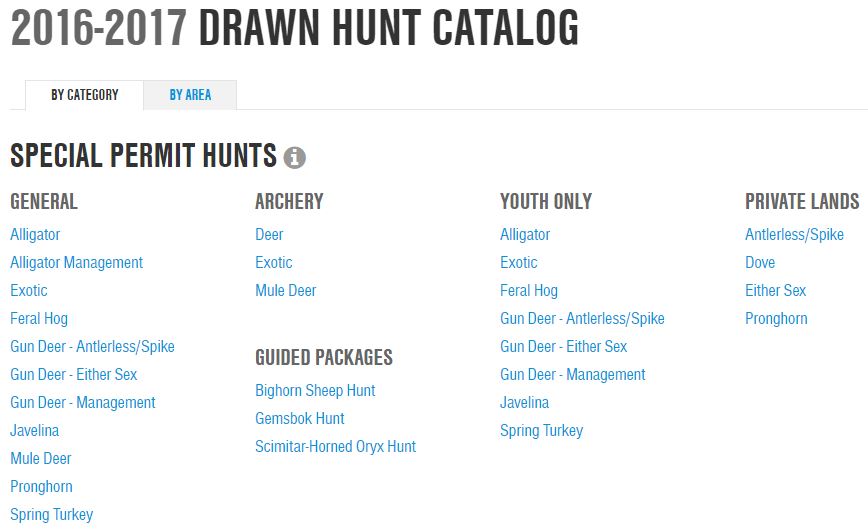
Included in these public lands hunts are hunts for white-tailed and mule deer, pronghorn, exotic ungulate species, turkey, alligator, as well as a guided hunt for desert bighorn sheep and even a new category offer public dove hunting. They key to getting on any of these hunts starts by putting your name in the hat.
I’ve come up empty handed in the draw process before, but more years than not I’ve been lucky enough to go hunt some new country across the state. Although I’m no-doubt focused on the quality public deer lands out there, I make sure to enter almost all of the other hunt categories as well.
State and Federal Hunting Opportunities
In addition to drawn hunts managed by TPWD, other public hunting land opportunities now includes applications for hunts administered by other agencies. This is especially good for deer hunters living in the eastern part of the state or closer to the Texas coast.
These federal land hunts include about 1,500 big game hunt positions on several U.S. Fish & Wildlife Service National Wildlife Refuges in Texas and antlerless deer permits for U.S. Forest Service properties in East Texas.
All hunt opportunities can be viewed by category or by area using an interactive web-based map. In fact, the entire application process is handled online — from browsing opportunities, to applications, fee payments and permit issuance. To participate in Texas’ draw hunts, applicants will need an email address and a credit or debit card.
Deadlines to Apply for Texas Public Drawn Hunts
Every year, the application deadlines for public land hunts begin in August, with early August being the deadline for alligator hunts and about mid-August being the deadline for archery deer, exotic, javelina and the new private lands dove hunts. Other hunt category deadlines, such as those for either-sex and antlerless deer hunts, occur from late-August through late-January.
Hunters interested in applying for Texas’ public hunts must apply online through TPWD through the Texas Public Hunt System. Hunters can apply up to 11:59 p.m. Central Time on the application deadline, and after the application is submitted, they can check their drawing status online at any time.
Costs of Public Deer Hunts
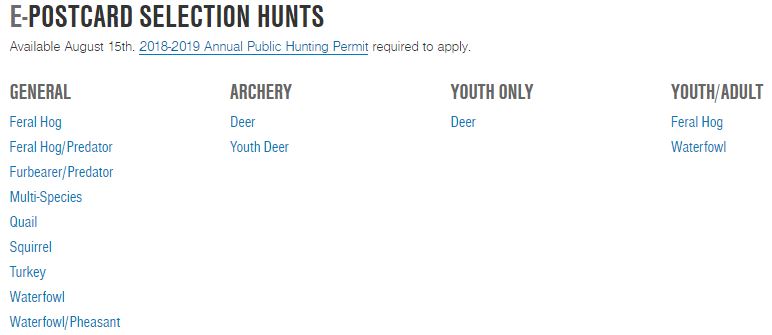
The drawn hunts program offers affordable public deer hunting in Texas with a good shot at success. Application fees are $3 or $10 depending on the hunt category. The E-Postcard Selection Hunts offered through the state, which includes hunts for white-tailed deer on both state and federal lands, requires that applicants possess a valid Annual Public Hunting (APH) Permit. This is the old “Type II” permit, for those that recall.
So what happens if you are selected and win a hunt? Adult hunters that are selected for regular drawn hunts may also need to pay a special permit fee of $80 for regular hunts and $130 for extended hunts. Some categories, such as the youth-only hunts, require no application fees or permit fees at all. Hunters selected through the E-Postcard Selection Hunts on public deer hunting lands do not have to pay any additional fees either.
Deer hunting season is still a half-year away, but planned changes to Texas’ deer hunting regulations may impact your harvest later this fall. That’s because the Texas Parks and Wildlife Commission adopted a bevy of changes to this year’s deer hunting regulations that includes expanding white-tailed deer hunting across counties located in the western Panhandle, as well as creating additional deer hunting opportunities in the eastern half of the state.
This is good news out of Texas Parks and Wildlife Department (TPWD). Simply said, the bulk of Texas’s new deer regs will add or create additional hunting opportunity is just about every county they touch for the 2016-17 season. There are really only a couple changes that do not increase deer harvest in some way, with the two most notable being changes regarding “unbranched antlered deer” and then addressing some issues regarding youth hunting.
Legal Bucks in Texas
The hunting regs approved for this fall will clarify what constitutes a legal buck across seasons and aim to alleviate confusion among hunters. This has been a little ambiguous regarding the “Special Late Antlerless and Spike-buck Season,” where hunters in antler restriction counties could harvest a buck with “at least one unbranched antler during the regular season,” but then were limited to spikes (bucks with two unbranched antlers) during the Special Late Antlerless and Spike-buck Season.
The new regs will allow the harvest of any buck with at least on unbranched antler during the late season, remove the mention of spikes from the name and will officially be named the “Special Late Season.”
MLDP Program Clarification
Another regulation clarification (say that over and over) involves archery-only season, youth hunters and properties enrolled in the Managed Lands Deer (MLD) Permit Program. The changes for the upcoming fall with clarify that white-tailed antlerless deer harvested during the archery-only season does not require a permit and harvest of antlerless deer during youth seasons is restricted to persons 16 years of age and younger including on properties issued Level 1 MLD Permits.
Whitetail Hunting in Panhandle
TPWD is opening up hunting seasons in a 14 Panhandle counties where no white-tailed deer hunting seasons existed previously. Changes for 2016-17 will implement both a general and special archery-only season for white-tailed deer in Andrews, Bailey, Castro, Cochran, Gaines, Hale, Hockley, Lamb, Lubbock, Lynn, Parmer, Terry and Yoakum counties, with a bag limit of three deer (no more than one buck and no more than two antlerless), which is identical to adjoining/nearby counties that currently have a season.
Hunters in Winkler County will also be greeted with new deer seasons. The regs for the upcoming year will add both a general and special archery-only season for white-tailed deer in Winkler County, with a bag limit of three deer (no more than one buck and no more than two antlerless, with the take of antlerless deer restricted to the archery-only season or properties issued MLD Permit antlerless tags). The new season is identical to adjoining/nearby counties that currently have a season.
Doe Days Added in Some Counties
Deer hunters in the Blackland Prairies, Post Oak and western parts of East Texas will also see a boost in deer hunting opportunity. TPWD is establishing four “doe days” (time periods in when antlerless deer may be taken without a permit in parts of the state where antlerless harvest regulations are conservative) in Bell (east of IH35), Burleson, Ellis, Falls, Freestone, Kaufman, Limestone, Milam, Navarro and Williamson (east of IH35) counties.
They will also increase the number of doe days to 16 in Anderson, Brazos, Camp, Gregg, Grimes, Henderson, Lamar, Leon, Madison, Morris, Red River, Robertson and Upshur counties.
For all Texas counties approved for more liberal doe harvest regulations, deer management goals across-the-board by TPWD cite increasing deer populations and diverging buck to doe ratios as rationale for the changes. Many of these counties will also get a muzzleloader-only season.
More Muzzleloader Hunting
TPWD’s hunting regulation changes for 2016-17 will implement a muzzleloader-only late season in Anderson, Bell (East of IH 35), Brazos, Burleson, Comal (East of IH 35), Delta, Ellis, Fannin, Falls, Franklin, Freestone, Grimes, Hays (East of IH 35), Henderson, Hopkins, Hunt, Kaufman, Lamar, Leon, Limestone, Madison, Milam, Navarro, Rains, Red River, Robertson, Smith, Titus, Travis (East of IH 35), Van Zandt, Williamson (East of IH 35), and Wood counties.
TX Regulation Changes Add Up
In short, changes to Texas hunting regulations will provide hunters with more opportunity and flexibility when heading to the field this fall. Increased antlerless options will allow doe harvest as a management tool on properties not participating in the MLD Permit Program. Harvest is still one of the most basic habitat management tools for whitetail deer.
Landowners and managers will no longer be limited to archery equipment to tighten up sex ratios, and many counties will have brand-new seasons. That is awesome for hunters!
The secret to killing mature bucks during hunting season means implementing harvest management: Don’t shoot them. Well, at least not while they are young. If bucks are protected when they are young and allowed to age then they will become mature. Makes sense, right?
Shooting mature bucks down the road means not filling your tag/s with young and middle-aged bucks this year, or maybe even next year. More and more deer hunters are subscribing to this deer management philosophy. But at some point, young bucks grow up to be old bucks. And shooting older bucks is exactly what US hunters did during the 2014-15 deer season.
The deer harvest data we are discussing today is from the season prior. It takes some time to compile the information from each state and put it into a cohesive report. It will be equally interesting to see how the 2015-16 whitetail season shakes out.
Image pureairnatives.com
Deer Management Practiced, Bucks Mature
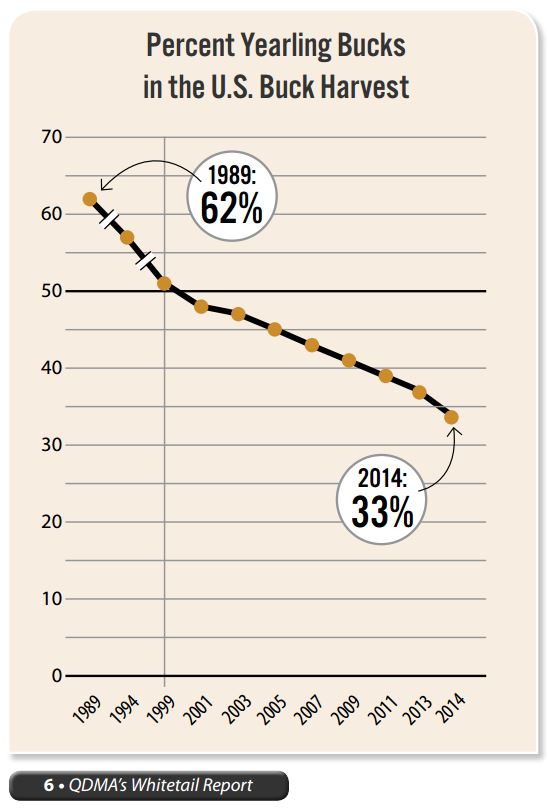
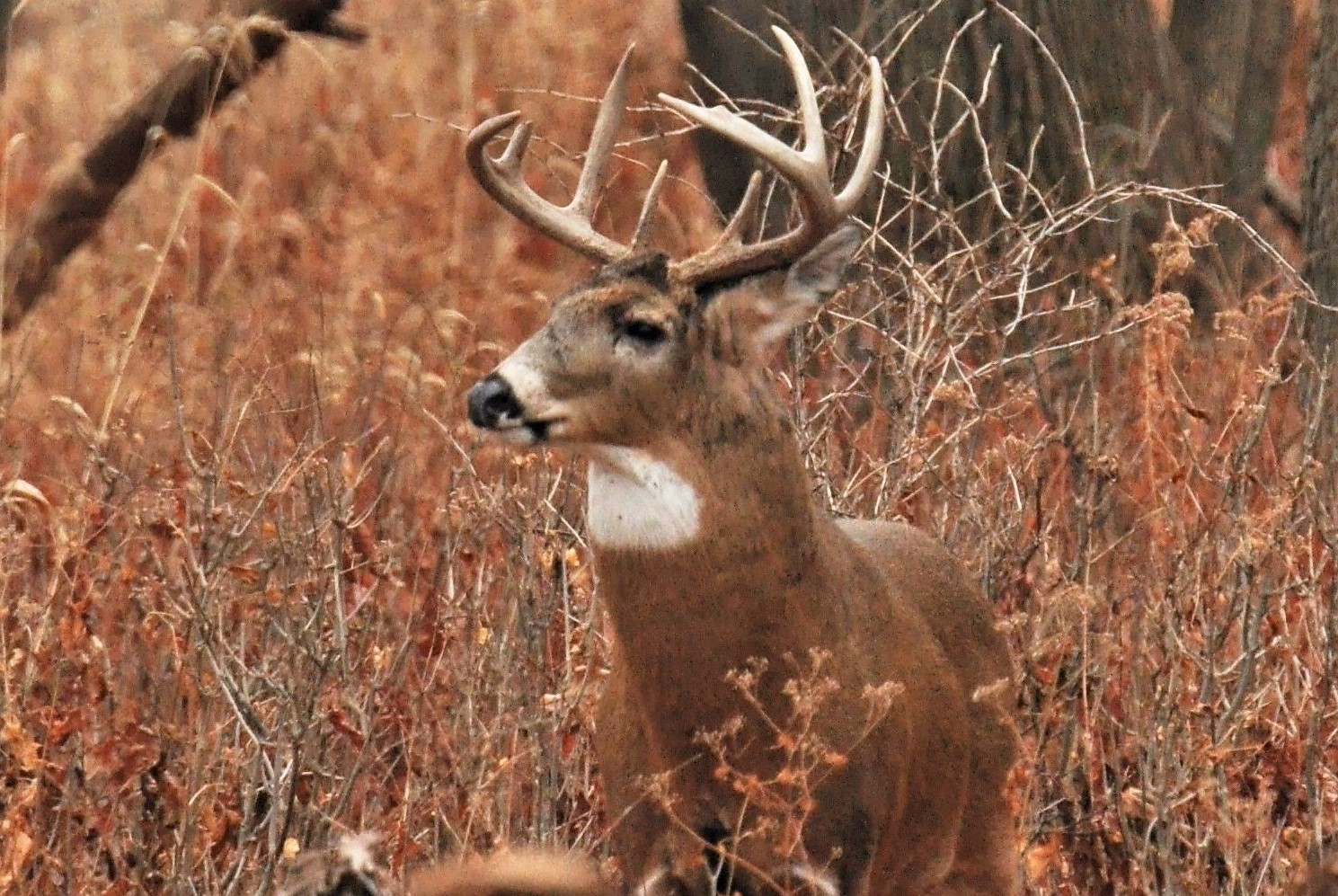
According to harvest data compiled by the Quality Deer Management Association (QDMA) in its 2016 Whitetail Report, deer hunters in the United States tagged more mature white-tailed bucks than 1 1/2 year old (yearling) bucks for the first time in recent history. Yearling bucks comprised 33 percent of the buck harvest, continuing the steady decline since 1989 when yearling bucks made up 62 percent of the buck harvest.
Source: “Since QDMA was founded in 1988, we’ve watched the harvest pressure on yearling bucks decline steadily from the extremes seen after restoration, and this resulted in climbing rates of mature-buck harvest as more older bucks became available. However, the 2014-15 season will be remembered as the first where the two trends intersected and hunters took more mature bucks than yearlings.
“The ongoing decline in harvest pressure on yearling bucks means that more and more hunters are enjoying an opportunity to see and kill mature bucks. They’re also enjoying other benefits of hunting deer populations with healthy numbers of older bucks, like intensified rut activity, more rubs and scrapes, and better success with rattling and grunt calls. This is good for hunter retention and participation, which is good for ensuring the future of deer hunting.”
Top States for Mature Whitetail Bucks
According to the 2016 Whitetail Report, the top state that killed the most mature bucks during the 2014-15 season was Mississippi, where 74 percent of bucks killed were 3 1/2 years old or older, followed by Arkansas and Louisiana at 67 percent, Texas at 62 percent and Oklahoma at 60 percent. The 5 states also had low harvest rates for yearling bucks.
Image druryoutdoors.com
Complete state-by-state estimates of total buck harvest, buck age structure, and other harvest data are available in the full Whitetail Report. This document is chock-full of deer data for the 26 reporting states, which includes most of the white-tailed deer’s range. I recommend checking it out for some interesting and eye-opening reading.
Will the trend of killing more mature bucks continue in your neck of the woods? That’s to be determined, but the trend is definitely our friend in this case. Harvest data suggests that whitetail hunters are increasingly passing on young bucks during the hunting season so we should all be very optimistic about the deer hunting seasons ahead!
Managing for Maturity
Passing on young bucks is easier said than done. We are all human, so we all have a desire for immediate gratification. Deer hunting is no different. Besides, there are ways to avoid eating tag soup over winter. First, start out with a plan. A deer management plan is a great first-step towards putting population management and a harvest strategy into action on a property.
The initial steps will involve figuring out what you have to work with, taking inventory of both plant communities and the deer found on a property. Next, it will be a matter of identifying your goals and establishing objectives so that you can get there. If one of the goals is to kill mature bucks, then it’s going to take hold off on younger bucks during the hunting season. Again, it’s not easy. Having a plan that can serve as a roadmap, however, will help tremendously.
When it comes to whitetail deer hunting the number one way to go is, well, up. Most hunters hunt from elevated positions, whether it be some type of ladder stand or climbing stand. This is one of the most effective ways to get close to deer, but sometimes it’s not the best way.
In areas where trees are small or in large open expanses (where the ability to see is your friend) then sitting up in the canopy of a tree may not be the best way to go. Get down out of that tree, monkey! Below are 8 tips on how to hunt deer from the ground.
Image wildlifedepartment.com
1. Keep the Wind & Deer in Your Face
This is always the first rule of deer hunting. Read it, learn it, know it. You can do a lot of things less than perfect and get away with a lot more while hunting deer if you heed this ground hunting tip. Although whitetail deer have great vision, most of the time it’s their nose that stops hunters from tagging them, putting them in the freezer. And since your reading this, I know you want to put venison in the freezer.
Here’s the breakdown: If the wind is blowing in your face and the deer are upwind of you then they have zero chance of smelling you. This is especially important for hunting from the ground since your scent will be at ground level. Position yourself downwind of where you think the deer will be moving/coming from and you will up your chances of success dramatically.
2. Scent free: The Way to Be
An important deer hunting rule is to stay scent free. Don’t stink. It sounds easy in principle but it’s not always easy to do. Sure, if you are going to prep at your vehicle and then walk 100 yards it may not be too tough. But what about someone that has to hoof it 2 miles on a mild day. A long walk is enough to get any hunter stinking, even on a cold day. Do your best of keep your scent level down.
A hunter does not have to be completely scent free, but you want to give off as little human odor as possible. You do not have to worry about the deer upwind; they will not smell you. But the deer downwind, whether you can see them or not, will scare everything off. Smell like dirt, leaves or nothing at all.
3. Hunting from the Ground: No Movement Allowed
Other than scent, the quickest way to get busted by whitetail deer is to be moving around. When you hunt from the ground you are at the deer’s level. This is where they live. They know this is where most of their predators live. Deer watch the ground very closely. One of the best hunting tips I can offer is to stay motionless when on the ground. It’s also a fairly good idea when you’re up in a tree, but not as big of a deal.
The thing with deer hunting is that you can probably move a lot of the time. But the kicker is that you have to see the deer before the deer see you. This is impossible to pull of when hunting from the ground unless you have 360 degree vision. Fail. Stay still and kill deer.
4. Camo Up for Ground Level Success
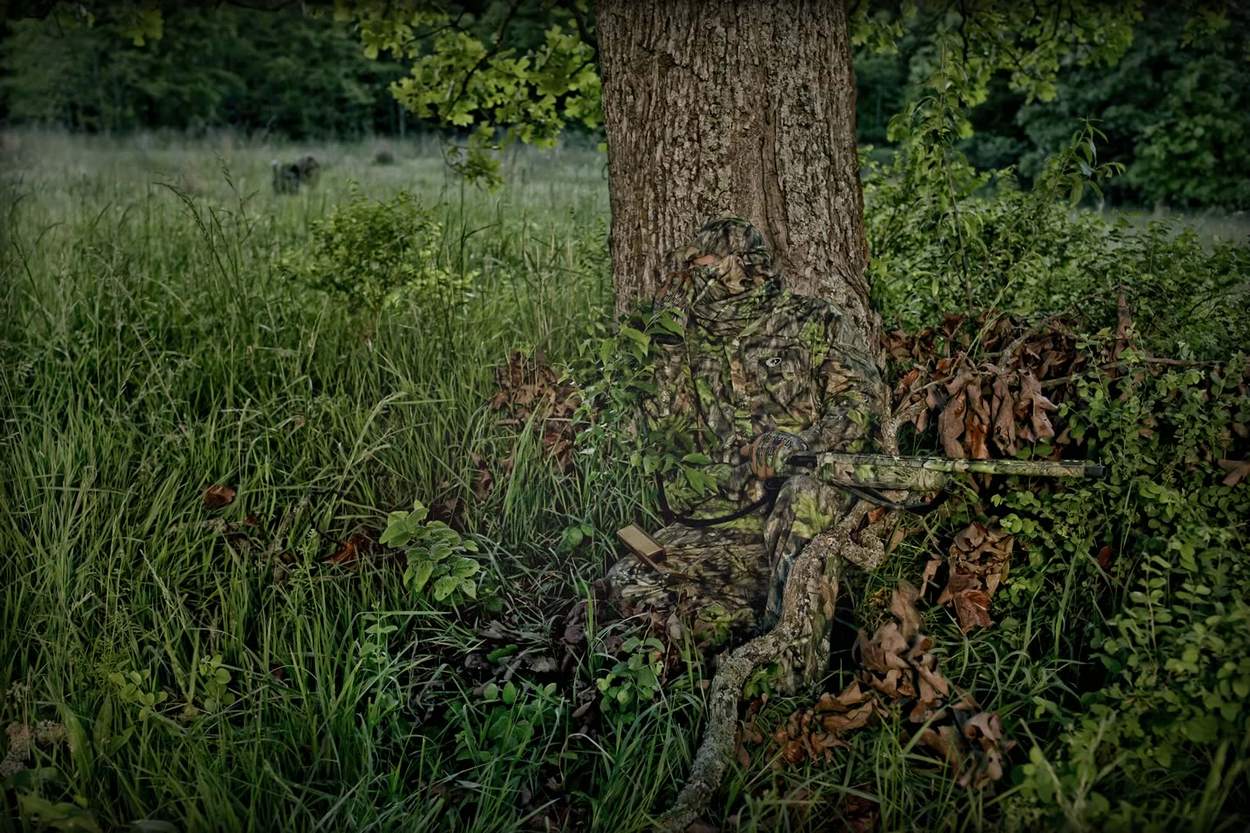
Whitetail deer can not see the entire color spectrum, but they can see in the blue-green range. One of the best ways to ruin your chances of tagging a buck or doe from the ground is for them to notice you, to stick out. Most hunters have camouflage clothing. Make sure to use it as well as well as a face mask while positioned on the ground. I don’t wear a face mask when hunting from an elevated position because from my experience deer just do not pick me up. This is most likely because I’m not moving around either.
However, hunting from the ground is a whole new ball game. Your face will look like one big, solid color to a deer. One that they rarely encounter except when they see… people! If a deer looks you in the eyes you will want to make sure you have your face mask on. Go camo. Even your gloves. Everywhere.
5. Ground Hunting Means No Silhouette
This falls into the same camp as wearing camo, but instead of trying to mask your head, arms and legs, you are trying to mask the shape of your body. Here is how you do not want to hunt from the ground: sit in sparse vegetation when you expect to shoot deer relatively close to you. Any “blob” sitting on the ground gets noticed by whitetail. Quickly. Do not sit against a fence post unless you are hunting with a rifle and you expect your target to be at least 100 yards out.
Instead, increase your chances of success while deer hunting by sitting at the base of a tree, stump,rock or even a small dirt pile/hill that is at least as tall as the top of your head while sitting and at least as wide as your shoulders. This completely breaks down your silhouette and makes you disappear into the object you are sitting in front of, especially since you will have your camo clothes, gloves and face mask on.
6. See a Long Ways
Sit where you can cover some country, where you can see a long ways. This is not as effective for hunters using archery equipment, although it still helps to pick up an approaching deer as soon as possible. Deer hunting from the ground can vary because vegetation and terrain can vary, but allowing yourself to see maximum area will offer you the opportunity to see the maximum number of animals.
Keep in mind that you do not want to hunt some place that does not look “deery” just because you can see 500 acres. You see everything in a plowed field, which may or may not have deer. If deer are crossing it or foraging on forbs/weeds growing in it, then by all means get out there. Otherwise, go someplace else. Just make sure you hunt someplace where you can see, whether that be a field or a long right of way.
7. Hunt Deer Travel Corridors
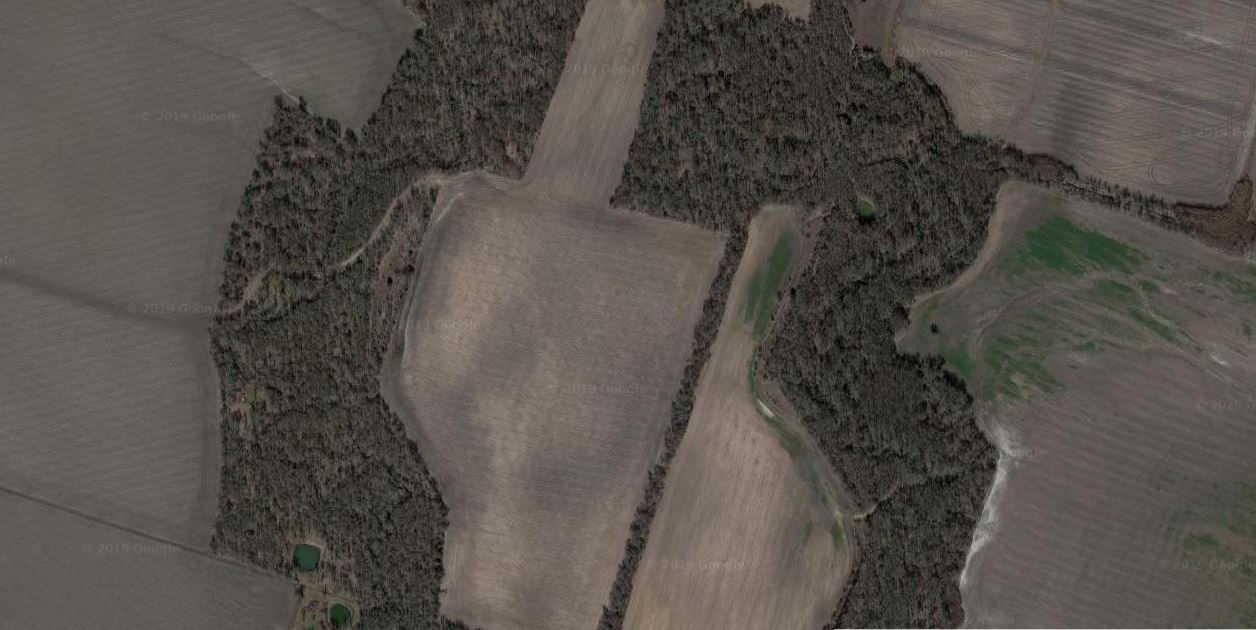
Mention travel corridors and deer hunting and most think of a strip of woodlands surrounded by open grasslands. Yes, this is a corridor, but the corridors that deer use can be more than just wooded areas. Often times, deer will use a fence line with very little brush as a travel corridor across open country. Sometimes they use a county or field road with a narrow strip of grass 2-4 feet tall. Deer are only about 3 feet tall when standing, by the way.
In addition, a travel “corridor” could be a grassy waterway in the middle of a cultivate field. It could just be a low saddle in a grassland. Either way, check out your hunting grounds and look for travel corridors. Set up downwind of one of these and you will be successful. This is often how I hunt deer from the ground. Find their travelway and you will see them, tag them. It may not happen on the first day but it will happen.
Image pureairnatives.com
8. Hunt at the Right Time
This is the last tip I have for deer hunting from the ground but it’s just as important as the others, maybe more so. That’s because the best way to increase the odds of you seeing deer is to hunt when deer are moving. Sure, the first 2 hours and last 2 hours of the day are when deer move the most. Both are great times to be hunting, no doubt. However, there is more to productive deer hunting than just getting out there early and staying late.
Hunting during the whitetail breeding season is always good. It is during the rut that bucks are moving more than normal. This increases the odds of him crossing your path. Find out when the rut happens in your area and hunt during that time. And during the rut it does not hurt to hunt all day since bucks will be constantly moving about.
The rut is awesome, but hunting at the right time even has more to do with the weather than anything else. From my experience, nothing gets deer on their feet more than cold weather. And I’m not just talking about winter time in general. What really makes deer move is when the mercury drops down low. The very best time to hunt deer is when deer must move. When it’s warm deer are content to sit under a tree somewhere back in the woods. When it gets below 30, 20, 10 degrees… that’s when their warm blooded engines kick into high gear. It takes ENERGY to stay warm. Time to move and eat. Time to hunt!
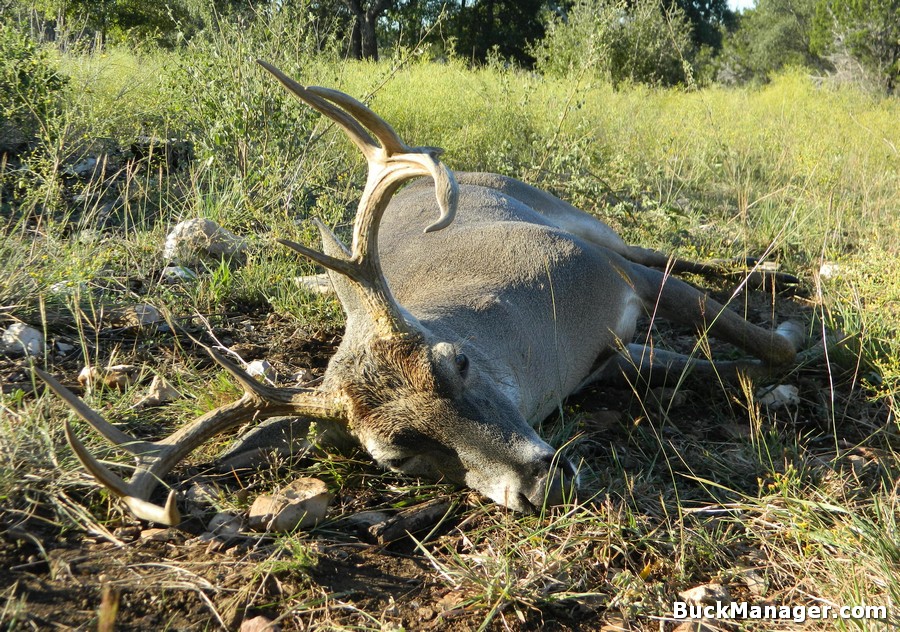
It’s been a good fall for deer hunting in Texas and the month of November is not yet over. There have been numerous reports of really nice whitetail bucks being harvested all across the state, as well as Oklahoma, with everyone indicating above average body weights and antler growth in deer. Sounds like a lot of full freezers for deer hunters.
Nothing grows more muscle, fat and antler than good habitat that is is good condition. Fortunately for both deer and hunters, that is mostly what we had this past year. We were flush with new-growth throughout the growing season. As they, say, it’s better to be lucky than good. Having a deer management plan in place on your property will help you be both.
Image wildlifedepartment.com
“We saw a diverse buffet of whitetail deer foods this spring where vegetation growth was measured in feet rather than inches this year,” said Alan Cain, TPWD white-tailed deer program leader. “Meeting nutritional demands of antler growth, raising fawns and building up body fat reserves for the rigors of breeding as well as the winter should be an easy venture for white-tailed deer this year.”
Unlike in recent years, whitetail did not have to look far to find a highly-nutritious diet of native weeds and browse plants. White-tailed deer are quite selective and prefer native forbs and browse high in protein and energy that are easily digestible. Forbs, a biologist term for weeds, fit that bill, and there were in abundance this year. The can have protein levels ranging from 20 to 35 percent!
Source: Buck antler growth should be well above average, predicts Cain. Exceptions to this overall excellent outlook may be in areas of East Texas where unusually wet years can result in lower-than-normal fawn recruitment. But overall, deer hunting will be good.
“I have no reservations suggesting antler quality will be above average this year, and with a good number of bucks in the 5-year-old age class I expect a number of hunters to harvest some exceptional bucks this year,” Cain said. “The habitat conditions statewide are much better than we’ve seen in years, and the abundance of native forage will help bucks maximize antler growth this year.”
So what can hunters expect with regards to deer numbers and quality. For starters the 2014 statewide deer population estimate was 3.95 million deer, the highest estimated population since 2005. Statewide whitetail population trends indicate a slow but steady growth in the deer population during the last 10 years.
Good rainfall helped produce a lot of fawns, which added to the deer herd this year. It also means that that more deer should be considered for harvest, at least in most parts of Texas.
“Although these numbers are from 2014 I would predict the deer population to be about the same if not break the 4 million deer mark for 2015, so hunters should experience a quarry-rich hunting environment this year,” Cain predicted, citing above average fawn production this year.
He also suggests hunters take advantage of opportunities to harvest antlerless deer this season, too, in order to offset high fawn production. “Hunters need to keep deer numbers at a level the habitat can sustain during lean years,” said Cain. If next year ends up being a poor rainfall year, then a smaller deer herd is more likely to have a better fawn crop, as available food is divided up among fewer mouths.
The key to producing good white-tailed deer year-in and year-out is to maintain the proper deer carrying capacity for the habitat. There really is no substitute for population control and habitat enhancement. Of course, it helps when ample rain falls because then every property produces good deer, even in areas with fair habitat for whitetail.
In Texas, dry or low rainfall years seem to be more common than wet ones. It’s best to plan on every year being a tough year. Then, on those years when it does rain you can reap the benefits in terms of both habitat and deer conditions.
Rainfall equates to forbs and those forbs translate into healthy deer, good fawn production and big bucks, even in areas where deer numbers are higher than what would be considered optimal. Again, shooting (literally) for a lower deer herd helps make every year a good year.
Chances are the next spring will not be as good for whitetail as the last one, so do your part for local deer management and take a doe or two if there is a need to do so. Improving the whitetail hunting in your part of Texas means taking inventory of what you have, then making a plan and taking the steps to make it even better.