Remembering Justin Hurst

From the time he was a teenager guiding goose hunters on the Texas coastal prairies, probably even before then, Justin Hurst was subconsciously preparing himself to make a difference in natural resource conservation. Those who knew him say he seemed to approach life with that goal in mind. Although his journey was cut short when he lost his life in the line of duty on his 34th birthday, March 17, 2007, Hurst had already made his mark on the Texas landscape. And, the impacts he had on the state’s wildlife resources, as well as on his family, friends, coworkers, and even adversaries, serve as his legacy.

“Game Warden Justin Hurst personified all of what Texas Parks and Wildlife represents,” Col. Peter Flores, TPWD Law Enforcement Division Director, says. “He cared for wildlife, he was a pillar of his community, and he cared deeply for his family and was a faithful public servant. His death is a great loss to the people of Texas.”

Hurst started his career with the Texas Parks and Wildlife Department as a biologist in August 1995 specializing in waterfowl management along the mid-coast. Fellow wildlife biologist Matt Nelson remembers joining TPWD at the same time as Hurst.

“He went to Peach Point (Wildlife Management Area) and I went to Mad Island (WMA), both of us worked on the central coast wetlands project,” Nelson recalls. “We had numerous research projects going on at the same time and spent most weeks together; fish sampling, working up alligators and mottled ducks. A lot of late nights together running around the marsh in air boats. Justin was very enthusiastic, dedicated towards the resource and approached everything full-bore.”

At Peach Point WMA, Hurst was able to submerse himself in his passion for waterfowl and the marsh habitat. For six years, he built a reputation as a wildlife biologist who understood the resource and conservation.

“He got it,” offers Dave Morrison, TPWD waterfowl program leader. “He understood the importance of resource management and conservation and could relate that to others. He was a heckuva biologist.”

That’s why it came as such a surprise when he announced plans to become a game warden.

“No one within the project saw that coming,” says Nelson. “He never mentioned anything to us, and then out of the blue he said he planned on going to the game warden academy. He’ll always be a biologist to us. The thing about Justin, whatever he put his mind to, he’d do it well. We lost a good biologist.”

Hurst became a part of the 48th Texas Game Warden Academy and graduated in August of 2002. While at the academy, Hurst shared his knowledge about waterfowl with fellow cadets and actually taught duck identification techniques. Some of his classmates referred to Hurst as the “Super Cadet” because of his diligence and drive.

After graduation, Hurst served about a year in Brazos County when a game warden slot became open in Wharton County. Hurst met with then TPWD Law Enforcement Division Director Col. James Stinebaugh personally to make his case for a transfer.

Stinebaugh says the decision to transfer Hurst was a no-brainer, but admits it did cause a rumbling in the ranks at the time.

“Typically, we required at least two years experience before letting a warden put in for a transfer, but it just made perfect sense to put Justin back down there because we needed someone who knew waterfowl in that position,” Stinebaugh says. “I took some heat for that move, but it was the right move.”

Hurst’s supervisor, Capt. Rex Mayes, says he knew well ahead of time he would eventually see Justin Hurst working in his district some day and is glad the colonel broke from tradition. “I remember meeting him for the first time when he was still in the academy,” Mayes recalls. “He said he wanted to come to my district because we had the bay that he loved so much. I remember when he left my office that first time; it was a rude awakening for me because I was seeing for the first time a new breed of game wardens, the whiz kids.”

Game wardens who worked in the field with Hurst remember him most for his preparedness, dedication and respect for others; even those individuals he issued citations to for game law violations.

Hurst is survived by his wife, Amanda, and son, Kyle Hunter, age 4 months, his parents, Allen and Pat Hurst of Bryan, a brother, Greg Hurst of Denver, Colorado, and in-laws, Larry and Jeanie Wilcox of Denton, Texas.

Memorial fund donations may be made to Operation Game Thief, c/o Justin Hurst Memorial Fund, 4200 Smith School Road, Austin, TX, 78744. The Houston 100 Club is also accepting donations for the family at: 100 Club Survivor’s Fund 1233 West Loop South, Suite 1250, Houston, TX 77027-9107.
Cajun Boudin Recipe

Recipe:

2 lb Pork meat, 30 % fat (Pork Butt works well)
1 1/2 lb Pork liver
2 teaspoons Salt
2 teaspoons Black pepper
1 large Onion, finely chopped
3 Green onions, chopped
12 cups Cooked rice
2 tablespoons Cajun spice
1 Lot sausage casing

Place meat in enough water to cover and season with salt and pepper. Cook until meat falls apart. Remove meat and reserve some of broth. Grind meat, onion, and green onions. Mix the ground meat mixture with the Cajun spice, rice and enough broth to make a moist mixture. Taste mixture and adjust seasoning. Using a sausage stuffer, stuff the mixture into sausage casing.

Refrigerate or freeze.

Importance of Buck to Doe Ratio: What’s Best?

The buck to doe ratio over much of the United States is probably somewhere around 1 whitetail buck per 3 to 5 adult whitetail does. This ratio is considered satisfactory for good (annual) production and recruitment of white-tailed deer if one is interested in a quick turnover in the herd.

Essentially, a sex ratio in favor of does can increase the size of a whitetail herd quite quickly each year. As a result, many young bucks and does are often available for harvest each year. A ratio highly skewed towards females is good for maximum deer production, but it’s not necessarily beneficial for optimal quality production. A population skewed towards doe deer is hard on bucks.

What's the Best Buck to Doe Ratio?

Buck to Doe Ratio in Perspective

Thoughts on the ideal buck to doe ratio are quite varied and somewhat controversial in some cases. Depending upon the part of the country you are located, the experiences of the person you are talking with, and a person’s general management philosophies, you will most likely get different answers from every single person you discuss the topic with.

They may all be correct under certain circumstance. The fact is there is no single correct answer for every property out there. However, there are some rules of thumb that may help with the management of the local deer herd.

Deer Sex Ratio: An Example

If a manager wants to harvest a high number of white-tailed deer each year then maintaining many more does than bucks will definitely get you there. For example, let’s say your hunting property is 500 acres. Assuming the proper carrying capacity for this land is roughly 50 deer (1 deer/10 acres) then a buck to doe ratio of 1:4 would mean your deer herd is comprised of 10 bucks and 40 does.

If the annual fawn production, fawn crop is 50 percent then that equates to 20 fawns survive through the summer and into the fall. With this number in mind, the manager must now remove an excess of 20 deer on the property come fall hunting season to keep the overall deer population size in check with the carry capacity and available habitat.

In this example, hunters will have to harvest 10 bucks and 10 does each year to maintain a sex ratio of 1:4 and in order keep the deer population and the proper density. This sounds pretty good since a lot of bucks and does will need to be shot each year (opportunity!), but it will definitely limit the number of mature bucks in the population.

Buck to doe ratio is very important!

Tightening Up the Ratio

Now, let’s change the scenario. If a manager wants to maintain better quality bucks and have an improved buck age structure, then consider lowering the buck to doe ratio on the property to around to 1:2. This would maintain the herd on our hypothetical 500 acres at 17 bucks and 33 does.

Under these conditions, a fawn crop of 50 percent puts annual fawn production at only 16 animals. With continued herd management in mind, a 1:2 sex ratio can be maintained by harvesting roughly 8 bucks and 8 does each year. It also allows the manager to leave some bucks to grow on the property while also maintaining a proper deer density for the example area, 1 deer for every 10 acres.

1:1 Ratio?

The above examples illustrate how the number of both males and females plays into a whitetail management program. Under a managed situation with a deer herd at carrying capacity the hunter’s annual harvest equals the number of fawns produced by the herd that year.

So, can we take it a bit further? In this example let’s say we want to promoteĀ an evenĀ better age structure in the buck segment of the herd. Let’s consider shooting for a 1:1 sex ratio, so just 1 buck for every 1 doe.

Okay, back to the hypothetical ranch. The 50 deer on the ranch would now consist of 25 bucks and 25 does. A 50 percent fawn crop means only about 12 fawns. This number looks low compared to the numbers of fawns produced in the prior example, but keep this in mind.

To keep the deer population in check under a 1:1 ratio hunters only need to remove 12 deer, 6 bucks and 6 does. This makes the deer management program a bit easier with respect to total deer harvest because you don’t need to remove as many deer, but the real reward is the number of older age class bucks found within the herd.

Remember, with a ratio of 1:4 ratio we had to shoot all of the adult buck herd annually to maintain the proper number of deer on a ranch. This equates to shooting nothing but 1 1/2 year old (yearling) bucks every year.

A sex ratio closer to 1:1 means hunters need to harvest 6 of the 25 available bucks on the property to maintain the deer herd. So instead of shooting 10 yearling bucks under a 1:4 ratio, hunters are now able to shoot more mature bucks that are likely much better in quality.

Best Buck to Doe Ratio

The deer herd examples above are intended to illustrate how the number of bucks, does and fawns interact on an annual basis. A 50 percent annual fawn crop was chosen because that’s about what it averages in my part of the world. Some years are a better, some worse.

Fawn survival is something that should be considered when thinking about a deer management program. Maintaining the total deer population within the carrying capacity of the habitat will go a long ways towards keeping the whitetail using your property in good condition and will increase fawn survival.

What’s the best buck to doe ratio for your property? The answer depends on the goals of property owner and/or hunters and must take into account many other variables. First, does the size of the property lend itself to some level of deer population management? Other factors that should be considered on a property include:

  • Deer density (carrying capacity)
  • Average annual fawn production
  • Desired total annual deer harvest
  • Desired annual buck harvest
  • Desired annual buck quality
  • Deer harvest on adjacent lands

The buck to doe ratio is a key parameter for the management of a white-tailed deer herd. Decide on a place to start using the above considerations and then manage the herd to get there. That may mean shooting deer or not shooting deer. Once there, evaluate the results of your management actions and adjust according. That’s what management is all about, adapting to the current situation to get to a desired situation.

Do not fall victim to believing that a 1:1 buck to doe ratio is best for your property. Maybe, maybe not. With the proper number of deer on a property and a sex ratio that is closer together the quality of bucks on a property will improve because of adequate food resources, lower energy expenditure during the breeding season, and improved age structure. Maintaining deer numbers will become achievable. The buck to doe ratio does make a difference.

Big Buck Found at Lake Waco in Texas

Lake Waco Buck

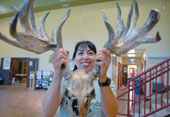
This Lake Waco non-typical monster scored 224 2/8 Boone and Crockett points. The buck's head and antlers were found by a woman looking for a place to fish near the lake. Lucky for us, drought conditions exposed the record-setting pair of deer antlers that can be considered a genuine wonder of nature. They are the largest antlers on record found in McLennan County, Texas, according to the Boone and Crockett Club.

The antlers were actually discovered in December 2005 by Cindy Parongao, a U.S. Army Corps of Engineers volunteer, while she was searching for a new fishing hole near the twin bridges area on the south side of Lake Waco. The land surrounding the lake is protected from hunting and this allows deer to live longer and grow larger antlers.

Based on a set of thorough measurements by Boone and Crockett officials, the antlers scored 224 and two-eighths points, making them the 21st largest on record in the state of Texas since the 1830s. If you are in the area, the antlers will go on display in a couple of weeks at the Lake Waco Wetlands Research and Education Center, 1752 Eichelberger Crossing Road.

Chronic Wasting Disease in White-tailed Deer

Chronic Wasting Disease (CWD) is a brain disease related to Bovine Spongiform Encephalopathy, also known as “Mad Cow Disease.” CWD affects elk, mule deer and white-tailed deer. Researchers are just beginning to understand CWD. CWD appears to be caused by an abnormal protein called a prion. CWD can be spread by close contact between animals, and animals exposed to a CWD-contaminated environment may also become infected.

Usually, months to years pass from when the animal is infected to when it shows signs of disease. Research suggests that the minimum incubation period for CWD in deer is about 16 months. Classic CWD signs in deer/elk 18 months or older include poor body condition, tremors, stumbling, increased salivation, difficulty swallowing, and excessive thirst or urination.

Chronic Wasting Disease in Deer
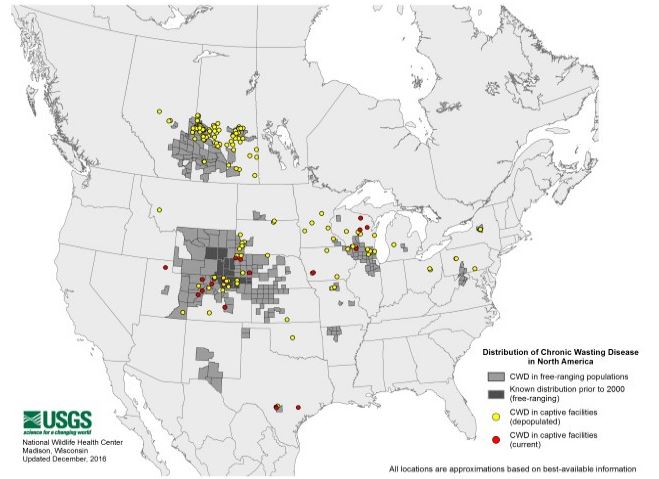
Locations of Chronic Wasting Disease (CWD) in the US as of December 2016.

Typical signs of the disease include drooping head or ears, poor body condition, tremors, stumbling, increased salivation, difficulty swallowing, or excessive thirst or urination. In Minnesota, CWD has been discovered in two captive elk farms in Aitkin and Stearns counties. In the wild, over 15,000 deer have been tested and the disease has not been detected.

The disease was first discovered in Colorado and Wyoming, and has since been detected in wild or captive animals in Illinois, South Dakota, Nebraska, Kansas, Oklahoma, New Mexico, Montana, Utah, Wisconsin, Saskatchewan and Alberta. CWD was confirmed in Texas in July 2012. More states will need to be added to this list as CWD spreads throughout the US.

CWD has been detected in wild and captive deer and elk populations in 12 states in the West and Midwest. Though it is deadly to some deer and elk species, there is no evidence that CWD is harmful to humans or other domestic livestock.