Brush Management Considerations – Texas Examples

Brush management is the selective removal or suppression of target woody species, including exotic species, to allow the increased production of desirable trees, shrubs, grasses, and forbs for forage and cover. This practice includes retaining the proper kind, amount, and distribution of woody cover for selected wildlife species.

Brush management planning must consider deer and other wildlife cover requirements, soil types, slope angle and direction, soil loss and erosion factors, and subsequent planning to control reinvasion. This practice also includes the retention of snags to provide cover and nesting sites for cavity nesting animals. It can also include the planting of native tree and shrub species to provide food, corridors and/or shelter where these habitat components are limited.

First and foremost, the emphasis of brush management should be in areas with the best soils?it is here you will find the greatest potential for increased production of preferred species of herbaceous and woody plants. Woody cover should be retained in areas of shallow soils and/or steep and rocky terrain where vegetation removal and soil disturbance would enhance soil erosion and where the response of preferred plants would be minimal.

Denser cover should also be retained along drainages and other natural breaks in the terrain. These blocks of cover can serve as travelways and as “refuges” that wildlife can retreat into for security when disturbed and for protection from inclement weather.

In Texas, the control of plant species such as ashe juniper, eastern red cedar, mesquite, prickly pear, and oak species that invade a variety of rangeland sites is often warranted. When these species dominate an area, they diminish plant diversity and the quality of habitat for most wildlife species. Vegetation manipulation may be in the form of prescribed burning, mechanical, biological, or chemical control of trees, brush, or weeds. Most of these practices will require the use of specialized equipment or machinery for plowing, discing, bulldozing, spraying, or other vegetation or soil manipulation procedures. The cost effectiveness of the different control measures must be considered prior to initiation of control measures.

Prescribed burning under a predetermined set of guidelines and plans is the most cost-effective habitat management tool that can be used to enhance plant diversity by stimulating the production of a variety of forb and grass species. It is also effective in controlling low-growing woody plants and maintaining them at the low heights most beneficial to wildlife. Livestock as well as wildlife can benefit from a properly planned and conducted prescribed burn. However, there are legal constraints and liabilities in the use of fire. The land manager should be well-trained and knowledgeable on the proper use of fire before attempting a prescribed burn.

A written burn plan should be developed that specifies the environmental conditions under which burns should be conducted. A long-range burn plan for a ranch should indicate the number of acres that are planned to be burned annually and the general burning cycle. A 5-7 year burning cycle, where an area is burned once approximately every 5-7 years, is generally recommended for north and central Texas. The burning cycle in your area will vary with the plant community, soil type, and rainfall in your area.

Mechanical equipment can also be used to control woody plants, and can be highly effective on smaller, targeted sites. The use of mechanical equipment to control woody plants will typically result in an initial growth of forbs and annual grasses and the resprouting of many woody species.? Soil disturbance associated with mechanical controls releases the natural seed bank found in the soil, increasing the quantity, quality, and distribution of plants beneficial to wildlife. However, without periodic follow-up treatments of fire, herbicides, or additional mechanical manipulations, and/or without proper livestock grazing management, these sites will eventually again become dense stands of regrowth brush and trees.

Mowing (shredding) areas of herbaceous plants and/or low-density woody plants is another form of mechanical treatment. Mowing should be postponed until after the peak of the nesting/young-rearing period of local ground-nesting birds and mammals. One-third of open areas can be mowed per year, preferably in strips or mosaic types of patterns, to create “edge” and structural diversity.

Biological control can also be implemented to control brush in certain situations.? Biological control is the use of heavy grazing pressure by livestock such as goats to control or suppress woody plants and sheep to control herbaceous weeds. Long-term heavy grazing pressure by goats, which prefer woody browse but will also consume forbs, will eliminate all leaves from woody plants up to a height of four feet.

The creation of this “browse line” and the resulting park-like appearance of the woody plant community will have negative effects on the?deer that also depend on the low-growing foliage of woody plants for both forage and cover. Heavy grazing pressure by sheep, which prefer forbs, will reduce or eliminate forbs that are also beneficial to deer. Under certain management goals, short-term biological control of woody plants and forbs can be a legitimate practice if done correctly.? However, it is not normally a recommended wildlife habitat management practice.

Finally, chemicals can also be used to control the growth of woody plants. The use of chemical herbicides can have a significant negative impact on many plant communities and may suppress or eliminate plants other than the target species. From a wildlife habitat management perspective, the use of herbicides is one of the least desirable methods of vegetation control. If herbicides are used, selective applications, rather than broad-scale applications, are recommended to avoid the elimination of plants that are important to wildlife. When used, herbicides should be applied in strict accordance with label directions.
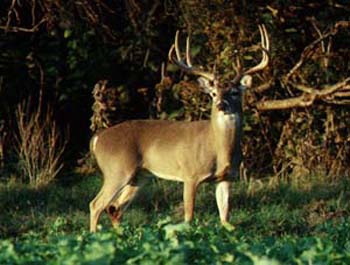
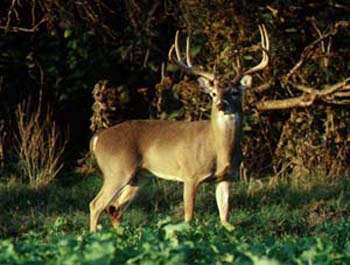
Introduction to Whitetail Food Plots and Forage Management

Intro to Food Plots

The white-tailed deer is the most popular big game species in the United States. Landowners and ranch managers are becoming more interested in intensive deer management strategies including supplemental food plots in order to conserve and further enhance deer populations, in some cases in areas with rapidly decreasing amounts of deer habitat. The establishment of supplemental food plots can be an important deer management strategy which has become widely accepted throughout the southeastern part of the U.S. out to east Texas.

However, it should be noted that most plot plantings are not aimed at improving nutrition of white-tailed deer despite the fact that much of the southeastern deer range provides substandard nutrition for quality deer production. This is compounded by the fact that often times the number of deer (deer density) is greater than the number of animals the habitat can support under optimal body and antler growing condition. Continue reading “Introduction to Whitetail Food Plots and Forage Management”

Breeding Success and Fawn Survival

Breeding Success in white-tailed deer 

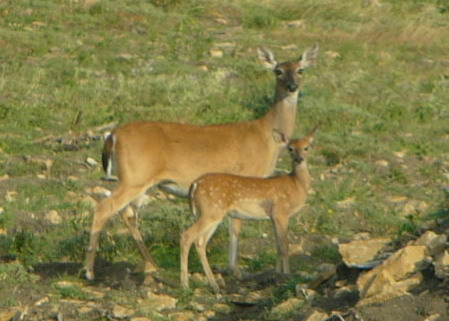
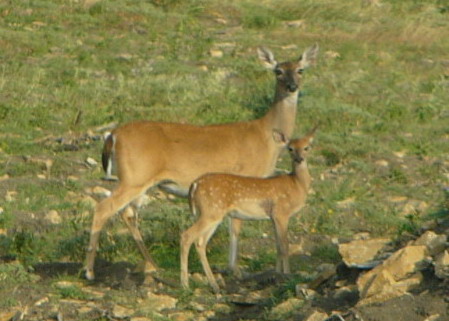
In some circles, you will still hear people talk about the old barren doe that lives in a particular part of the ranch. This line of thinking blames poor fawn production on the idea that many older does do not get pregnant. In reality, if the doe isn’t bred during the first estrous period, she will be receptive again 28 days later. This explains the high breeding success in white-tailed deer, even when bucks are scarce. It was recorded in one Texas study, that on average, 92 of every 100 does sampled were pregnant.

White-tailed deer are known for producing twins. In the previously mentioned study, over half of the does examined had twins. Triplets, however, were not common, and the occurrence of triplets was less than two percent. Quadruplets didn’t show up at all in the study. There were more male fetuses than female fetuses. Males represented 56 percent of the unborn fawns over the three years of the study.

Continue reading “Breeding Success and Fawn Survival”

Wildlife Management Area Named After Justin Hurst

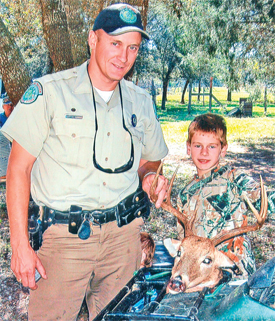
Justin Hurst and young hunter

The 12,000-acre Peach Point Wildlife Management Area located west of Freeport will soon be known to hunters and other waterfowl enthusiasts as the Justin Hurst Wildlife Management Area. The Texas Legislature passed May 29, and Gov. Rick Perry signed June 2, House Bill 12, Section 53 of which makes the name change official.

Soon after Texas Game Warden Justin Hurst of El Campo was killed March 17 in a shoot-out near Lissie with a suspected poacher (which involved another game warden, Texas DPS and Wharton County Sheriff’s Department officers), word got out that the Texas Wildlife Commission would be asked to consider renaming Peach Point for Hurst since he had worked there as a wildlife biologist from 1995 through 2001.

Texas Parks & Wildlife Department officials said shortly after Hurst’s funeral March 21 that the renaming was all but a done deal. The late game warden’s wife, Amanda, said she thinks the renaming ceremony and dedication will be held in October, which is exactly when large numbers of Hurst’s beloved migrating waterfowl are arriving on the Texas coast. “Justin would think we are making way too big a deal out of this, but I think it’s awesome,” Mrs. Hurst said.

“I think it’s very much a fitting memory for him, and I think it’s good for the biologists that he worked with. It’s been their baby, and was something they wanted to do in remembrance of Justin.” Peach Point wasn’t just special to Hurst as a TPWD biologist, but to his wife as well. It was where her future husband took her on their first date on March 14, 1998.

They had met at a Wildlife Society meeting in Beaumont in 1997, and were married April 7, 2002. Both earned degrees in wildlife ecology from Texas A&M. They also hunted and fished together.

“We went down there and drove around. He showed me the different impoundments.It was spring, so we probably looked at a few teal and some mottled ducks, shore birds and stuff like that. He showed me the bunkhouse, the barn, the tractor and the airboat. I know it’s pretty exciting,” she said, laughing.

Mrs. Hurst said her husband’s duties as biologist were wide in scope. “He did everything from cutting grass around the bunkhouse to burning, shredding … he maintained the habitat there.” Justin also worked with waterfowl banding programs, youth hunts and regular hunts on the weekends.

Peach Point provided public hunting opportunities for more than 2,000 hunters this past season. Hurst was instrumental in helping to develop those public hunting opportunities. Hurst left the TPWD Wildlife Division at Peach Point in the fall of 2001 to join the Law Enforcement Division. He entered the TPWD Game Warden Academy in March 2002.

About Peach Point WMA

Peach Point WMA near Jones Creek has 10,311 acres which were purchased using waterfowl stamp funds from 1985 to 1987. In 1988, an additional 1,627 acres were acquired as mitigation from the Brazos River Harbor District. Peach Point WMA is a part of the Central Coast Wetlands Ecosystem Project (CCWEP). The CCWEP’s mission is to provide for sound biological conservation of all wildlife resources within the central coast of Texas for the public’s common benefit.

Peach Point WMA is located within a league of land deeded to Stephen F. Austin by the Mexican government in 1830. The tract was known as Peach Point Plantation. The plantation was established in 1832 by James F. Perry and his wife, Emily Austin Perry, Stephen F. Austin’s sister, who bought the property from Austin for $300. The land was operated as a slave plantation until 1863 with cotton and sugar cane the primary crops.

Perry died in 1853, after which Emily Perry gave William Joel Bryan (her son by previous marriage) 200 acres of the original plantation. Bryan and his wife, Lavinia Perry, made their home there and developed a thriving cotton and cattle business known as the Durazno Plantation. A portion of Durazno Plantation is contained within the present boundaries of Peach Point WMA.

The portion of Peach Point Plantation that contained Peach Point WMA was donated to Austin College by Lucy Harvey. The property was later sold to a consortium of six major petro-chemical corporations. Development plans included construction of an offshore pumping station for oil tankers. However, plans were canceled due to the decline in the oil-based economy. The Nature Conservancy eventually acquired the 8,580 acre tract, and it was from them that TPWD purchased the area using waterfowl stamp funds.

Goals of Peach Point WMA

In prioritized order, the Central Coast Wetlands Ecosystem Project’s goals are:
n To develop and manage habitats for indigenous and migratory wildlife species with a special emphasis on waterfowl.

To formulate research and management activities on WMAs and private lands and disseminate research results and management information to scientists, land managers, resource agencies, and other interested groups and individuals.

To expand and improve WMA facilities to accommodate intensive research and management activities that will allow complete understanding of coastal ecosystems.

To provide optimal public outreach and recreational opportunity on state-owned lands compatible with the resource.

The wildlife management area where Justin Hurst worked as a wildlife biologist prior to becoming a game warden will be renamed as the Justin Hurst Wildlife Management Area and dedicated in October 2007.

Influencing Antler Development in Bucks

Believe it or not, big bucks are both born and made! The whitetail bucks on your property may be born with great genetics, but if they don’t get what they need, they may never show their true potential. On the flip side, some bucks will never meet your expectations simply because they are genetically doomed. It’s not their fault, but not all bucks are born with the same genetic code.

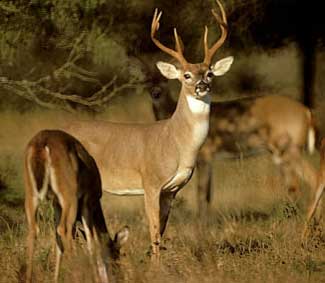
So how do you get maximum antler growth from your deer herd? Antler development (main beam length, antler spread, basal circumference, and number of points) is dependent upon three factors: nutrition (quantity and quality of food), age, and genetics.

Whitetail age genetics nutrition

Nutrition: Nutrition can be optimized by the methods discussed above: controlling the numbers of deer and exotic ungulates, utilizing a rotational system of domestic livestock grazing with moderate stocking rates, and controlling noxious vegetation.  Supplemental feeding and supplemental plantings, in conjunction with the above practices, can be used to help meet the nutritional needs of deer.

Age: Maximum antler development of buck deer is attained at 5 to 6 years of age.Allowing bucks to reach older ages and grow more body mass through selective harvest will allow them to attain their maximum potential antler growth. Heavy, mature bucks typically produce the largest antlers.

Genetics: Spike antlered bucks are the result of inadequate nutrition, genetics, or a combination of these two factors.  Research has shown that yearling (1 1/2 year old) bucks have the potential to produce 4 to 8 points as their first set of antlers if nutrition is adequate and they have the proper genetic background.  Conversely, bucks may only produce spike antlers as yearlings if they have “spikes genes”, even with adequate nutrition.  Although the subsequent sets of antlers of yearling spikes generally will not be spikes, their antlers tend to be inferior to those of bucks that were forked antlered as yearlings.

Consequently, the incidence of inferior antlered bucks in the population should be minimized by the combination of optimizing nutrition (habitat management) and including spike antlered bucks in the total deer harvest.