CWD Found in Whitetail Deer in Del Rio, Texas

Val Verde County Deer Test Positive

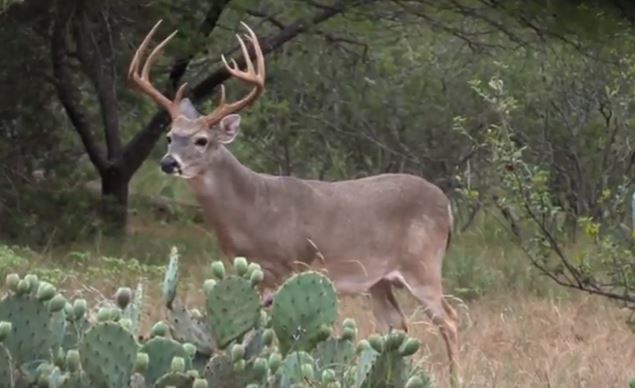
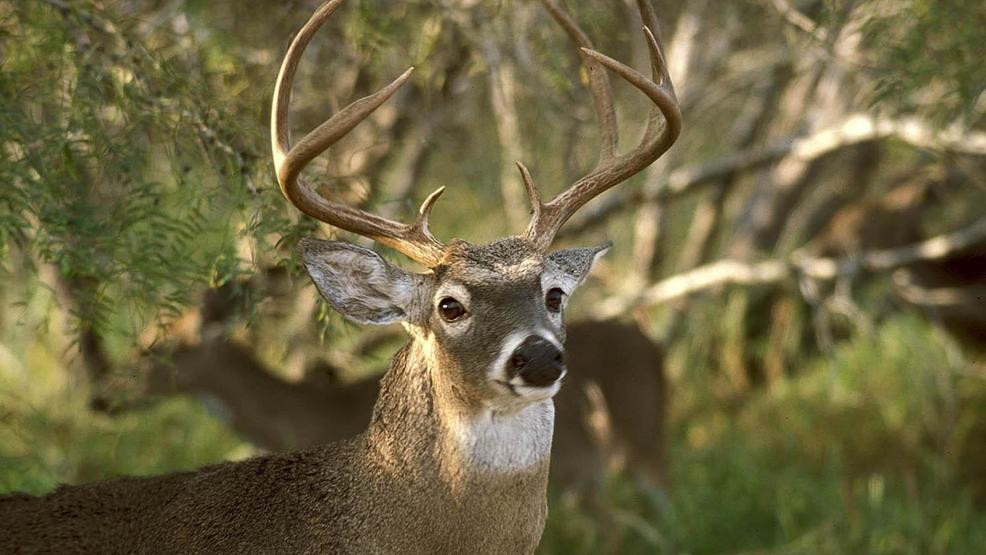
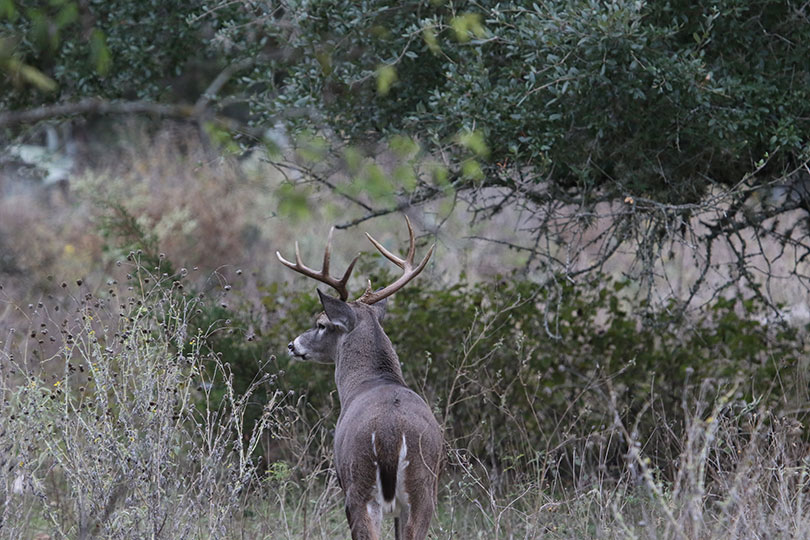
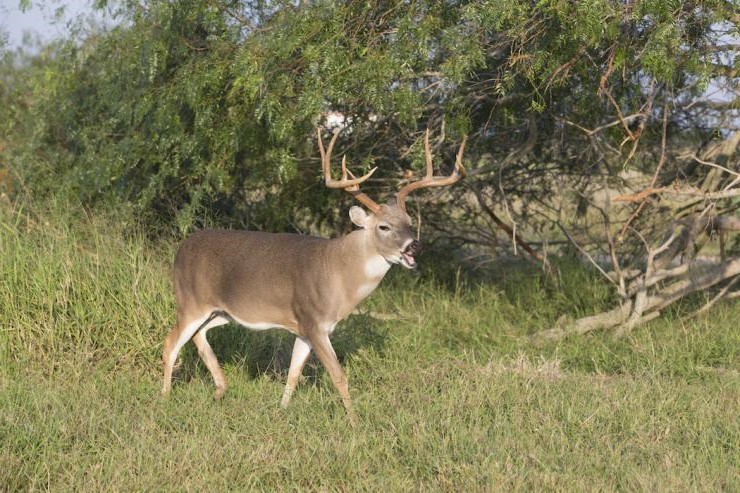
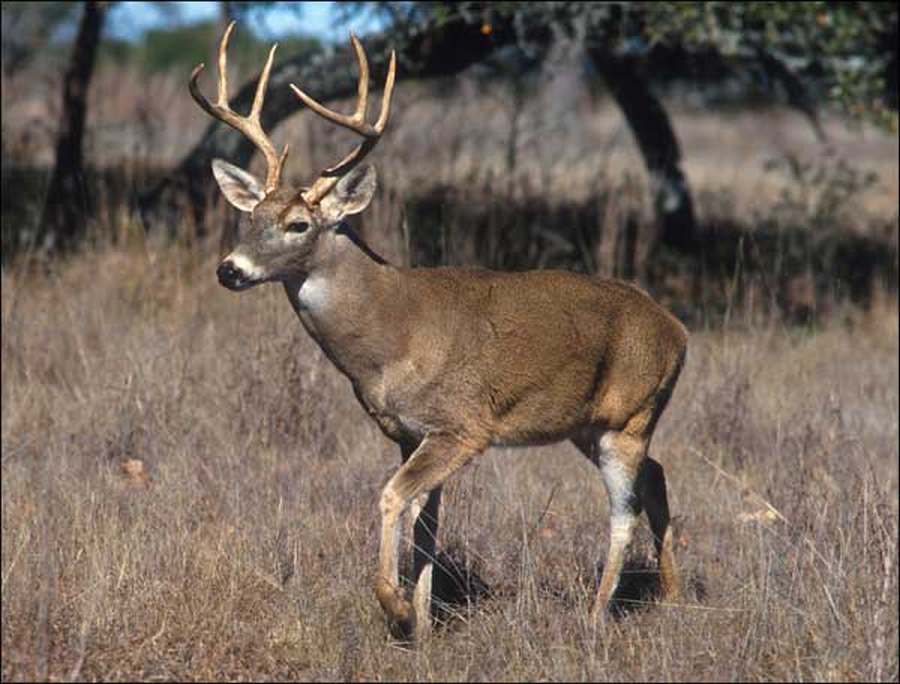
A white-tailed deer in Del Rio, Texas, tested positive for Chronic Wasting Disease (CWD), says Texas Parks and Wildlife Department (TPWD). CWD was first discovered in cervids in North America over 50 years ago.

Initially, CWD was an little-known illness that seemed to occur only in a small geographic area in northeastern Colorado and southeastern Wyoming. In the last two decades, additional states have documented the disease. It’s showing up in more whitetail herds each year. The disease is being found at an increasing, almost exponential, rate.
Chronic Wasting Disease Found in Del Rio, Texas

CWD in Texas

CWD was first documented in Texas in the Trans-Pecos region in 2016. When deer hunting season opened, Texas had three CWD Zones where mandatory testing of hunter-harvested deer is required by TPWD. Now that CWD has been been detected in a free-ranging, 5 ½ year-old white-tailed doe between Del Rio and Amistad Reservoir, Texas will have four CWD Zones. More is not always better.

TPWD and Texas Animal Health Commission (TAHC) are implementing a containment strategy designed to limit the spread of CWD from the affected area and better understand the distribution and prevalence of the disease.

“Because eradication is thought to be impossible once CWD becomes established in a population, it is imperative that we work with other agencies, landowners and hunters to contain this disease within a limited geographic area and prevent it from spreading further among Texas deer populations,” said Dr. Bob Dittmar, TPWD’s Wildlife Veterinarian. “This containment strategy is particularly urgent considering this detection happened in the middle of the general deer season.”

Texas CWD Containment Zones

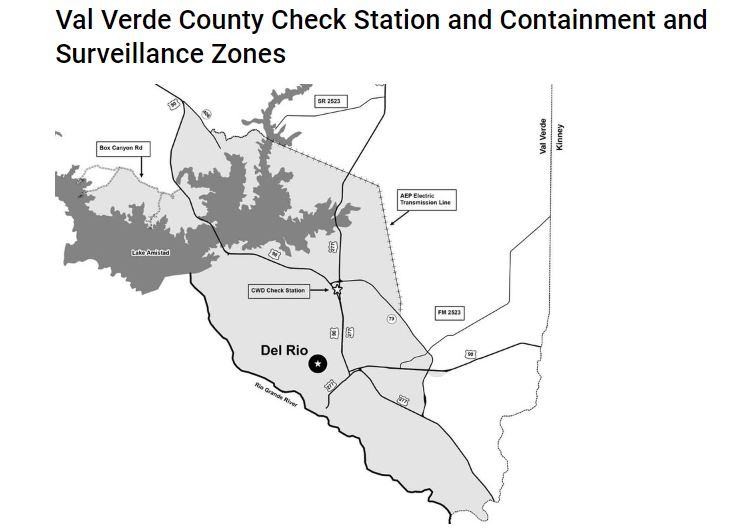
Effective immediately under an executive order issued by TPWD Executive Director Carter Smith, a CWD Containment Zone and all associated rules for that designation are in effect within the boundaries of a line beginning in Val Verde County at the International Bridge and proceeding northeast along Spur 239 to U.S. 90; thence north along U.S. 90 to the intersection of U.S. 277/377, thence north along U.S. 277/377 to the U.S. 277/377 bridge at Lake Amistad (29.496183°, -100.913355°), thence west along the southern shoreline of Lake Amistad to International boundary at Lake Amistad dam, thence south along the Rio Grande River to the International Bridge on Spur 239.
Val Verde County CWD Zones

A CWD Surveillance Zone is in effect within the boundaries of a line beginning in Val Verde County at the confluence of Sycamore Creek and the Rio Grande River (29.242341°, -100.793906°); thence northeast along Sycamore Creek to U.S. 277; thence northwest on U.S. 277 to Loop 79; thence north along Loop 79 to the Union Pacific Railroad; thence east along the Union Pacific Railroad to Liberty Drive (north entrance to Laughlin Airforce Base); thence north along Liberty Drive to U.S. 90; thence west along U.S. 90 to Loop 79; thence north along Loop 79 to the American Electric Power (AEP) Ft. Lancaster-to-Hamilton Road 138kV transmission line (29.415542°, -100.847993°); thence north along the AEP Ft. Lancaster-to-Hamilton Road 138kV transmission line to a point where the AEP Ft. Lancaster-to-Hamilton Road 138kV transmission line turns northwest (29.528552°, -100.871618°); thence northwest along the AEP Ft. Lancaster-to-Hamilton Road 138kV transmission line to the AEP Ft. Lancaster-to-Hamilton Road maintenance road (29.569259°, -100.984758°); thence along the AEP Ft. Lancaster-to -Hamilton Road maintenance road to Spur 406; thence northwest along Spur 406 to U.S. 90; thence south along U.S. 90 to Box Canyon Drive; thence west along Box Canyon Drive to Bluebonnet Drive; thence southwest along Bluebonnet Drive to Lake Drive; thence south along Lake Drive to Lake Amistad (29.513298°, -101.172454°), thence southeast along the International Boundary to the International Boundary at the Lake Amistad dam; thence southeast along the Rio Grande River to the confluence of Sycamore Creek (29.242341°, -100.793906°).

CWD Zone Rules

CWD Containment and Surveillance Zone rules include restrictions on the movements of carcass parts as well as live deer possessed under the authority of a permit. The department is also implementing mandatory CWD testing of deer harvested within the containment and surveillance zone within 48 hours of harvest at a new check station located at the RV park at the Del Rio Fisherman’s Headquarters, 4957 US-90, Del Rio TX 78840 (29.43187° N., -100.90898° W). For full details and instructions on how to bring harvested deer to the check station, hunters should check the Outdoor Annual mobile app or TPWD web site.

“This temporary emergency action will allow us to try to contain CWD within the affected zone while we collect more information and gather more data,” said TPWD Executive Director Carter Smith. “The protection of our state’s big game resources is of vital importance and we are grateful to hunters, landowners and local officials for their cooperation in following these rules and spreading the word in their community to help keep the disease contained.”
CWD Regulations

So, About CWD

CWD among cervids is a progressive, fatal neurological disease that commonly results in altered behavior as a result of microscopic changes made to the brain of affected animals. An animal may carry the disease for years without outward indication, but in the latter stages, signs may include listlessness, lowering of the head, weight loss, repetitive walking in set patterns, and a lack of responsiveness.

To date there is no evidence that CWD poses a risk to humans or non-cervids. However, as a precaution, the U.S. Centers for Disease Control and the World Health Organization recommend not to consume meat from infected animals.

“Though CWD has not been discovered in exotic susceptible species in Val Verde County, our agency is working proactively alongside our TPWD partners to achieve enhanced surveillance for all susceptible species in the identified zones,” said Dr. Andy Schwartz, TAHC Executive Director and State Veterinarian.

Reporting Deer for CWD Testing

Hunters are encouraged to report any “sick looking” deer, elk, or other CWD susceptible species while hunting in any CWD zone to TPWD. Contact information for the CWD zone check stations is found within the CWD section of the current Outdoor Annual and associated smart device application. To report a “sick looking” deer outside of a CWD zone, contact a TPWD wildlife biologist or Texas Game Warden.

TPWD will continue to collect samples from all hunted properties located within the containment and surveillance zone as well as roadkills. The department is seeking as many additional samples for testing as it can obtain in order to get a better handle on the geographic extent and prevalence of the disease in this area.

A public meeting is being planned by TPWD, TAHC and TAMU AgriLife to gather public comment, provide information, and discuss the containment strategy moving forward. The date, time and location for this meeting will be announced at a later date on the TPWD News Releases page online and on the department’s social media accounts.
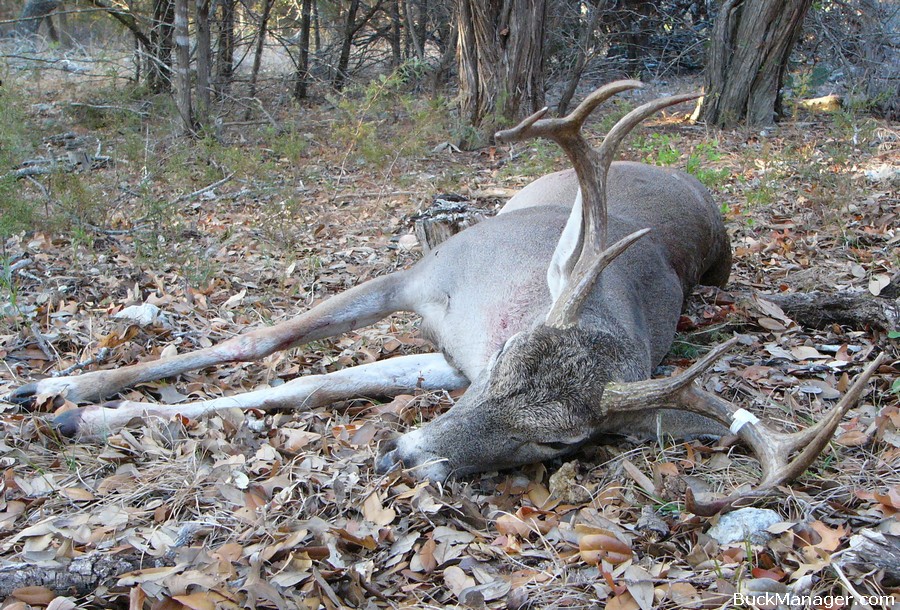
TPWD Will Help Get Your Deer Tested for CWD Disease

More on CWD

CWD is a neurodegenerative disease caused by a prion that affects cervids including deer, elk and moose. However, this disease is now found in wild and/or farmed cervids in many other states in the U.S., where it appears to be slowly spreading, and in parts of Canada. South Korea reported outbreaks among captive cervids between 2004 and 2010, after importing infected animals from Canada, and Norway detected CWD in wild cervids in 2016.

CWD is a member of the transmissible spongiform encephalopathies (TSEs), a group of neurodegenerative disorders caused by prions. Prions are infectious proteins that appear to replicate by converting a normal cellular protein into copies of the prion.
MLDP Fees: Costs for Deer Management Program?

MLDP Fees: The Cost of Success

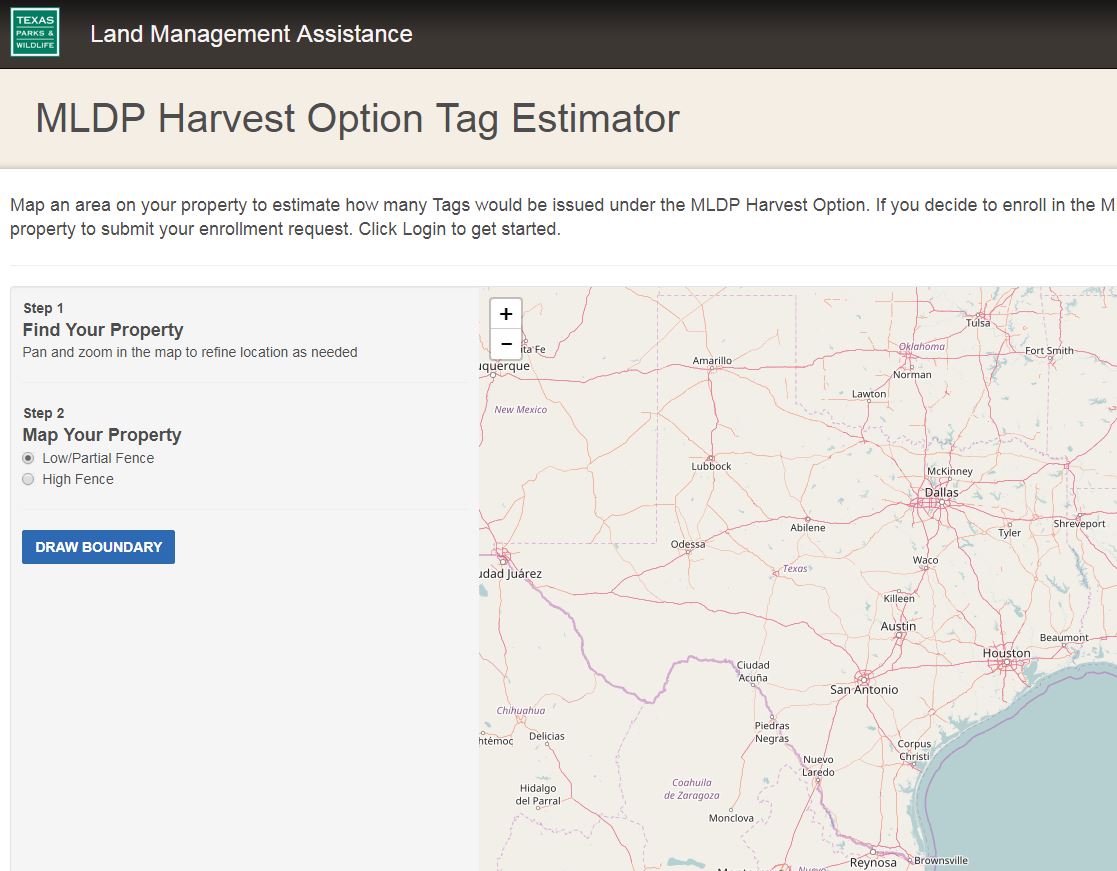
One of the great tools for white-tailed deer management in Texas has been the Managed Lands Deer Program (MLDP) administered by Texas Parks and Wildlife Department (TPWD). The program has historically been offered at no cost to participating properties, but TPWD will soon start charging MLDP fees for program participation.

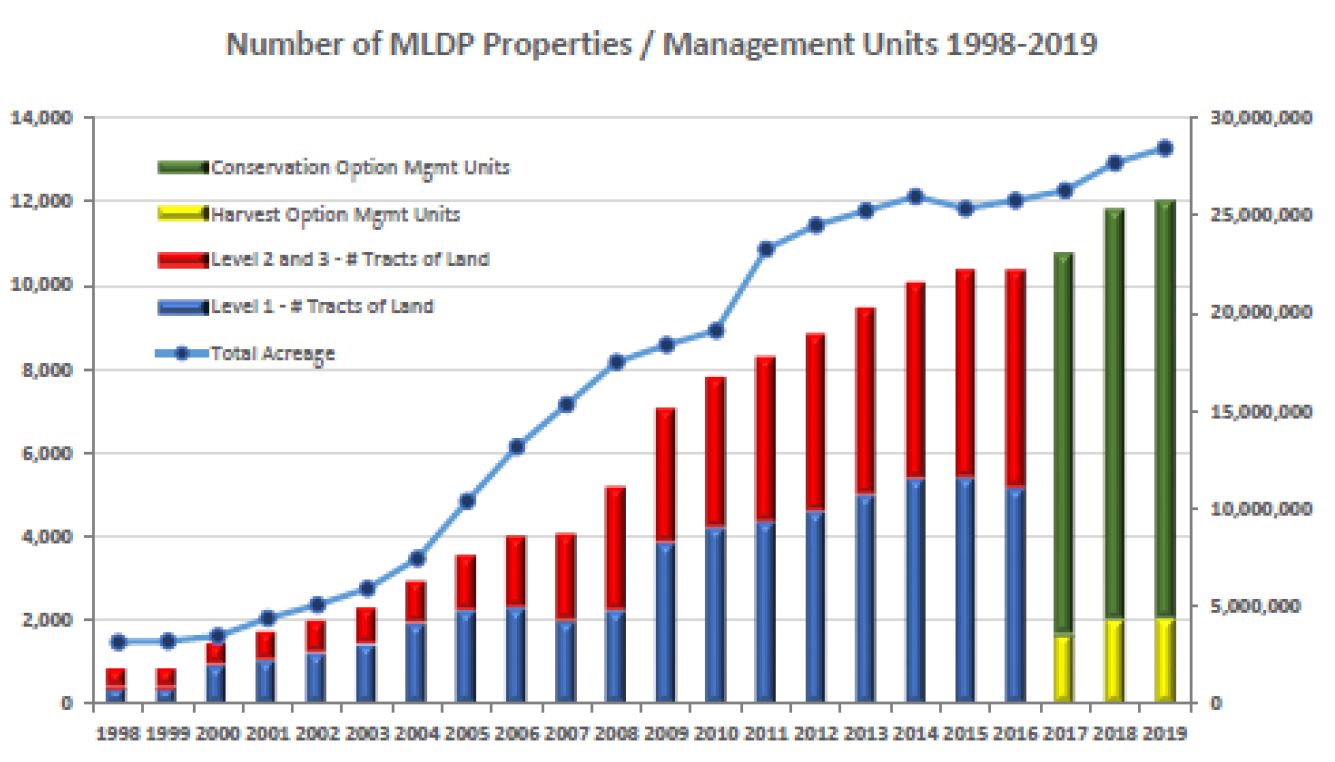
The program allows landowners and deer managers to participate in two different options, both of which provide flexibility outside of the normal whitetail hunting regulations established for a county. According to TPWD, the number of participating properties has grown exponentially over the years. Funds raised through MLDP program fees would be used to add staff positions throughout the state.

MLDP Participation has Grown Annually

Popular Deer Program Results in Fees

TPWD: “The MLDP is an extremely popular program that provides landowners and land managers with additional flexibility to manage deer populations, improve habitats, and provide greater hunting opportunities,” said Alan Cain, TPWD white-tailed deer program leader.

“Increased participation in the MLDP has made it challenging for wildlife staff to administer the program and provide technical guidance to participants. In response, the Texas Legislature earlier this year enacted Senate Bill 733, which authorizes the Texas Parks and Wildlife Commission to establish MLDP fees for participation.”

Below is the email that MLDP participants received on December 11, 2019 regarding proposed program fees.

MLD Program Costs

MLDP Fee Details Emailed to Participants

TPWD is seeking your feedback on proposed MLDP regulation changes that would establish a fee for participation and clarify existing program provisions. The proposed fee amendment is as follows:

Harvest Option

  • $30 fee for each management unit within a property that is enrolled in the Harvest Option (HO), provided the property is not part of an aggregate acreage enrolled in the MLDP;
  • $30 fee for each aggregate acreage enrolled in the HO;

Conservation Option

  • $300 fee for the first management unit of each property enrolled in the Conservation Option (CO) plus a $30 fee for each additional management unit of a property enrolled in the CO;
  • $300 fee for each aggregate acreage enrolled in the CO;
  • $30 fee for each management unit of a wildlife management association or cooperative enrolled the CO.

MLD Program Fees

Provide Feedback on MLDP Fees

The amount of MLDP fees were selected by the department after soliciting and receiving input from department staff, stakeholder groups, and advisory committees regarding what would be a reasonable fee for participation in the MLDP considering the benefits received, the demands on department staff in administering the various options available to landowners under the MLDP, and which would not result in significant attrition from the MLDP by landowners.

The proposed regulation changes are available for review in the Dec. 6 edition of the Texas Register. The public comment period is open through January 23, 2020, when the TPW Commission will meet to vote on adopting these changes.

Comments on the proposed MLDP fees can be submitted via TPWD’s public comment page on their website or in person during the TPWD Commission meeting January 23, 2020 at TPWD’s Austin Headquarters, located at 4200 Smith School Road, Austin, TX 78744. Comments on the proposed changes may also be submitted to Alan Cain by phone at (830) 480-4038 or email alan.cain@tpwd.texas.gov.

Where Do Bucks Go During the Rut?

Buck Movement During the Rut

The white-tailed deer breeding season has been strong this year. During the month of  November, I received reports of intense rutting activity throughout much of Texas. Bucks were easy to spot for those that were able to spend some time in a stand.  I think the strong rut was a product of good body condition in deer and colder than average temperatures.

To be clear, temperature does not impact the timing of the whitetail rut. Bucks can, however, more aggressive and more active for longer periods of time on cold days during the rut; not so much the case when it’s hot out. That puts a lid on everyone’s activity levels.

Whitetail breeding activity has been highly visible this season but I’ve seen years where it seemed like almost no whitetail rutting activity at all. Bucks and does still did their thing, of course, but sometimes rutting activity can be weak. In fact, I’ve seen years where it seemed as if deer just disappeared.

Where do Bucks Go During the Breeding Season?

Where Do Bucks Really Go During the Rut?

Research on whitetail buck movement during the rut has found conflicting results. A number of research projects have affixed various types of tracking devices to bucks in an attempt to figure out what these guys are up to during the breeding season.

All of these studies can be summarized into a handful of bullets:

  • Bucks can increase range and movement during the rut
  • Mature bucks can decrease movement and focus on doe-rich areas
  • Moon phase does not impact deer movement
  • Breeding is determined by photoperiod (day length)
  • Buck movement is highest at dusk and dawn
  • Bucks are individuals and will act differently

Bucks Movement and Range Can Increase

The belief is that during the rut, “you never know what’s going to show up.” I believe that’s true any day we climb in a stand.  Bucks can increase movement and range during the breeding season. This is the most exciting part about white-tailed deer hunting. The thought that on any day, at any time, anything can happen.

Research on buck movements during the breeding season has found that some bucks do move more, much more, during rut. They are also willing to move outside of their normal “home range.” To take advantage of this as a hunter you need to know when the rut occurs in the area you are hunting and then get into areas where bucks are likely to be cruising.

Mature Bucks May Move Less

Mature whitetail bucks may move less than other bucks during the breeding season. This contradicts the paragraphs above, but begins to makes sense once you wrap your mind around that we are only talking mature bucks now. Mature bucks are different than other bucks.

Mature bucks have more experience (surviving and breeding), they are the dominant deer in the woods, and they know where to find does. As a result, mature bucks can focus their efforts on areas known to hold does. These big-bodied deer are much less likely to be challenged by subordinates, so they end up moving less.

One study found that about 30 percent of the bucks in an area moved less during the rut. These bucks actually developed a search pattern that they repeated almost daily. Were these bucks looking in “doe hot spots” or merely staying with does until a mating opportunity presented itself? Either way, this sounds like the activity of older bucks as they would have the access/ability.

The key to hunting mature bucks during the rut then will be to find areas where does are known to frequent. Find areas were does feed and bed and hunt them, or get in between them. You shouldn’t have to wait long since bucks or doe/s (with a buck in tow) tend to repeat this pattern regularly.

Photoperiod Dictates Breeding, Deer Activity

Despite what your buddy thinks, day length dictates when the breeding season occurs within a deer herd each year. In fact, photoperiod determines most everything that whitetail do throughout the year, with some of the key items of interests being estrus in does and antler growth and shedding in bucks.

There is no doubt that geographic variation exists throughout the whitetail’s range, but breeding happens at the local level at the same time each year, rain or shine, hot or cold. Environmental conditions impact deer activity to some extent, but when it’s time—it’s time! Learn it, know it, use it.

Buck Movement Varies by Age During the Rut

Deer Movement Highest at Dusk and Dawn

It’s no wonder most deer hunts are referred to as morning hunts or evening hunts. White-tailed deer movement increases at dusk and dawn. Whether you hunt mornings and evenings because that’s they way you were taught or the way you learned, research has substantiated that buck movement is highest at these times, even during the breeding season.

So rut or no rut, make sure you are in the stand  for at least the first few and last few hours each day. The first and last hours of the day are pure gold. Not a morning person? Don’t blow your stand out by showing up late! That will only tip-off bucks that are already on hoof. Stick to the evening hunt and make the most of your time in the woods.

Bucks are Different, Movement Varies

We can identify the peak of the breeding season in an area but we can not predict the behaviors of individual bucks. It turns out that bucks have different strategies for how they intend to pass on their genes.

We covered how some older bucks may decrease movement during the rut in order to stay with a doe or doe groups, but some older bucks do the opposite. In these situations, is this behavior simply in the buck’s nature or is an increase in movement and/or range a product of the herd or habitat in which he lives?

The answer is likely yes. A countless number of factors dictate buck movement during the rut. As a hunter, the key is to learn as much as possible about the deer herd and area you hunt and then decipher how bucks will behave and then when they will use the area you hunt during the rut.

Finding Mature Bucks on the Move

Key points to know about an area you are hunting:

  • When is the rut?
  • Where are does feeding and/or bedding?
  • Where are travel corridors?

Once you’ve answered these three questions, then it’s a matter of getting into position to take advantage of the limited or expanded movement of bucks in the area. You can do all-day sits, but deer movement will still be highest at dusk and dawn.

Seasoned hunters know to take advantage of cold fronts during the hunting season as deer movement generally increases as temperature decreases. This holds true during the rut as whitetail bucks will stay on their feet for longer periods of time.

Big Bucks Shot in 2019

Big Bucks Lurking in 2019

Opening weekend of the Texas 2019-20 General “Gun” Season is just days away and it’s time to get pumped about white-tailed deer hunting. As if you weren’t already, right? General indicators suggests good age structure and exceptional antler quality in whitetail bucks in Texas this year. Yes!!!

Talking big bucks is a tried-and-true way to work whitetail hunters into a frenzy, so let’s take a look at a couple big bucks already shot during the 2019 season. The good news is that neither of these monsters were shot in Texas, so that big buck you’re after may still be hanging around your stand.

Huge Bucks Shot in 2019

Big Buck Down in Oklahoma

Oklahoma is OK, but the state has produced some exceptional wall hangers over the years. They found a big nontypical buck in 2017.  Now, a new all-time, big buck leader may have emerged in 2019. Oklahoma teenager, Guner Womack, could soon hold the record for harvesting Oklahoma’s largest typical whitetail buck.

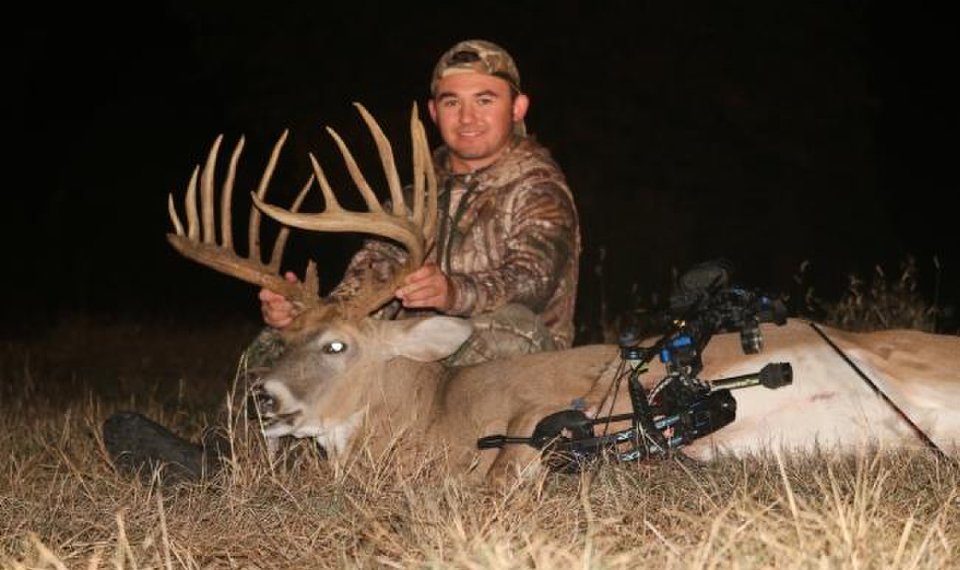
Source: Guner says the 8×8 initially came out into the field at 40 yards. Guner didn’t have a shot, and the buck jogged off. Not long after, he showed back up pushing younger bucks around and chasing does. This time he stopped broadside at 25 yards out from Guner’s stand, and Guner took a perfect shot.

Guner Womack Arrows Big Oklahoma Buck

Guner has hunted since he was a little boy, but this is his first season to hunt with a bow, and the bruiser buck is the first deer he’s ever taken with his bow. Beginners luck!

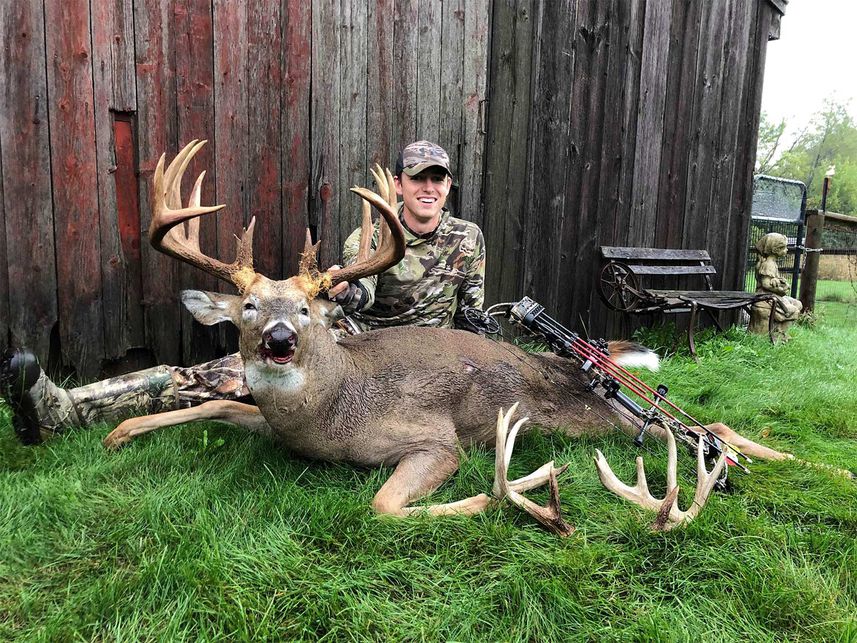
Guner’s family had a history with the free-ranging whitetail, they’d watched him grow up on their land in Pawnee County and estimate he was 4.5 years old. He also showed up on their trail cameras. Guner says last season the buck’s antlers were “all broke up,” likely from fighting. They knew he’d turn into a quality deer, they just didn’t anticipated a world-class buck.

Wisconsin Hunter Arrows Big Buck Too

If you like big bucks and cannot lie then Wisconsin is a great place to hunt monster whitetails. The Badger State grows big-bodied deer and big-bodied deer produced big, heavy antlers.

Source: When Matt Wachowiak, 23, of eastern Wisconsin arrowed this giant whitetail last month, he did a lot more than fill his 2019 buck tag—he put an exclamation point at the end of a three-year campaign to ultimately take this particular animal. Wachowiak’s monster whitetail, which he killed on September 28th, sported 15 scorable points and grossed 200-2/8 inches non-typical and netted 194-4/8 typical.

Matt Wachowiak takes Big Wisconsin Buck in 2019

“I walked in there well before light on opening morning and bumped what sounded like a big deer off the food plot. When I checked the camera later, I had pics of “The Prince” staring at me, then running off as I walked into the stand.

I was just sick. I was afraid he wouldn’t come back to the plot after that.”

Wachowiak decided to rest the farm in the wake of the encounter. “Ten days went by before I started getting pics of The Prince and Mr. Great, another buck, on that same food plot in the evening on my wireless camera,” he says. “I checked the weather, and there was a cold front coming in that weekend. The wind wasn’t right for the plot on Friday, so I decided to wait until Saturday to try him on an afternoon hunt.”

Wachowiak climbed into his stand and started seeing deer right way. “By 6:00 p.m. I’d seen 14 different deer, but no sign of the two big ones,” he says. “At 6:35 I stood up, and about five minutes later I saw Mr. Great approaching the food plot. I knew The Prince would be right behind him.

Prince stepped into the plot and was already in bow range. “I drew as The Prince stepped into the plot. He was already in bow range. I settled in, took the shot, and everything felt perfect,” Wachowiak says. “He just tore off the plot like crazy. I backed out and decided to call the neighbors, because they’d been a big part of this.

One question though: If he shot The Prince, then where is the buck they call The King? Perhaps there is another, bigger buck running around out there or they really are saving that name for something special. Now wouldn’t that be something?

Texas Deer Hunting: Opening Weekend, Season Look Promising

Deer Outlook 2019

Colder weather has finally rolled into Texas and the drop in temperature has white-tailed deer on the move. Several reports have made it to me over the past few days regarding an increase in the number of bucks observed traveling during daylight hours. Hunters will also be on the move. The general deer hunting season opens this weekend for white-tailed deer.

With an estimated 5.3 million deer in the statewide white-tailed deer population, Texas hunters heading to the field this fall should not need much luck to bump into at least a few deer. It’s been a good year for deer.

Texas Whitetail Deer Hunting Season Underway

More Deer Means Good Hunting

“Good fawn production this year should help maintain the overall population and provide an abundance of deer for hunters to pursue,” said Alan Cain, Texas Parks and Wildlife Department (TPWD) white-tailed deer program leader.

“We’ve seen a slow but steady growth in the statewide population over the last 15 years, particularly in areas such as the Hill Country, Oak Prairies and portions of the Cross Timbers. As a result of the growing population, we’ve expanded hunting season opportunities in the last several years, including a couple of changes to the antlerless season, the addition of doe days in 2019.” This is good news for deer hunters looking to fill the freezer with some high protein, low fat venison.

“Doe Days” Added to Hunting Season, Again

For the first time, 21 counties in south-central Texas can partake in a four-day antlerless season that runs from Nov. 28- Dec. 1.

Any antlerless deer harvested during the archery, youth-only, muzzleloader, and the 4 doe-days during the general season is required to be reported to the department within 24 hours of harvest using either the “My Texas Hunt Harvest” mobile app (for iOS and Android) or on TPWD’s My Texas Hunt Harvest web page.

Use My Texas Hunt Harvest App to Report Antlerless Deer Harvest

Counties required to report their harvest include Austin, Bastrop, Caldwell, Colorado, Dewitt, Fayette, Gonzales, Guadalupe, Karnes, Lavaca, Lee, Waller, Washington and Wilson. Also included in the change are Goliad, Jackson, Victoria and Wharton counties north of U.S. Highway 59 and Comal, Hays and Travis counties east of IH-35.

A Change in the Wind Good for Hunters

The change in weather may be what is needed to jump start white-tailed deer movement. Whitetail activity was curbed during archery season due to unseasonably warm temperatures. It also doesn’t hurt that the whitetail breeding season is looming, just two to three weeks away across much of Texas.

As deer hunting conditions improve with cooler temperatures, hunters can expect an above average year in terms of buck antler quality, total deer numbers and, as a result, overall harvest. This is good news for hunters looking to fill that void on the wall.

“Despite a slow start to archery and the Managed Lands Deer Program (MLDP) season, I’m hearing of some exceptional bucks being harvested including an incredible 214 gross Boone and Crockett score low-fenced buck from La Salle County,” said Cain.

“I’ve talked to a number of hunters and landowners who have been scouting at their lease or hunting property for the upcoming general season and are reporting good antler quality as well. I think hunter excitement is high this season and hunters have lots to look forward to.”

Texas Whitetail Deer Hunting

BOOM: Texas Deer Hunting Season

The general gun season opener kicks off on Nov. 2 and runs through Jan. 5, 2020 in north Texas and Jan. 19, 2020 in south Texas. A late youth-only season is also slated for Jan. 6-19, 2020. For additional late season deer hunting opportunities and county specific regulations, consult the 2019-2020 Outdoor Annual of hunting and fishing regulations.

TPWD is also reminding hunters to review the chronic wasting disease (CWD) regulations for information about CWD testing requirements and carcass movement restrictions for the 2019-2020 season. Also, Texas hunters harvesting deer, elk, moose or other susceptible species in other CWD-positive states must also comply with carcass movement restrictions when bringing those harvested animals back into Texas.

In addition, the Texas Animal Health Commission has mandatory CWD testing requirements that apply to elk, red deer, sika, moose and reindeer in Texas, regardless of whether they are harvested in a high or low fence property. Familiarize yourself with these requirements if you hunt land where there is a possibility to harvest one or more of these CWD-susceptible exotics.

In closing, don’t expect whitetail to hit feeders or food plots hard during the early part of the season. Ample acorns are falling and recent rains have resulted in an abundance of cool season forbs. This will provide all that whitetail need through November, possibly beyond. Bucks will of course be moving throughout the rut.

The weather is forecast to be drier and colder than normal, so expect deer to use bait, feed and plots readily once we get into December. Time your hunts with the cold fronts, keep the wind in your favor and have a good hunting season.