Want to know how to manage white-tailed deer? Deer management is about herd improvement coupled with habitat enhancement. Although many hunters doubt the antler potential for native whitetail bucks in their area, in every area where white-tailed deer exists bucks exceeding 170 Boone and Crockett inches can be grown.
In fact, I have seen native 190+ inch bucks come from every region in Texas. And Texas is not alone. Of course, in free-ranging, native deer populations the majority of bucks will have their antlers max-out anywhere from 120 to 150 inches at maturity (5 1/2+ years old). These are good bucks. At maturity, most bucks will be good deer.
How to Manage Whitetail Deer
With that said, most deer hunters have never harvested a whitetail buck exceeding 130 inches. Why? For starters, most hunters are hard-pressed to find well-nourished bucks. Often times, habitat is in poor condition from livestock operations or there is simply a lack of deer food/habitat. This is often the case in farming communities where the only available habitat is low-lying land, untillable areas where woodlots have developed, or along creeks and rivers.
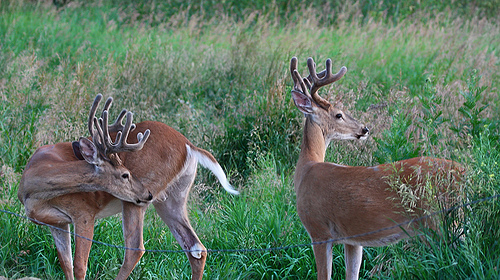
Deer can forage on most row crops, but only during certain stages of growth or at maturity. The remainder of the time the crops are not consumed or the alleged “habitat” is plowed dirt. Well-nourished bucks need good habitat throughout the year.
Manage Whitetail Bucks for Maturity
Maturity. Show me a mature buck and I’ll show you a deer that more than one hunter is willing to put on a wall. Age, nutrition, and genetics combine to determine the potential for any whitetail buck’s antlers. Without a little age, a buck will never reach his true potential. The short answer for this maturity phenomenon is that it takes 3 years for a buck to complete his long bone growth. After this time, valuable minerals can be put toward antler growth, not skeletal growth. Bones also help store minerals prior to and during antler growth.
Mature bucks are easy to talk about, but few hunters will let a potentially great deer walk. And it’s not because deer hunters do not have patience, it’s simply because most of us do not have enough land to ensure that the buck we pass this hunting season survives into the next season or the hunting season after that. It’s difficult for anyone hunting on 30 acres, 100 acres or even a few hundred acres of land to let a young 140 inch deer walk through.
Sure, that buck may end up being over 200 inches at maturity, but what are the odds that your neighbor let’s him walk, too? And your neighbor’s neighbor? This is why the best thing small landowners can do is form deer management cooperatives with their neighbors, form some bylaws so that everyone is one the same page, and stick to them.
Managing Whitetail Deer Nutrition
So proper deer nutrition and age are very important, but genes, of course, play a part. I mentioned earlier that most native bucks will likely never exceed 120 to 150 inches, even at maturity. However, habitat that provides proper nutrition with or without supplemental feeding can add another 10 to 20 inches, but genetics still determine how big a whitetail buck can get.
A buck with “superior” genes for antler growth will outperform bucks with “normal” genes for antler growth under the same conditions. Exceptional bucks are just that, exceptions to the rule. This is where the management part must take place for the whole deer management concept to work.
Whitetail Management: How to Implement
Take any group of bucks on any property in any part of the country and some deer will have larger antlers than the others. Regardless of the bucks a property owner has to start with, the best whitetail bucks on the property are the very deer that a hunter should be managing to increase the quality of the bucks found in the deer herd. And in this case, management involves NOT shooting them young, rather providing them and their offspring with good habitat to survive and thrive in.
The other bucks should be culled, harvested, and removed, if possible. Culling is not a must. A property can still produce good bucks in the absence of culling. How to manage whitetail deer on your property is up to you. As mentioned earlier, most mature bucks are good deer. Culling is best applied to deer herds when excess deer need to be removed to keep the population in check with the habitat that is available.
In short, if a bunch of deer need to be removed from a property during a given year or over a series of years do not shoot all of the best deer or all of the mature deer, but focus on taking some trophies and then cleaning up some of the “lesser” bucks found throughout the age classes.
Managing Deer Takes Time
Repeating this process methodically year after year while keeping the herd size at an appropriate level for the habitat will SLOWLY improve a deer herd. It’s difficult to change the genetic composition of a deer herd but culling will allow the native bucks that reach maturity to be the best bucks that the property can produce.
It’s a mistake to over-focus on the culling of bucks as THE way to manage a deer herd. Managing for good deer herd nutrition and allowing bucks to reach maturity will go further towards reaching your goals. Research has shown that fawns that start off in good shape end up being bigger, more healthy deer. For that, you need healthy does with plenty of food. And as for bucks, with proper nutrition and a little bit of age, most hunters would be quite surprised at what a native white-tailed buck can do. And more than happy to put it on their wall!
Understanding the need for allowing native whitetail deer to grow to full size, I would like to share an experiance with y’all. I have taken up hunting in the Fredricksburg, Texas, area and have been helping a close friend out with the management end of his operation. A new piece of property was purchased 2 years ago and has since gone into an extensive brush management, sculpting the landscape for both wildlife and grazing. The property was solid cedar (ash juniper). Two years into the project and several 140 class bucks have been seen through out the ranch, with a 160 shot last year. So, yes, it can happen and does.
First of all, great article! Our ranch is located in Terrell County on the rugged western edge of the Hill Country in Texas. The Hill Country is not known for producing “trophy-size” bucks in general. We have just over 60,000 acres and by working in conjunction with Texas Parks & Wildlife biologists, we have developed a uniform deer age structure with a 2:1 doe-to-buck ratio. The ranch holds one deer for every 10-12 acres. The ranch consistently produces trophy bucks that will score 150-160 B&C or better each year.