Aging Deer by Teeth
This article is intended to inform hunters and those managing deer how to age deer by looking inside their mouths, specifically by looking at their teeth. The tooth wear and replacement method is one of several techniques used for harvested aging white-tailed deer. This technique of aging deer by teeth has been used for half a century to age and manage deer on ranches across the US.
Although this method is far from perfect, it has been used in the successful management of deer herds since tooth wear is site-specific, which mostly depends on the types of soils as well as diet. Aging deer takes place by examining the wear and replacement of the premolars and the molars found on the top side of the lower jaw bone.
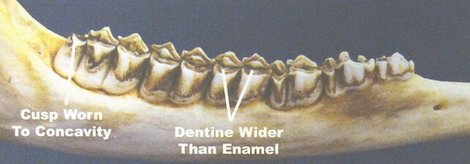
As a deer grows ages, its teeth wear down. As the enamel begins to wear away, and the exposes the dark dentine material and noticeable distinctions in tooth wear begin to occur between each age class. Deer are aged in year and half increments, such as 1 1/2, 2 1/2, 3 1/2 etc., since fawns are born from late May through July and are not harvested until the fall hunting season.
Why Aging Deer is Important
Deer managers may be, and should be, interested in deer ages from a deer management standpoint. Age data provides information about deer herd characteristics, hunting or mortality pressure on a particular age class, and progress of the wildlife management program. Anyone interested in deer management should have an interest in knowing how to age deer.
Age data becomes a valuable piece of information when used with other data, such as antler characteristics, dressed body weights, or lactation in females. As a result of this date collection, deer herd trends can be monitored if enough data is collected over time. Often these trends can be related to a particular management style, climatic conditions, or any other factors affecting deer.
Field dressed body weights, age, and antler measurements should be collected every year and from every deer harvested to keep a close eye on impact of management activities.
How Aging Deer by Teeth Works?
Deer can be aged using the tooth wear and replacement technique when we have them in hand. This is easily accomplished once the deer has been harvested and one side of the lower jaw is either exposed or removed. If you recently tagged one, congratulations are in order!
Aging deer using the tooth wear and replacement method is not difficult, but it will require practice on your part. When aging a deer, it will help to cut the skin along the edge of the jaw t allow better inspection of the teeth. Of course, if you are planning to mount the deer, you are not going to want to cut the jaw. Instead, open the mouth and use a flashlight to get a good look. Otherwise, you can ask the taxidermist to save the lower jaw for you after the skin is caped.
First, let’s talk a bit about tooth terminology. You first need to know what you’re looking at before you begin aging deer by teeth. The basic terms include cusp, back cusp, lingual crest, enamel, dentine, and infundibulum. A cusp is a point of projection on a tooth. The back cusp is the very last cusp on tooth 6 on the cheek side of the jaw. Lingual crest in the tooth ridge adjacent to the tongue.
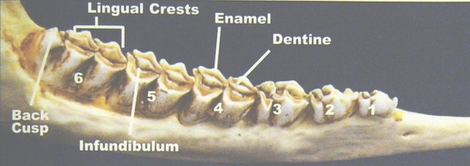
Enamel is the hard, white, outer coating of the tooth. Dentine is the soft, dark brown, inner core of a tooth. And lastly, infundibulum is the crescent shaped depression in the central crown of a tooth between the enamel ridge or crest.
It’s not critical that one actually memorize these terms, but you will definitely need to know what is being referred to when learning how to age deer from jaw bones. Knowing the specific terms for the the parts of teeth does help when discussing with another person, such as a hunting buddy or biologist.
Age of Deer: 6-7 months
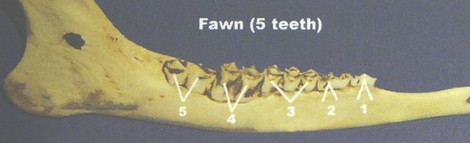
Aging fawns is not difficult. They will be 6-7 months of age during the hunting season of the year they were born. The size of the animal alone is using a good indication of age, but for confirmation, inspection of the teeth atop the lower jaw will indicate age. Fawns have 5 or less teeth present and the third premolar (tooth 3) has 3 cusps. Tooth 6 has not yet erupted. In younger fawns, tooth 5 has not erupted and only 4 teeth will be visible.
Age of Deer: 1 1/2 Years
A deer that is at least 1 year of age (but not yet 2) is technically referred to as a yearling. Hunters commonly use the word “yearling” to refer to a fawn. They are technically, well, fawns. You should be aware of this improper use of the word.
Yearling deer are easy to age. Tooth 3 has 3 cusps. Tooth 6 has erupted and is slightly visible just above the gum line. Also, later in the hunting season you may see tooth 3 as a 2 cusps tooth, but it will just be erupting and will be short. After 1 1/2 years of age, tooth 3 will always have 2 cusps (and this quickly eliminates the animal from being a yearling or fawn).
Age of Deer: 2 1/2 Years
On a deer of this age, the lingual crest on all molars are still sharp and pointed. Tooth 3 will now have 2 cusps and the back cusp of tooth 6 is sharp and pointed. The enamel is wider than the dentine in tooth 4, 5, and 6.
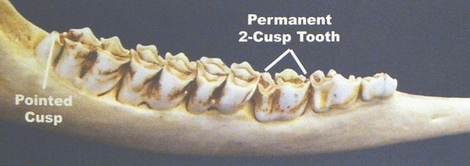
Age of Deer: 3 1/2 Years
On a 3 1/2 year old deer, the lingual crest on tooth 4 is blunt. The dentine will be as wide or wider than the enamel in tooth 4. The back cusp on tooth 6 is finally showing noticeable wear and is starting to form a concavity.
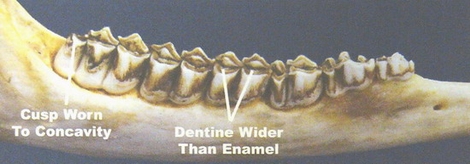
Age of Deer: 4 1/2 Years
The lingual crest on tooth 4 are almost rounded off and lingual crest on tooth 5 are blunt on a deer that is 4 1/2 years of age. The dentine in tooth 4 us twice as wide as the enamel. The dentine is tooth 5 is wider than the enamel. The back cusp on tooth 6 is worn so badly that it slopes downward towards the cheek.
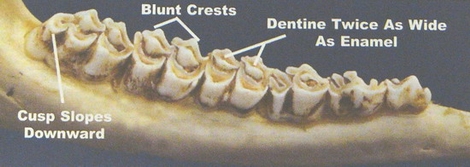
Age of Deer: 5 1/2 Years
A deer that is at least 5 years of age is considered mature. On a deer of this age, the lingual crest is worn away on tooth 4 and rounded in tooth 5. The lingual crest in tooth 6 is blunt and dentine in tooth 6 is now wider than the enamel.
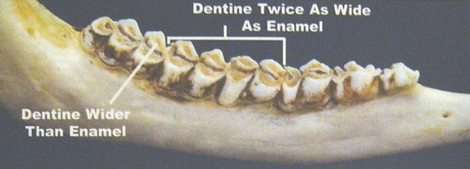
Age of Deer: 6 1/2 Years
Once a deer hits 6 years of age, tooth 4 is worn completely smooth — no enamel ridge should be visible in the center of tooth 4. A small enamel ridge will be present in the center of tooth 5 and tooth 6. Lingual crest on tooth 5 is almost worn away and rounded in tooth 6. A deer of this age is plenty mature.
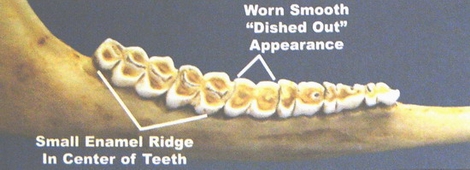
Age of Deer: 7 1/2 Years
A deer that reaches 7 1/2 years of age is old. Tooth 4 and tooth 5 are worn smooth. There are no enamel ridges present in the center of these teeth. The lingual crest is gone from tooth 6. Infundibulum in tooth 6 is a narrow crescent shape.
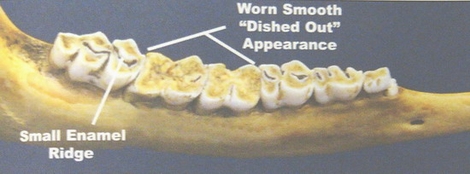
Age of Deer: 8 1/2 Years
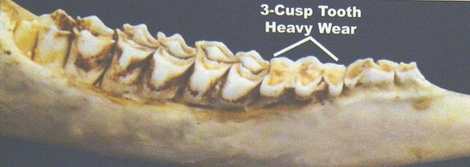
A deer of this age is not common on most properties. On a 8 1/2 year old deer, tooth 4, 5, and 6 are completely dished out and no enamel ridges are showing in the center of these teeth. If you look atop the jaw bone and see anything that looks like the photo below, rest assured your deer lived a long life and would soon begin to suffer from the inability masticate (chew), if not already.
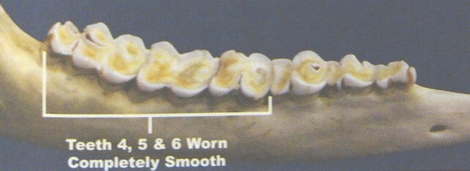
Tips for Aging Deer by Teeth
The tooth wear and replacement method is the single best way to age harvested deer, but learning how to age deer by teeth is not a one-time event. After looking at the photos above, you probably realize there is some amount of discretion that needs to be used when looking at and interpreting tooth wear. This technique works from place to place but is best suited to comparisons from a particular site, where tooth wear/estimated deer age is compared within and between age classes.
Tooth replacement is straight forward, but that only gets a hunter to 2 1/2 years of age on deer. At that point, it becomes both art and science with regard to best-estimating the age of a harvested deer based solely on tooth wear. It is recommended that hunters maintain game cameras and photo logs of bucks on a property from year to year where deer management is to be practiced, then the physical characteristics of bucks on the hoof during the year of harvest can be combined with the estimated age based on teeth/tooth wear.
Camera photos help develop an “assumed deer age” based on successive years of photos. Once the deer is harvested, the teeth and physical (body) characteristics can be used to cross reference one another so that hunters on the property become calibrated to how a middle-aged or mature buck, for example, look in the field.

Lastly, to assist with aging deer by teeth, a simple jaw spreader can be made from rebar and welded into a similar shape as the above photo. This tool comes in handy after the deer has been dead for some time and rigor mortis has set in. Insert the jaw spreader into the deer’s mouth as shown. Make sure the spreader is pushed completely through the mouth and then rotate the jaw spreader downward to open the mouth. A deer’s teeth are now visible for inspection/interpretation and you can age deer by the replacement and wear of the teeth. Again, a flashlight will be helpful on those deer that will not be cut and are headed to the taxidermist.
Thank you for very clear deer age determination information. This is the clearest explanation I have seen. We began aging deer last season. This is very interesting. We try to shoot adult doe. The biggest surprize is the age of bucks. The teeth do not lie.
Thank you.
I harvested a 3 point buck today and it only had one tooth. It had no teeth on either side. How old is this deer?
Ryan, deer are aged based using the tooth wear and replacement technique using teeth located on the bottom jawbone. Each deer should have three premolars and three molars on each side of it’s lower jaw. If the teeth are missing, then who knows? Are you sure you looked far enough back?