Most hunters know that a successful white-tailed deer management program is a multifaceted endeavor. For noticeable changes to be observed in a deer population, the age, genetics and nutrition of the herd must be managed at some level. Because age is an important parameter within a deer population, aging deer on the hoof and then re-evaluating that assessment after “ground checking” based on the deer’s tooth wear is a common practice on many ranches.
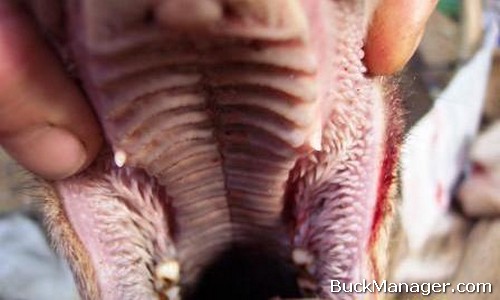
After cutting a deer’s check, most hunters expect to see teeth with six teeth per side, with some amount of wear, but most never expect to see a deer with fangs in its upper mouth.

Canine Teeth are Rare
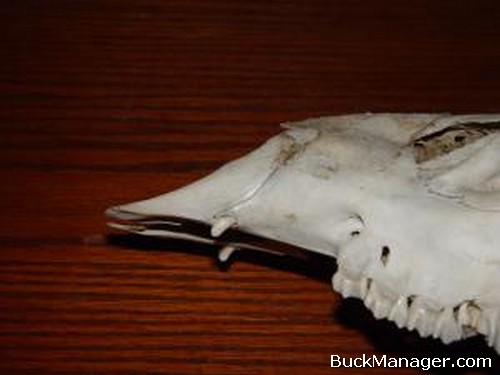
These “fangs” are actually canine teeth. All whitetail have lower canines, but few deer have upper canines. The harvested deer that do have them often go undetected because hunters focus on the teeth located in the bottom jaw when aging, not those positioned on top.
The upper canine teeth that are seen are usually discovered by taxidermist preparing buck deer for European (skull) mounts, not by curious hunters probing around inside an animals mouth. Common sense would make one believe that most ungulates such as white-tailed deer do not have canine teeth, but a small number of deer actually do.
A History of Cervids with Canines
Although most whitetail do not have fangs, there are some ungulates that posses the more appropriately termed canine teeth. But why do these teeth occur at all in deer? Genetics. We have to go back many, many years to understand the relationship between the whitetail and its prehistoric ancestors.
Research suggests that the white-tailed deer evolved from deer that originated in Asia tens of millions of years ago. Several of the deer found on that continent back then had canine teeth. Some, like the Chinese Water Deer and Muntjac (oldest known deer), still do.
Adult Muntjac males have tiny antlers, but have well-pronounced canine teeth that can grow up to three inches in length. In the same manner that whitetail bucks use their antlers to intimidate and fight other bucks during the rut, the canine teeth of Asian deer have similar functions in buck competition during the breeding season. While the whitetail deer’s genetic link to its Asian ancestors has weakened over time, the gene for these vestigial canine teeth still remains.
Bucks with Canine Teeth?
Like the Asian deer mentioned above, only whitetail bucks typically possess these small, upper canine deer “fangs.” It’s been reported that whitetail does never grow canines, but there have in fact been documented cases of does having upper canines.
But even when these specialized teeth are not present, deer can pass on the canine gene to their offspring. By the way, whitetail deer are not the only North American cervide with canine teeth. Elk, both male and female, possess canine teeth. In fact, you can age this species based on canine tooth wear.
I actually took a whitetail doe this season growing canine teeth. One in particularly was very prominent. This was my first deer and I did not notice until cleaning the skull. Her head was shaped a little odd, but that’s it. Many photos available. I was told she was maybe two years old.
My son, Tyler, killed an eight point buck in January 2011. As I was preparing a skull mount of the buck, I discovered canine “fangs” about 1 inch long in the upper jaw. I have never seen any others like this.
Has anyone ever sold or had a “fanged” buck appraised?
I killed a five year old six point this year in Pensacola, Florida, with upper canines. I had never herd of it before, until two weeks ago. Does anyone know how rare is this?
A friend of mine and my husband’s shot a buck in an area my husband’s family has been hunting for over 60 years. My husband had shot a buck on the same ridge as the friend, but about four years prior. Both bucks had the same exact horn growth, i.e. width, length, girth and color. My friend decided he wanted a Euro mount done with his. I took the head to a taxidermist, who called me three days later and told me this deer had fangs. I refused to believe him until he sent me pictures of the mount completed with the fangs in place. Unfortunately at the time, we had never heard of this so we were unable to confirm whether my husband’s buck had fangs or not. Now, before I decide how I want to have my bucks mounted, I check to see if there are “fangs” !!! Both deer were shot in the Panhandle of Idaho.
I killed a whitetail doe yesterday with a canine tooth on the left side. I was hunting a draw hunt on a WMA here in Tennessee, so the warden wanted to age the deer. He noticed the tooth and immediately went to get his camera. He told me that he had heard about this but mine was the first he had ever seen.
I shot an 8 pt fanged whitetail in 2008 in Trinity, Texas. Pretty cool. Got it euro mounted and the taxidermist called freaking out.
On the last day of my hunt in Richmond this past year a nice 9 pt was slipping thru the bottom where I was set up on the ground.A good broadside shot at 95yds with my encore 50 cal put him down. I just got the Euro mount back today and the fangs are about three eights of an inch long. My buddies were telling me about it and I thought they were BSing me.Of the 10 deer on my wall iam sure this one will get talked about the most. This happened on the same farm that 2 years ago we killed a white gobbler that scored 78,which according to the bioligist could be the biggest Smoke Gray gobbler killed in North America.Can’t wait to get back up there to see what’s next. Capt.Barry Meyer
I shot a nice 8 point in North Carolina this year. My taxidermist sent me a note saying it had canine like teeth and it only occurs in 1 every several hundred thousand deer. I sent to Johnathan, a biologist with N.C. State and he provided me this very interesting information.
I shot a large dry doe last week. Today when cleaning it for a euro mount I noticed two tusks about 3/8” on the upper. I was surprised. My wife looked it up on line. Yup… that’s my deer.
Gary, that is pretty cool! I wonder how many hunters have shot a doe with these extra teeth? Some hunters will cut the cheek to inspect the bottom jaw for tooth wear in order to estimate the age of a doe, but most don’t, and they sure aren’t looking for canine teeth when they do. Even fewer hunters clean doe skulls up for a euro mount. Maybe you will get another — bound to be hereditary.
I’ve shot 2 bucks within the last few years with upper canines. I would have never known but our taxidermist found them doing a European mount. He said it’s very rare and I live in central WI.
Jeanna, that’s awesome! I think many hunters never even think to look. Thanks for sharing this info with other deer hunters and best of luck this fall.