The hunting season has just ended for the majority of white-tailed deer hunters. Now, it’s time to reflect, look back over the past season while it’s all fresh in your mind. If you had the opportunity to spend many days in the field hunting, then you should have a good picture of the overall deer herd using the property you hunt.
Better yet, if you recorded deer observations while hunting, then you have the hard data to support what is happening under your property’s current deer management program. These field observations, in addition to game camera photos, will allow a deer manager to track individual bucks from one year to the next. I strongly recommend keeping both photo and stand observations since some bucks always seem to avoid getting caught on camera.
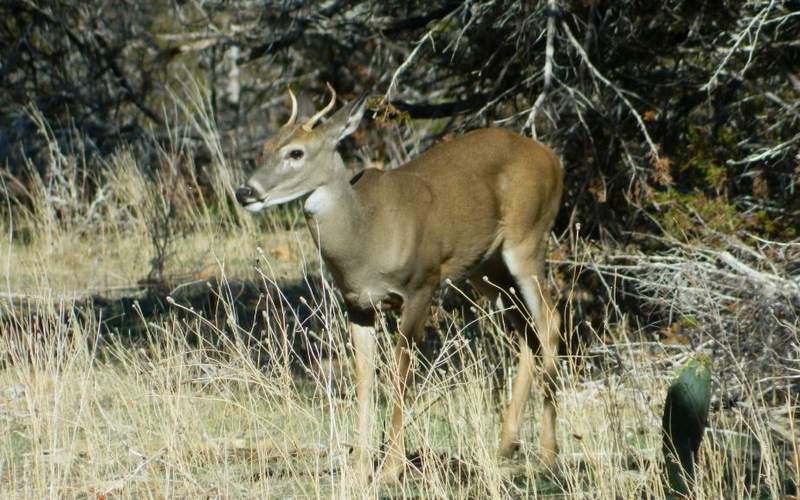
Missing Brow Tines
With regards to antlered deer, one issue that always seems to arise is the lack of brow tines (G1) on some whitetail bucks. Hunters have often questioned why some middle-aged and mature bucks simply lack brow tines. Is something going on in the deer herd?
Well, yes. Antler characteristics are genetically linked and highly heritable This means a young buck will likely look a whole lot like his daddy. To back up this claim, I will cite some long-term data collected from Kerr Wildlife Management Area (WMA), located in Texas.
From 1974 to 1997, the research facility at the Kerr WMA was involved in a number of studies designed to determine the role of nutrition and genetics in white-tailed deer antler development. During each of various studies that took place over that time, researchers recorded antler information for individual whitetail bucks throughout a 23 year period.
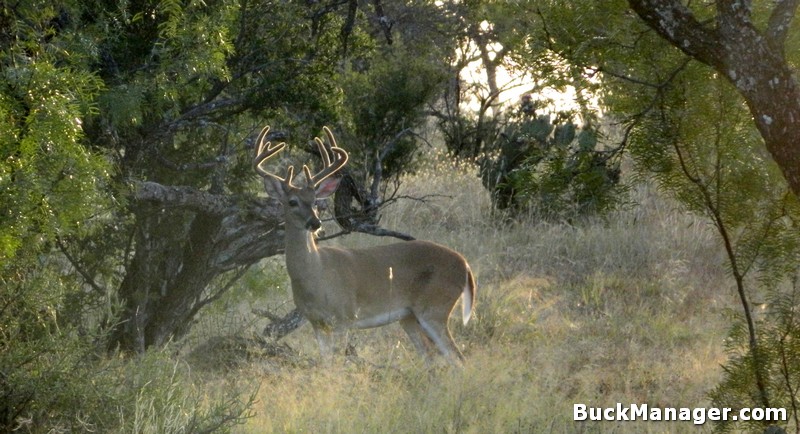
Brow Tines on a Buck?
This wealth of antler data allowed wildlife biologists to back-test 217 whitetail bucks from yearlings (1 1/2) to 3 1/2 years of age and 168 bucks until they were 4 1/2 years old. That’s a lot of deer, and from what I can find, represents one of the largest sets of antler data available. So what did they find?
In short, data from 385 bucks found that 90 percent of the bucks without brow tines at 3 1/2 and 4 1/2 years of age were spikes at 1 1/2 years old! All bucks without brow tines at 1 1/2 years old lacked brow tines at 4 1/2 years old. On the other hand, all bucks with 5 or more points as yearlings had both brow tines at maturity. Bucks that had both brow tines as yearlings had both brow tines at 3 1/2 and 4 1/2 years of age.
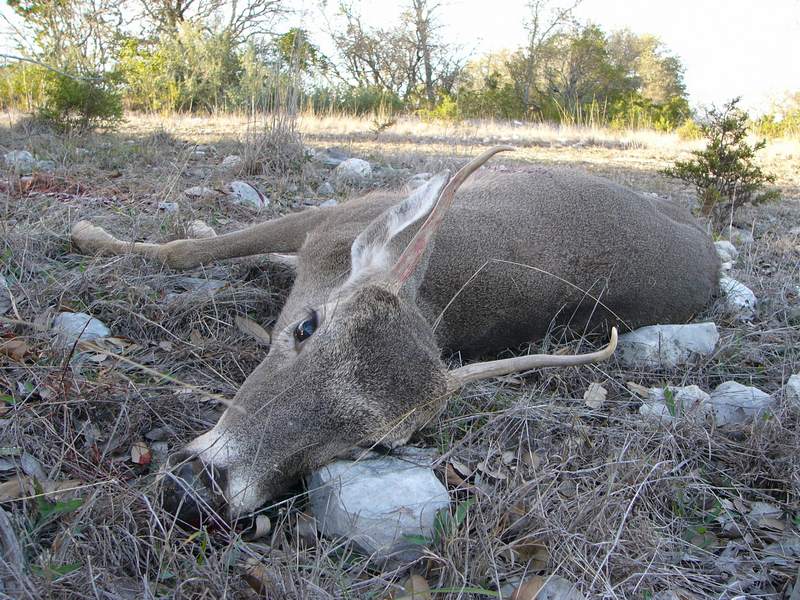
Incredible Antler Data
The numbers above speak for themselves. In addition, deer researchers know that antler characteristics in white-tailed deer are highly heritable, so the probability of passing on genes for specific antler characteristics (larger or smaller antlers) is a given. The future of the deer herd on a property depends a good amount on the quality of the bucks doing the breeding.
To sum up, a whitetail buck that has spikes as his first set of antlers has a 90 percent chance of developing into a buck with missing brow tines later in life. A buck that has 5 or more points as his first set of antlers is much more likely to have brow tines later in life, at least according to this data set out of Texas.
Deer Management Implications
How does knowing this information affect you and the deer you manage moving forward? It likely depends on the goals you have for the deer that use your property. If one of the goals is to harvest the maximum number of mature bucks on the property annually then you want to allow all bucks to reach maturity.
However, if you are looking to improve buck antler quality, then at least one of the factors you should consider is the quality of the young bucks on your land. Antlers are the result of genetics, but they are also influenced by the environment. Nutrition plays a role in how genes are expressed, how a buck looks.
This phenomenon can be seen is deer herds with suboptimal nutrition as spike bucks tend to comprise a higher percentage of the young bucks, those 1 1/2 years of age with their very first set of hardened antlers. In these types of situations, increasing the available food by reducing the size of the total deer herd or the addition of supplemental foods/forages may be an appropriate step to increase overall deer health, buck quality.
If a property provides ample food and a manager is seeing a high percentage of 1 1/2 year old bucks without brow tines on the property, then you now know it’s all in the genes. The only way to improve antler quality and reverse missing brow tines in older bucks is to put pressure on spikes and bucks without brow tines, regardless of age.
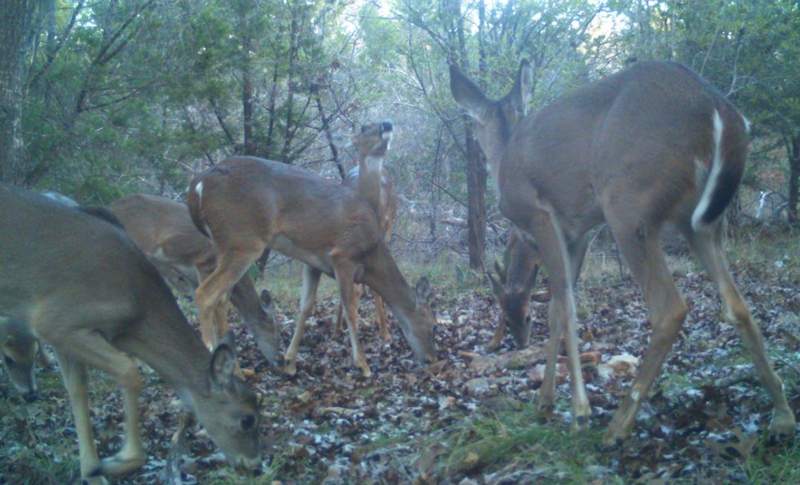
In this situation, deer management practices should also include rolling over the doe herd to reduce the number of old does sired by bucks lacking brow tines. This is not a management strategy that plays out overnight, but a practice that must be integrated into the long-term management of a deer herd using a property.
I’ve been searching for information on how to make a buck sanctuary on my property. Do you know where I can find information on this topic?
Thanks, Gregg
We have several bucks on our property as well that don’t have brow tines. We have been trying to get rid of them each year and it seems to be working. I agree that it’s a good strategy to keep track of all of your deer sightings and game camera photos. My boyfriend and I used to keep track of this by hand, but we discovered a site called Big Game Logic where you can keep track of it all electronically. You set up a camp and then keep notes about all of your deer sightings and post game cams and stuff.
I also had encounter this season with two bucks with no brow tines. The first time I can remember this. We are minus one, and minus two will come soon if seen again.
Killing the buck without tines solves nothing. It could be a trait carried by a doe. Will you kill ALL your does too? Culling deer does not work. I would like to know if every buck sired by a brow tine less buck also grows up tine less.
According to Texas Parks and Wildlife a buck without a brow tine was probably a yearling spike and those traits will be passed on. A yearling buck that has 5 or more points will always have a better rack its entire life.
Randal, missing brow tines in whitetail bucks are linked to genetics. Although we as hunters can not see the genetics of a deer, we can see how genes are expressed through a buck’s antlers. I think the quality of yearling bucks, those 1 1/2 years of age, is a good indicator of future potential.
I’ve raised spike bucks on Texas ranch around camp, deer we didn’t shoot. I watch a specific spike and 5 years later was a skinny rack 9 point with no brows. We have lots of deer, so we take all bucks with no brow tines and it has worked, growing better racks. We also shoot the big mature does (lead does) and its making a differenc. We have a lot of deer so we can take those inferior bucks, and doesn’t hurt numbers. Fact.
Brent, thanks for taking the time to share your experience watching and managing deer. The total number of deer in an area is super important. I think a lot of hunters believe just shooting “management” bucks is going to move the needle and create better quality deer. It takes controlling the entire population and habitat improvement. Removing inferior bucks when deer numbers are high is a good idea, as it allows the better deer to reach maturity. It’s just about impossible to change the genetics of a deer herd, but if hunters have the deer they can decide which bucks go in the freezer and which bucks benefit from the habitat found on their property (for a few more years, anyway).
Those that hunt in areas with low deer numbers do not have this opportunity. In these situations, it’s generally good to keep a tight buck to doe ratio, improve the habitat, and harvest older bucks. A one-size-fits-all approach rarely works in deer management.