What Foods do Deer Eat?
White-tailed deer are large animals. They require many pounds of food each day. Ever think to yourself, what do deer eat? Well, whitetail are ruminants like cows, but deer diet selection is much different than cows. Cattle are grass-roughage eaters, have a relatively large rumen compared to body size and depend heavily on grasses for their diet.
Grasses are low in crude protein and digestibility when compared to the items deer eat. Whitetail food sources include legumes, forbs (broadleaf weeds) and the new-growth of browse plants. To a white-tailed deer, browse consists of the leaves and twigs of trees, shrubs (brush) and vines. Forbs and browse plants have high protein levels, ranging up to 15-35% depending on time of year.
Deer Eat High Quality Foods
Because grass is relatively low in nutrition, grasses need a longer residence time in an animal’s rumen. Longer residence time increases rumen microflora (bacteria and protozoa) degradation and digestion of the forage. Thus, for grass-roughage eaters like cattle and sheep, residence time is quite long and rate of food passage is slow.
Deer can’t go slow! They have high physical demands for energy. Whitetail can not afford to carry around extra, dead-weight. Deer must remain lighter and faster. There is a predator around every corner in the woods. Instead, white-tailed deer focus only on the most palatable, most-easily digested food items found in their habitat. This ensures that they get the most energy possible with the lowest amount of food intake. Besides, eating takes energy and time. It’s difficult to watch for predators with your head down.
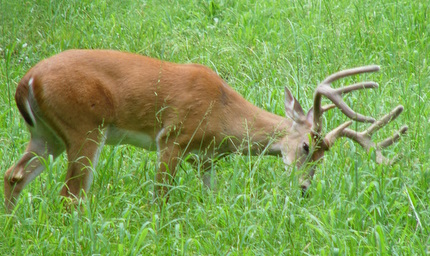
What do Deer Eat Then?
White-tailed deer are what people in the diet business call “concentrate selectors.” Their rumen is small relative to their body size. Deer simply cannot hold a lot of forage. As a result, their diet must be very high in nutritive value and capable of being rapidly degraded in the rumen. This makes for quick digestion.
Therefore, white-tailed deer rely primarily on the good stuff. Whitetail food sources consists of the best forb and browse plants that are found growing in their environment. These items are usually much higher in crude protein and digestibility than just about every species of grass.
Some forb plants that deer eat:
- Illinois bundleflower
- Deer pea vetch
- Lespedeza
- Euphorbia
- Patridge pea
- Spiderwort
- Wild carrot
Some browse plants that deer eat:
- Oaks
- Elms
- Hackberry
- Greenbriar
- Dogwoods
- Poison Ivy
- Grapevines
Deer Eat Little Grass
Grasses comprise only a very small part of the overall diet of the white-tailed deer. Often, it’s less than 10 percent. I think this important to point out because so often I hear people say, “The deer have so much grass to eat.” Yes, you may see deer in a field, but it is not the grass they are eating. Instead, deer search for interspersed forbs/weeds that are much easier for them to digest. Furthermore, these food items are loaded with protein.
Warm season perennial grasses supply livestock with most of their nutrients. These items will not meet the nutrient and consumption requirements of white-tailed deer. In fact, a white-tailed deer will not survive in a field of grasses. A whitetail will literally starve to death with a belly full of grass.
Whitetail do eat some grass. However, deer only consume grasses that are rapidly degraded in the rumen. These include the small grains and ryegrass that are used to any extent by deer. This is why winter food plots for white-tailed deer containing these cereal grains and grasses can work. Other useful introduced forages include both warm and cool season legumes. Most hunters know them as clovers. Deer will use small grains and legumes, but they still cannot comprise a deer’s entire diet.
Some grass plants that deer eat:
- Canada wildrye
- Green sprangletop
- Little bluestem
- Silver bluestem
- Rescuegrass
Deer Eat A Diversity of Foods
As you can see, it takes diverse plant communities to meet a deer’s dietary needs. Healthy deer make for a healthy deer herd. Furthermore, diverse whitetail food sources grow big-bodied deer. Big-bodied bucks grow big antlers, too. Good habitat is key. Supplemental feeding will ensure good body condition during periods of low rainfall.
Deer are very selective feeders so they require a diverse environment. It takes a diverse diet for whitetail to remain healthy. As a result, white-tailed deer prefer high quality habitat. It takes active habitat management to continually create whitetail food sources.
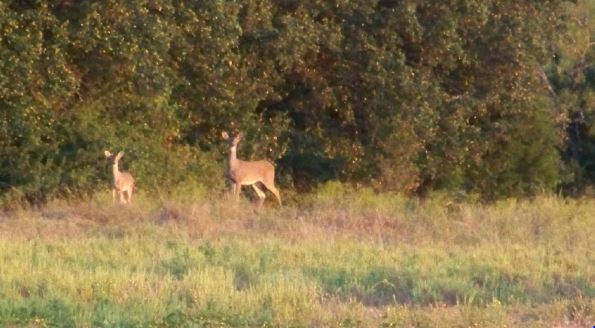
For several reasons, deer are often observed feeding along field edges. First, deer are very difficult to see in dense woods so we rarely see them there. They spend time in dense woods but these areas often lack food sources. Second, there is always a greater diversity of food available at the intersection of field and the edge of a woodland. This is because forb diversity is low in woodlands, but browse diversity is low in grasslands. Put them together and you have a deer buffet! So, what do deer eat in these transition zones? Go to the edge of the wood line and you can see for yourself. Evidence of deer browsing can be found on palatable browse plants.
More Resources on Deer Diet
- What do deer eat and why?
- Foods of Northern Deer
- Deer Feeding Habits in Missouri
- Whitetail Food Habits Central Texas
Diet: What do Deer Eat?
A complete list of native plants used by white-tailed deer includes browse, forbs, soft and hard mast (fruits, acorns), and mushrooms. Again, deer are not classified as grazers. Rather, whitetail a are commonly referred to as browsers. Each day, a deer’s mission is to get high quality food with as little effort as possible.
Some mast that deer eat:
- Acorns
- Pecans
- Persimmons
- Dewberries
- Hackberries
Forbs and mast, while providing good nutrition, may not be available in abundance every year or at certain times of the year. Forbs are often most numerous during the rainy seasons such as during the spring and fall. Deer will consume these readily when available because they have very high protein levels.
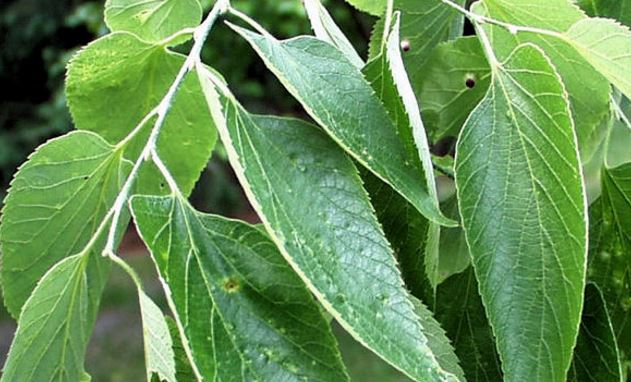
Browse plants tend to be more stable from year to year. Consequently, browse plants are the “bread and butter” of a deer’s diet. Again, browse plants are trees, shrubs and vines. These types of plants are deeply rooted and can persist through the summer. When natural foods are low during the winter, deer will also eat old, dead leaves directly off the forest floor. They are low in nutrition at this point, but they may be the best food available to them at that time.
In closing, whitetail food sources can be classified into several categories. However, browse is the most important source of deer nutrition because of its year-round availability. Important browse plants include green briar, poison ivy, grape vines, honeysuckle, hackberry, elm species, oak species and a variety of other trees and shrubs that are palatable in the area/region where the deer live.
Your website helped me with school! Thank You!
Your website helps me with science class and homework, too. Thank you!!!
This also helped me today. Thanks for the information on what deer eat!
Deer are my favorite wild animal, and this information about deer food habits also helped me with a school report. Now I know all about what deer eat. Thanks for the info!
My dad and I had a couple of things we needed to know about whitetail and deer management and this site is good. Thank you for this information!
What are 5 things white-tailed deer eat other than grass, fruits and acorns?
MM-
Although deer eat grass, keep in mind that they consume very little as a percentage of their diet. Whitetail prefer forbs (which are commonly referred to as weeds) and browse (commonly referred to as brush).
The types of forbs are quite diverse, but good forb plants for deer are spiderwort, clover, and Engelmann daisy. Browse plants vary by region, but deer will use leaves of hackberry, elm, and grape. They also eat the mast (fruits) of many plants when in season.
Nice bucks.
I am concerned about planting rhododendron near a frequently used deer passage. I recently read that they could possibly be poisonous to the deer. Should I reconsider my planting location? Thanks.
Thanks for telling me what deer eat. When they eat mushrooms, can they tell if it’s poisonous or not? And what types of fruit do they eat?
Katie, deer have evolved to over time to “know” what to eat, but each deer will sample things. If it does not bother them, they eat more. Deer will eat all sorts of fruit: apples, pears, dewberries, black berries, strawberries, as wells as nuts like acorns, walnuts, and pecans.
I have a very large planter in my yard full of hens and chicks. The deer have been eating either the roots or the succulent parts because they take them out of the planter. Will these plants hurt them or make them sick? I got a picture on my wildcam.
Patricia, if the deer are still eating them then I would not worry about it. Deer know by sampling plants which ones to eat and which ones to avoid. Obviously, they like yours!
I planted several weeping willow trees and the deer ate them all.
Why won’t the deer come into my woods there is A LOT of apples and pears and all that crap?? I’m getting sick and tired of these bucks. I lay out a bunch of food and they won’t come in!!!
I’ve noticed that deer tend to avoid pastures where the cows have overgrazed. The only time they eat in them is after a rain, when new forbs spring up from the ground. If you have cows, make sure they are not eating the browse too hard or deer will have little to eat until it rains again.
Our lawn man told us the deer had dug up our grass in areas to eat the grubs that appear at certain times of the year. Sounds dumb to me!
Mary, he may have meant armadillos? Or possibly raccoon. Or maybe even feral hogs depending on the size of the excavated soil. Armadillos and even raccoons have been known to dig up grubs in well-maintained lawns. Deer? No.
Been searching for some more information on a deer’s diet, and you’ve covered all the points I was looking for!