Albino White-Tailed Deer
They may be neat to see, but did you know that a true albino occurs in only one of out of 100,000 births and very few fawns survive beyond the first year of life? It’s absolutely true. For an albino deer to live over just a few years in the wild is extremely unusual, almost unheard of. But if you think about the high mortality rate of these anomalies, it actually makes sense for a number of reasons. Unfortunately, these facts offer no comfort to an albino.
First, most of the whitetail’s range consists of habitat that is dominated by the colors green and brown—not white. The whitetail’s range includes the entire western-half of the US. Most of that area has a relatively long growing season, especially the south. Albino deer definitely have the odds in their favor during the winter season in snow-covered areas, but the deck is still stacked against them over the remainder of the year in most places.
VIDEO: Albino Buck in Wisconsin
Seeing an Albino: The Odds are Against You
Animal coloration is based on the process of natural selection within all wildlife species. The coloration best suited for survival becomes the dominant (normal) color within a species. There are always abnormalities within a species, but most are relatively small variations of the norm. Albino animals are quite the opposite. They stand out!
Color mutations occur infrequently overall in deer and other wildlife, but if those color variations were well-suited for the environment, then those “oddly” colored animals would survive to breed and pass on their genes. If genetics cause an animal to stick out, such as a white deer in a primarily green or brown environment, then the animal will be more noticeable to natural predators, including humans.
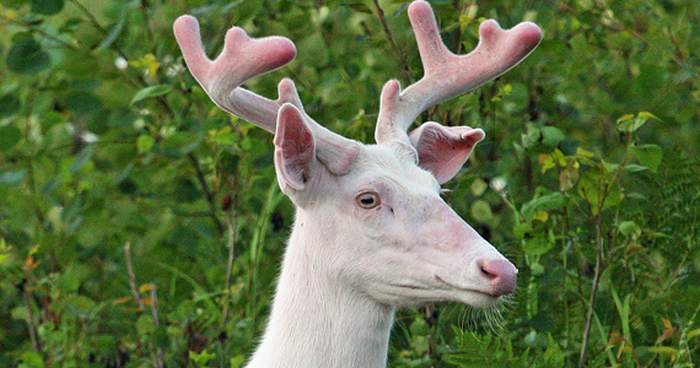
This results in the animal being depredated by a coyote or wolf, or possibly harvested by a hunter simply because it’s much easier to see. In either case, the color abnormality does not benefit the white animal. This increased level of mortality is Mother Nature’s way of saying “no.” There is no doubt that albino deer would have the upper hand in a perennial, snow-laden landscape.
In such a situation, albino deer would have the upper hand on both two and four-legged predators, the number of white-colored animals would increase and soon begin to comprise the majority of the breeding population.
True Albino or Just White?
The albino whitetail buck seen above is a true albino deer. In cases of true albinism, albino deer lack pigmentation in the hair, skin, and, in the case of deer, the iris of the eyes. However, eyes can be pink or blue and the hoofs a pale gray. In some areas, albino deer are even protected by law. In the state of Wisconsin, for example, white and albino deer are protected from hunting.
However, most states do not protect deer with color abnormalities. In addition, deer and other wildlife can be white in color without being albinos. Leucism is a partial loss of pigmentation, which can cause an animal to look white without the animal being an actual albino.
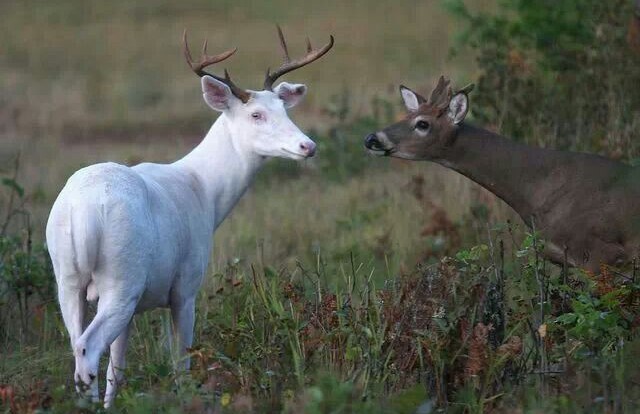
To sum up, albinos are interesting animals in general, and albino white-tailed deer, specifically, are really cool. Albino deer are a genetic phenomenon that physically do not make sense, at least in most cases, within their natural environment. However, under certain environmental conditions, such as in areas where snow cover remains throughout the year, it would be the best thing going.
So although most of us will never see a wild albino deer, if you do, then just consider the odds, then consider yourself lucky. And go buy a lottery ticket!
We saw one this last week in Fuquay-Varina, North Carolina, in the clearing behind Chick-fil-a, just off of 55/401.
Oct 14 2009, a true albino 6 point buck was harvested in Zuni, Virginia, by crossbow.
I saw and took a picture of an albino buck in my backyard in southwest Cedar Rapids, Iowa. It was a digital picture and didn’t come out very clear, but I saw it on October 31, 2009
When I was a child my father, brother, and I saw a massive white buck that crossed the road in front of us, stopped when we stopped and looked at us for about 30 seconds before bounding away in the woods. That was in Grapeview, Washington, about 1990. My younger brother, who still lives in Grapeview saw a large 6 point white buck last night. Could this be the same deer we saw 20 years ago?
Alysha, although it appears the area you refer to has genes for albinism, the buck that your brother recently saw is not the same deer. The longest living, wild white-tailed deer I have heard about lived just over 15 years. Most bucks are very lucky to live to be 6+ years of age.
I have great photos of an albino deer. He or she is surrounded by 3 other very healthly looking normal pigmentation deer. Would anyone like to see the photos? They are amazing. I live in New Jersey.
There are at least four albino deer living in Father Hennepin State Park, on the south shore of Lake Mille Lacs, Minnesota. They are beautiful. The white buck comes into the park during deer hunting season. Smart deer!
We have an albino and two piebalds that pass through our backyard in the Canton, Ohio, area.
I live in Alton, Virginia. We, my wife and son and I, have been seeing a normal color doe with two fawns. One of the fawns is an albino. We see them everyday late in the evening and have seen them as close as 200 feet away. No one hunts in the nearby woods and we are surounded by hay fields. After reading about albinos surrival chances, I only hope we get to continue to enjoy the view. I’m 52 years old and have hunted in many states. This is my very first sighting of an albino deer.
I saw a doe with an albino fawn near Pecan Plantation in Hood County, Texas, last Sunday morning. This was the first albino deer I have ever seen in the wild. I’ve seen color variations in whitetails before this, but never an albino.
Some say that the white stag is the protector of the forest, some sort of guardian that kept the forces of nature in balance. To see the elusive creature was rare, but to kill it was simply sacrilege and the act would stain one’s very soul. I think Hercules was tasked with taking down a similar animal. Interesting.
We have had the pleasure of regular visits from “our” albino whitetail deer since we moved here to Virginia over 8 years ago.
I came to this sight to research albino deer because I have had one roaming in my yard for 2 years now. I wanted to know just how rare they really are. I can’t believe the odds… guess I’m just lucky.
On October 16, 2010, my buddy and I saw an albino buck enter our cut-over we were hunting at 7 o’clock in the morning. It was a once in a lifetime hunt. Not only did we see this oddity, we got the chance to harvest him as well. What a hunt!
We have a family group living in the forest beside our house and have seen a young albino 3 or 4 times now. I just saw them cruise through in broad daylight with the albino young one. Located in the western suburbs of Pennsylvania.
My wife and I recently saw a herd of white deer and a buck grazing in the front yard of a home near Bastrop, Texas. There were about 6 or 7 does and a buck. The buck was about an 8 point or more. They appeared to have longer tails than the normal whitetail deer. We did get several photos before they spooked and ran off.
It was amazing and exciting to see them. We are going to go back to the location and see if we can find them again. Is there any agency that would be interested in our find?
Saw one tonight in the tree line along Route 476 in Pennsylvania. Always see a lot there, but NEVER in my life had I ever seen an albino. Just may stake it out to get some pics!
Just saw 2 fawns. One was normal and the other a solid white one. Gainesville, Georgia, Hall County, Lake Lanier area. Wow!
Albino deer spotted in North Raleigh off Durant Road on Oct. 28, 2011. Gorgeous!
I saw a white buck grazing in my backyard in North Raleigh on Oct. 30, 2011! Must be the same guy that Claudia saw on the 28th! He was beautiful!
Tonight we a saw an albino buck behind our new apartment in the Pantops area in Charlottesville, Virginia. We were less that 20 feet away.Very neat.
Yes, I would love to see the photos. I also live in New Jersey and have white deer on my property.
I just saw a doe with three young fawns – one was an albino! Very cute in Gainesville, GA located on the last cove located on the North West side of Lake Lanier. 7-18-1.
I would love to see the pics of the Albino deer you have
every mornin i go outside on the front porch and theres a huge field across the road and theres always a 5 point albino buck out there. i have been seeing him for 2 years
Not all white whitetails are albino. There is a rare, but dominant gene, causing white fur, but not albinism. Where I grew up we had a pocket of the gene proliferate as the deer were protected (and the gene able to replicate) inside the fences of a large army depot. Very cool.
I have photos of white fawn in my back yard taken on Dec.24, 2012, in Parker Colorado. Not sure if albino or just solid white deer? Part of herd of 8-10 normal deer. Also not sure if white tail deer or mule deer??
Saw an albino in Indianapolis, Indiana on 5/24/2013. It was in a well populated area of town.
Just saw one of this evening on Slater Rd, near Morrisville, NC. I’m here on business and I was stunned when I saw the white deer standing beside the road. As it saw my vehicle approach it took off along side the road, then jumped a silt fence near some construction. A very large rack and an amazing sight!
See them all the time just south of Guthrie, Oklahoma. They are protected there, and closely watched by wildlife and game department.
Two-thirds of the deer population in subdivision are white/albino. I live in Midlothian, Virginia. One white deer was at my back sliding glass door, and one light brown one in my front yard. We see the white one every other day and or evening. Is very cool to see.
I saw a white doe today driving to work on I-540 West just before Creedmore Road in Raleigh, NC.
Just saw an albino deer today in the same location, the Creedmore exit off 540, west bound. Pretty awesome!
Saw and took a picture of a white deer on Old Kelly Road in Cary, North Carolina, today.
I saw a white doe in our backyard (off of Sunset Lake Rd-Fuquay) about sundown last night. Beautiful creature. She was eating under the bird feeder, heard us and stopped. Before we could snap a picture she disappeared.
Saw 5 deer eating apples that had fallen to the ground near graham Washington Oct. 1, 2016. One of the deer was 90% white, 1 was 75% white, 1 was 50% white and 50% brown and the other 2 looked like normal whitetail deer. We saw 3 eating the apples when the other 2 that were mostly white ran across a field at a good paced run to meet the others at the apple tree. This was at just about sunset, and it looked amazing, literally mystical to see them running across the field. They let us take several pictures and simply continued to eat the apples while we watched.
Today, I saw a white dear with brown sports on Edgerton Road in North Royalton, Ohio. What a great thing to see!
Sue
I saw an albino deer last night. I think it’s the same one mentioned above by Ryan and Bunnie. She was close to 540 around Creedmore Road. So beautiful.
Saw a pair of small, white deer in coachman’s trail, not too far from 540 and Creedmoor Rd. Stopped and took photo and video, but it was pretty dark (around 11:30pm). They didn’t startle or bolt. Looked like a pair of goats at first.
November 24, 2017 – I saw a large all white doe between Creedmoor Road and Leesville Road exits off of 540 (Raleigh, NC). She was calmly grazing just a few feet from the wooded area there. She was amazing!
There is a doe with an albino fawn in my neighborhood this year. First I have ever seen in the wild and it walked thru my front yard. I later got a few pics. That said, I question why a hunter would kill something that only occurs once in 100,000 births? I guess you could mount the thing but personally I’d let it live out its life because it’s so rare. To be clear I have no problem with hunting deer otherwise. Here in Virginia more of them need to be culled. They walk around like dogs in neighborhoods.
Al, thanks for chiming in from Virginia. I think albino and piebald deer are visually neat animals since they are out of the norm. Hopefully, someone is preparing to help you with your suburban deer problem right about now.
My wife and I live across the street from a state park (Elmwood Park, Norristown Pennsylvania) and from my bedroom window I’ve been spotting an albino deer along with a medium size herd bedding down directly in front of our residence, which is across from a narrow ravine. I’ve been spotting this albino deer regularly for the last 3 to 4 weeks but not getting a good picture with my cell phone, until today, and to my surprise that deer is one of two albino deer.
I know a little bit about animal behavior and sexual motivation was surely taking place amongst the herd and especially interacting with one of the female albino deer. She’s definitely playing hard-to-get but if she were not interested, she wouldn’t be there (?).
Vernon, thanks for sharing your albino deer observations. It’s well past the breeding season for mature whitetail, but doe fawns will often come into estrus at about 7 months of age. If the albino deer is a fawn from last year then maybe there is some interest from a suitor.